
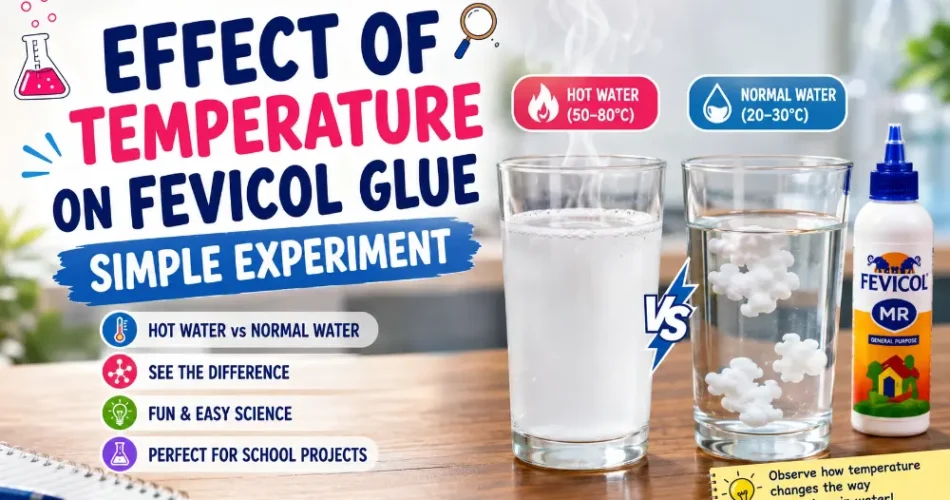
When you drop Fevicol (PVA-based white glue) into hot water and normal (room-temperature) water, you’ll notice different behavior because temperature affects how quickly the glue interacts with water.
In Normal Water (20–30°C)
- The glue stays thick for a while.
- It dissolves or disperses slowly.
- You may see white blobs or strands before they gradually mix.
- The glue’s stickiness decreases slowly as it becomes diluted.
Why?
- At room temperature, water molecules move at a moderate speed, so they penetrate and break up the glue slowly.
In Hot Water (50–80°C)
- The glue softens and spreads much faster.
- It mixes with the water more easily.
- The white color may disappear more quickly as the glue disperses.
- The glue loses its sticking ability faster because it becomes highly diluted.
Why?
- Hot water molecules have more kinetic energy.
- They move faster and penetrate the glue more quickly.
- This speeds up the separation of the glue molecules, allowing them to disperse throughout the water.
Comparison
| Property | Normal Water | Hot Water |
|---|---|---|
| Mixing speed | Slow | Fast |
| Softening | Slow | Fast |
| Stickiness loss | Gradual | Rapid |
| Appearance | White blobs remain longer | Blobs disappear quickly |
Simple Science
Fevicol is mainly made of polyvinyl acetate (PVA) mixed with water and additives. It does not truly dissolve like sugar; instead, it forms a dispersion in water. Heat speeds up this process because faster-moving water molecules interact with the glue more efficiently.
Easy Experiment
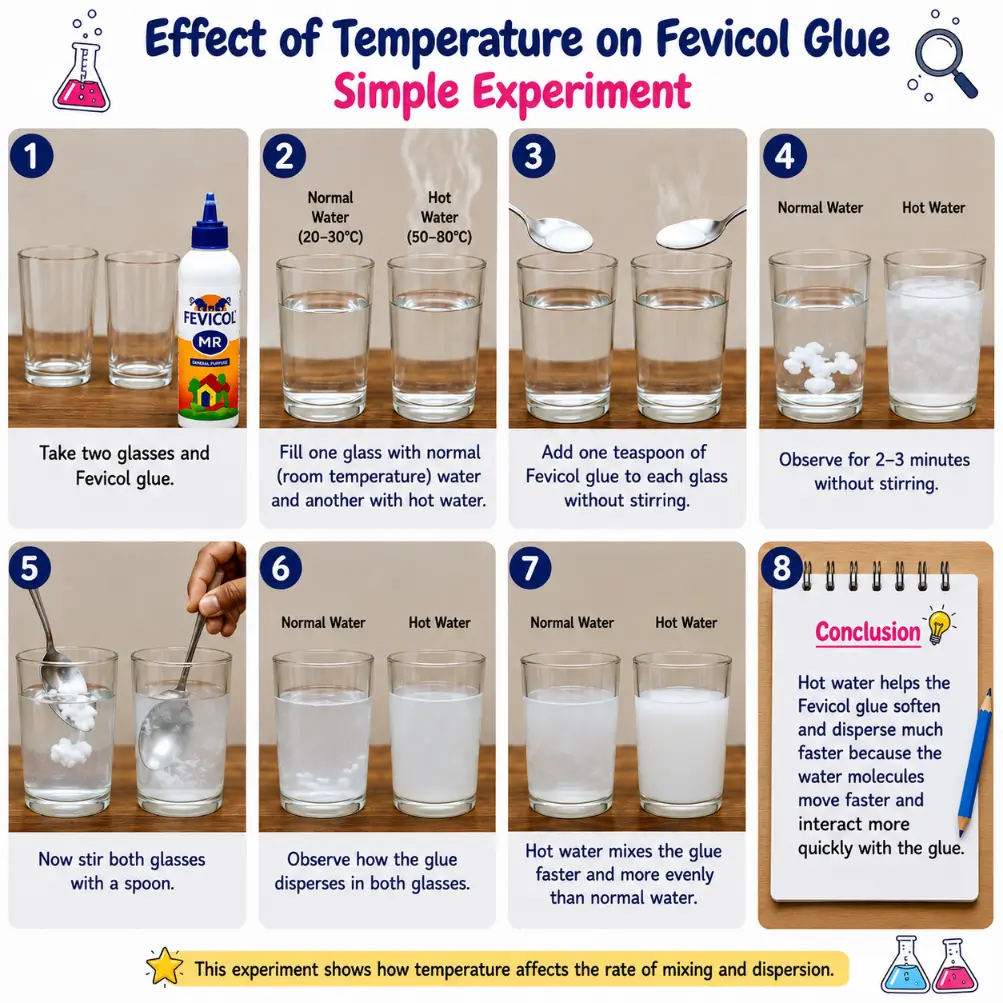
- Fill one glass with room-temperature water.
- Fill another with hot (not boiling) water.
- Add one teaspoon of Fevicol to each without stirring.
- Observe for 2–3 minutes.
- Stir both glasses and compare how quickly the glue disperses.
This is a good classroom experiment to demonstrate the effect of temperature on the rate of mixing and dispersion.
Show Comments