


This engaging worksheet helps young learners practice recognizing and matching uppercase and lowercase letters of the alphabet, A-Z. Mastering letter identification is a crucial early literacy skill that lays the foundation for future reading and writing success.
[Scroll Down for Download Link]
Contents
- Circle the matching lowercase letter to the uppercase letter
- “A-D” Matching Lower Case Letter To the Upper Case Letter
- “E-H” Matching Lowercase Letter To the Uppercase Letter
- “I-L” Matching Lowercase Letter To the Uppercase Letter
- “M-P” Matching Lowercase Letter To the Uppercase Letter
- “Q-T” Matching Lowercase Letter to the Uppercase Letter
- “U-X” Matching Lowercase Letter to the Uppercase
- “Y-Z” Matching Lowercase Letter To the Uppercase Letter
- Key Facts About the A-Z Upper and Lower Case Letter Matching Worksheet
- Parts, Types, and Examples of Letter Matching Activities
- How Does the Letter Matching Worksheet Work?
- Benefits of Learning About Upper and Lower Case Letter Matching
- Learning Objectives
- Worksheet Instructions
- Interesting Facts About Letter Recognition and Preschool Literacy
- Vocabulary Words
- Real-Life Applications
- FAQs
- Q1. At what age is this uppercase and lowercase matching worksheet?
- Q2. Why do children struggle with matching certain letters?
- Q3. Should I teach letter names or letter sounds first while doing this worksheet?
- Q4. How many letters should my child practice at one time?
- Q5. Can I reuse these printables for multiple practice sessions?
- You may like these:
- Uppercase Alphabet Handwriting Practice Worksheets for English Learners
- Lowercase Letter Tracing Worksheet Designed for Preschoolers
- Alphabet Activity Book for Children Aged 2 to 5 Years
- Christmas-Themed ABC Missing Letters Printable Worksheets
- A to Z Alphabet Writing Practice Book – Complimentary Tracing Printables
Circle the matching lowercase letter to the uppercase letter
Read More: Find the Letters Worksheets for Preschool
“A-D” Matching Lower Case Letter To the Upper Case Letter

“E-H” Matching Lowercase Letter To the Uppercase Letter

“I-L” Matching Lowercase Letter To the Uppercase Letter

“M-P” Matching Lowercase Letter To the Uppercase Letter

“Q-T” Matching Lowercase Letter to the Uppercase Letter

“U-X” Matching Lowercase Letter to the Uppercase

“Y-Z” Matching Lowercase Letter To the Uppercase Letter

Key Facts About the A-Z Upper and Lower Case Letter Matching Worksheet
Early childhood literacy depends heavily on a child’s ability to recognize the distinct visual structures of the alphabet. This printable pack is explicitly engineered to bridge the conceptual gap between big and small letters.
- Target Audience: Best suited for preschoolers (ages 3–5), pre-K classrooms, and kindergarteners needing remedial visual-spatial letter practice.
- Format Structure: Broken down into small, digestible chunks (e.g., A-D, E-H, I-L) to prevent cognitive overload in young learners.
- Core Exercise: A hands-on visual discrimination activity where children identify a dominant capital letter and scan a row to select and circle its matching lowercase partner.
- Focus Area: Enhances foundational reading readiness, fine motor muscle control, and early print awareness.
Parts, Types, and Examples of Letter Matching Activities
Alphabet matching worksheets typically fall into specific structural categories depending on how a child processes visual information. The Kidpid printable bundle targets these areas through the following formats:
1. Sequential Letter Segments
Instead of overwhelming a child with all 26 letters on a single page, this packet divides the alphabet into manageable chunks:
- Early Segment Example: Working exclusively with letters A, B, C, and D to introduce the concept of capital-to-lowercase pairings.
- Mid-Alphabet Segment Example: Focusing on letters M, N, O, and P, which contain unique linear and curved differences.
2. Form Variations (The Core Worksheet Type)
This particular worksheet uses a “Multiple Choice Identification Grid” structure.
- Example: On the letter ‘A’ row, the uppercase ‘A’ is featured prominently on the left. The child must scan horizontally past distractor letters (like ‘b’ or ‘d ‘) to find and encircle the correct matching lowercase ‘a ‘.
How Does the Letter Matching Worksheet Work?
This worksheet acts as a scaffolded visual filter. From a developmental psychology perspective, a child processes the activity through a three-step mental loop:
- Isolation & Encoding: The child looks at the target uppercase letter on the left (e.g., “G”) and commits its shape—curves, straight lines, crossbars—to short-term memory.
- Horizontal Left-to-Right Tracking: Mimicking the organic movement of natural reading, the child scans their eyes from left to right across the row of lowercase letters.
- Visual Discrimination & Selection: The child compares the mental image of the uppercase letter to the lowercase options, filters out the incorrect “distractor” shapes, isolates the lowercase “g”, and uses a crayon or pencil to physically circle it.
Benefits of Learning About Upper and Lower Case Letter Matching
Mastering the dual natures of the alphabet offers critical neurological and educational advantages:
- Accelerates Reading Fluency: Since the majority of text in books is written in lowercase, kids who only know capital letters struggle to read smoothly. Matching ties both forms together instantly.
- Strengthens Visual Discrimination: It trains a child’s eyes to notice minute geometric differences (e.g., the difference between a lowercase b, d, p, and q).
- Develops Fine Motor Mechanics: Gripping a writing utensil to circle a small, targeted area on a piece of paper builds hand-eye coordination and prepares fingers for proper pencil grip.
- Boosts Academic Confidence: Completing small, visual successes gives early learners immediate positive reinforcement, making them view reading activities as a fun game rather than a chore.
Learning Objectives
By utilizing this structured printable bundle, students will achieve the following developmental benchmarks aligned with early childhood education standards:
- Cognitive: Demonstrate the ability to accurately pair all 26 uppercase letters with their corresponding lowercase forms with at least 90% accuracy.
- Print Awareness: Understand that an uppercase letter and a lowercase letter represent the same phonetic sound despite looking completely different visually.
- Motor Skills: Demonstrate improved fine motor tracking and precision by cleanly encircling target characters.
- Habits of Mind: Cultivate left-to-right eye tracking habits required for future literacy exercises.
Worksheet Instructions
To get the most out of this educational resource, guide your young learner through these simple steps:
- Prepare Your Space: Print out the desired alphabet segment pages. Provide the child with a comfortable, chunky pencil, crayon, or washable marker.
- Point and Name: Have the child point to the large uppercase letter on the far left of the first row and say its name out loud (e.g., “This is uppercase E!”).
- Scan the Row: Instruct the child to look at the row of small lowercase letters directly to the right of the big letter.
- Identify and Circle: Ask the child to find the small, matching version of that letter. Once they locate it, have them circle it firmly.
- Review: Move row-by-row through the page, celebrating each correct match!
Interesting Facts About Letter Recognition and Preschool Literacy
- The Shape Anomaly: Some uppercase and lowercase letters look identical but vary only in size (like C/c, S/s, O/o), while others look completely different from one another (like A/a, G/g, R/r). The completely different pairs require significantly more cognitive processing for a child to memorize.
- The Left-to-Right Wiring: Humans are not born naturally wired to read from left to right; it is a culturally learned behavior. Rows on a worksheet intentionally train a child’s visual pathways to read in the correct direction.
- The “Century-Old” Design: The terms “uppercase” and “lowercase” come from old printing shops during the days of manual typesetting. The large metal stamps for capital letters were literally kept in the upper physical boxes (cases) on the wall, while the smaller letters were kept in the lower ones.
Vocabulary Words
Introduce these key terms to your child or use them in your lesson planning to enrich the educational environment:
- Alphabet: The standard set of 26 letters used to write the English language.
- Uppercase (Capital): The larger form of a letter, typically used at the beginning of sentences or proper names.
- Lowercase (Small): The smaller form of a letter, which makes up the vast majority of written print in books.
- Match: Bringing two things together that belong to the same pair or group.
- Circle: A round shape drawn around an object to select it.
Real-Life Applications
Letter matching skills extend far beyond the margins of a printed worksheet. Here is how children apply this knowledge in the real world:
- Reading Children’s Books: When a parent reads a bedtime story, the child begins to recognize how the big capital letters at the start of a paragraph connect to the smaller words that follow.
- Navigating the Neighborhood: Recognizing traffic signs (like a big red STOP sign) and matching those large letters to the lowercase print found on regular street name signs.
- Interactive Grocery Shopping: Looking at food boxes at the store and finding the small letters on nutrition labels that match the big, bright letters in the food brand’s logo.
- Keyboard Identification: Learning how to type their own name on a computer keyboard (which usually features capital keys) into an online form that outputs lowercase letters on the screen.
FAQs
Q1. At what age is this uppercase and lowercase matching worksheet?
Answer: This worksheet is ideal for children aged 3 to 5 years old. This typically covers preschool, Pre-K, and the early stages of kindergarten.
Q2. Why do children struggle with matching certain letters?
Answer: Many early learners struggle with letters that change form drastically between uppercase and lowercase (such as A turning into a, or G turning into g). Additionally, letters that look like mirror images of each other (like b and d) require extra time and visual practice to separate mentally.
Q3. Should I teach letter names or letter sounds first while doing this worksheet?
Answer: It is highly recommended to do both simultaneously! When your child looks at the letter B/b, have them say its name (“This is the letter B”), but also immediately reinforce its phonetic sound (“It makes the /b/ sound like ball”). This builds a stronger foundation for reading.
Q4. How many letters should my child practice at one time?
Answer: To prevent fatigue and frustration, stick to 4–5 letters per session. This is why our worksheets are intentionally broken down into small, bite-sized alphabetical sections like A-D and E-H.
Q5. Can I reuse these printables for multiple practice sessions?
Answer: Yes! A fantastic tip for parents and teachers is to slide the printed pages inside clear plastic sheet protectors. Have your child use a dry-erase marker to circle the letters. When they are finished, you can easily wipe them clean to use the same worksheet again tomorrow!

By completing this A-Z letter matching activity, preschoolers will strengthen their familiarity with letter shapes and solidify the connection between upper and lowercase forms. This worksheet is a fun and effective way to build essential early learning skills. Turn learning into an adventure with worksheets, essays, paragraphs, flashcards, quizzes, and interactive resources from our website. Follow YouTube & Facebook for more educational fun.
The Content Team developed this worksheet to foster learning progress.
Reviewed By Swati
You may like these:
Uppercase Alphabet Handwriting Practice Worksheets for English Learners

Structured worksheets to help learners master uppercase English letters, improving handwriting and letter recognition through consistent practice in a clear, guided format.
Lowercase Letter Tracing Worksheet Designed for Preschoolers

Preschoolers trace lowercase letters to enhance fine motor skills and letter formation, providing a foundational understanding of the alphabet through engaging exercises.
Alphabet Activity Book for Children Aged 2 to 5 Years
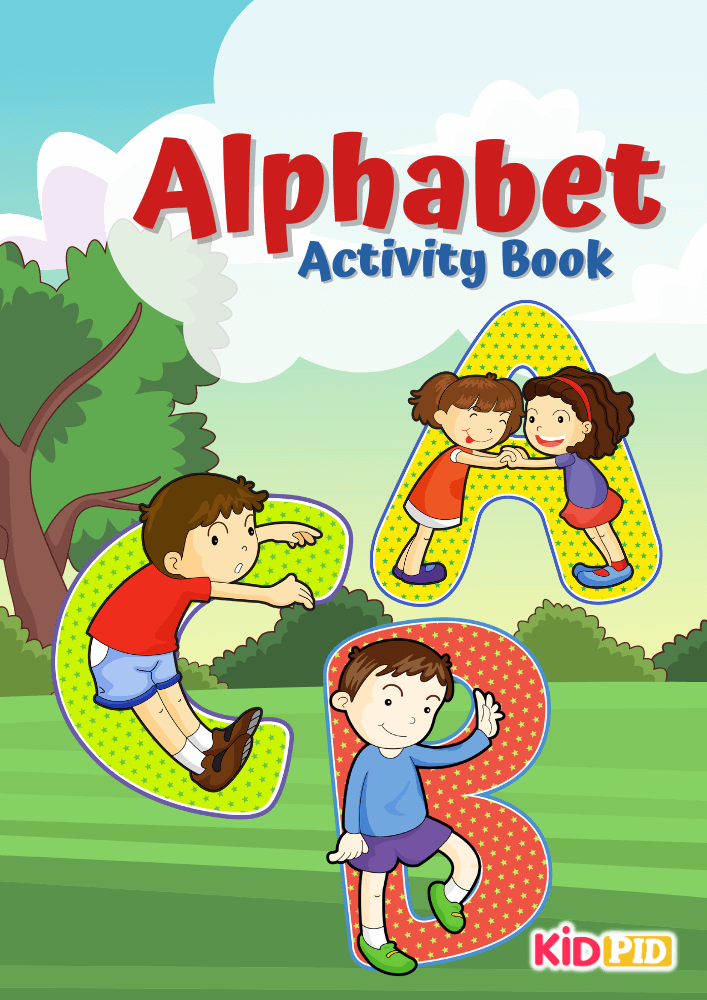
A vibrant activity book introducing the alphabet to toddlers and preschoolers through interactive games, tracing, and coloring, fostering early literacy and creativity.
Christmas-Themed ABC Missing Letters Printable Worksheets
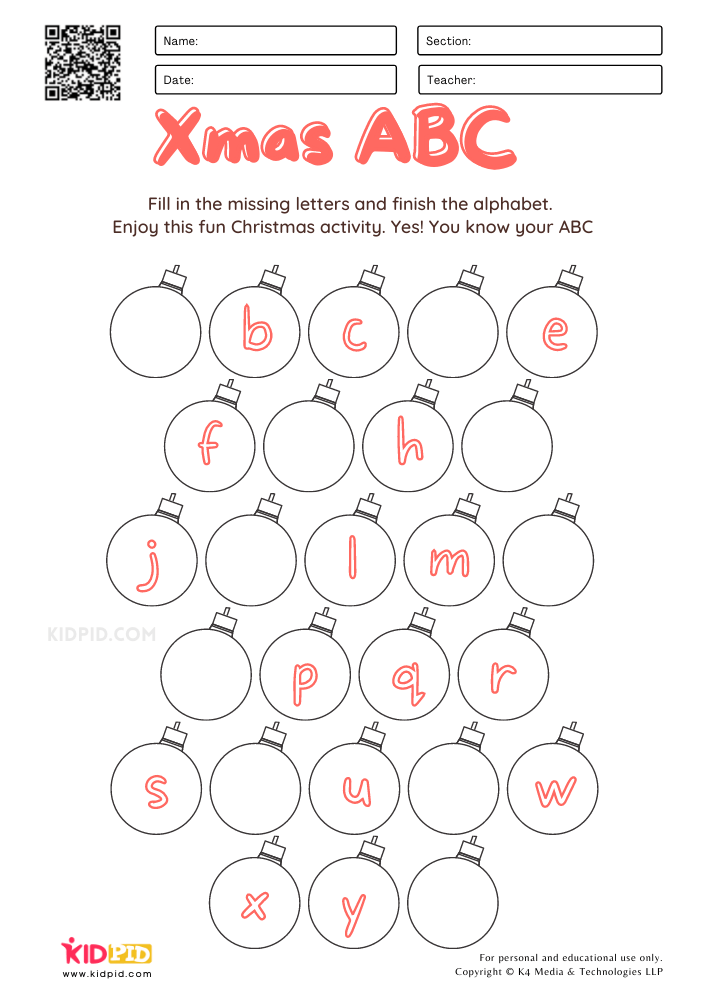
Festive worksheets where children identify and fill in missing letters, combining holiday fun with alphabet practice to reinforce letter sequencing and recognition.
A to Z Alphabet Writing Practice Book – Complimentary Tracing Printables
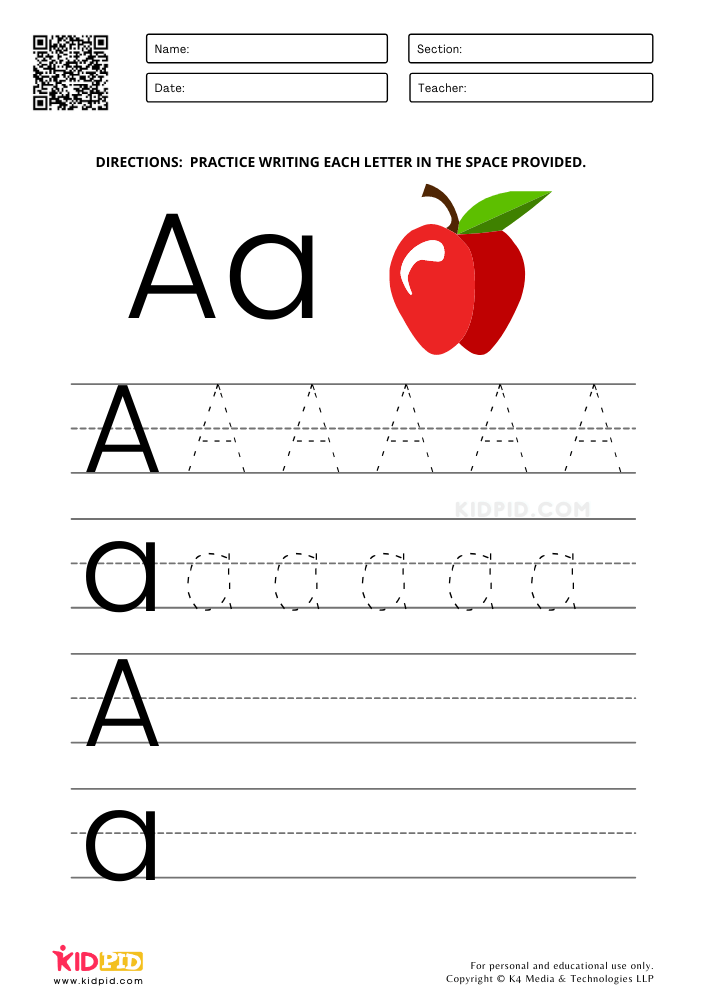
Free printable sheets offering systematic practice for writing letters A to Z, helping children develop neat handwriting and confidence in mastering the alphabet.



