

Alfred Nobel was a famous inventor who created the Nobel Prize to honor people who made important contributions to humanity. He wanted to be remembered for doing good, not just for his invention of dynamite. The Nobel Prizes are given to people who have done amazing work in fields like science, peace, and literature.
- Who Was Alfred Nobel: A Swedish inventor born in 1833.
- What Did He Invent: Dynamite, a safer way to use explosives.
- Why Did He Start the Nobel Prize: To reward people who help humanity.
- The First Nobel Prizes: Awarded in 1901, a year after Nobel’s death.
- Fields of the Nobel Prize: Alfred Nobel established prizes in physics, chemistry, medicine, peace, and literature. The Economics Prize was added later in his memory.
- His Legacy: Nobel wanted to be remembered for helping make the world better.
“Alfred Nobel: How the Renowned Nobel Prize Came to Be”
Related MCQ’s
1. Where was Alfred Nobel born?
a) Paris, France
b) Stockholm, Sweden
c) Moscow, Russia
d) San Remo, Italy
2. What invention made Alfred Nobel famous?
a) The telephone
b) Dynamite
c) Nitroglycerine
d) The printing press
3. Why did Alfred Nobel create the Nobel Prizes?
a) To support his family
b) To promote education
c) To honor those who contribute to humanity
d) To invent new explosives
4. What inspired Alfred Nobel to include a Peace Prize?
a) His love for writing poetry
b) His invention of nitroglycerine
c) His friend Berta von Suttner and her book “Lay Down Your Arms”
d) His travels to Russia
5. When were the first Nobel Prizes awarded?
a) 1833
b) 1896
c) 1901
d) 1914
6. What fields are included in the Nobel Prizes?
a) Literature, sports, and music
b) Physics, chemistry, medicine, peace, and literature
c) Medicine, art, and history
d) Engineering, architecture, and law
You may like these:
How does the Nobel Peace Prize work?
The Nobel Peace Prize is awarded annually to individuals or groups who promote peace. Nominees are selected by experts, and the winner receives a medal, diploma, and money.
Essay – C.V. Raman: The Nobel Laureate In Physics

C.V. Raman, India’s first Nobel-winning physicist, discovered the Raman Effect, revolutionizing light scattering studies and contributing immensely to scientific advancements.
Essay – V.S. Naipaul: The Nobel Laureate Author
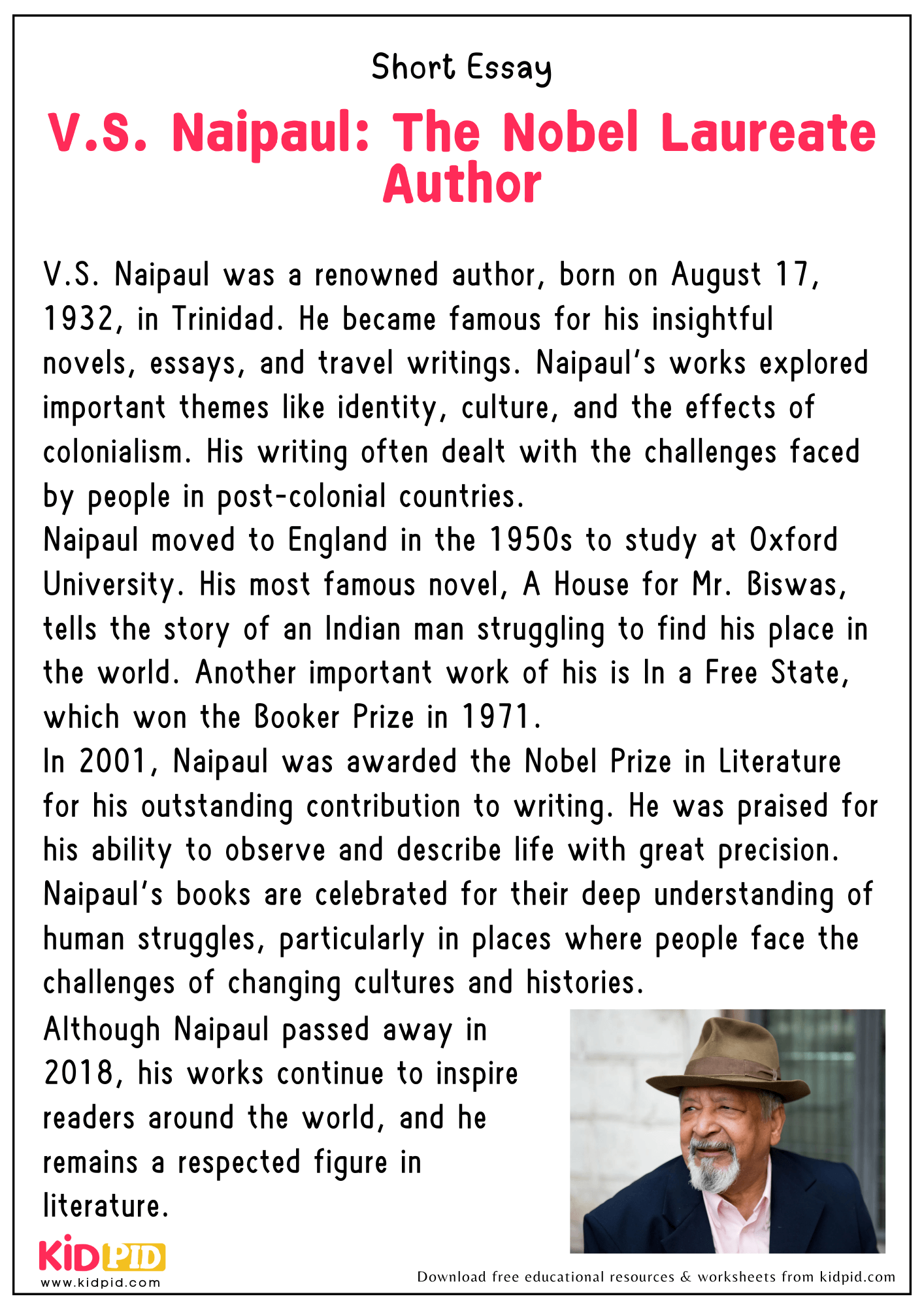
V.S. Naipaul, a literary genius, explored themes of identity, displacement, and post-colonialism through his acclaimed works, earning the Nobel Prize in Literature.
Essay – Marie Curie

Marie Curie, pioneering physicist-chemist, discovered radioactivity, won two Nobel Prizes in Physics and Chemistry, and advanced cancer treatment through her groundbreaking research.
Essay – Amartya Sen: The Economist And Nobel Laureate

Amartya Sen, Nobel-winning economist, advanced welfare economics and human development theories, emphasizing equity, poverty alleviation, and social justice in economic policy globally.