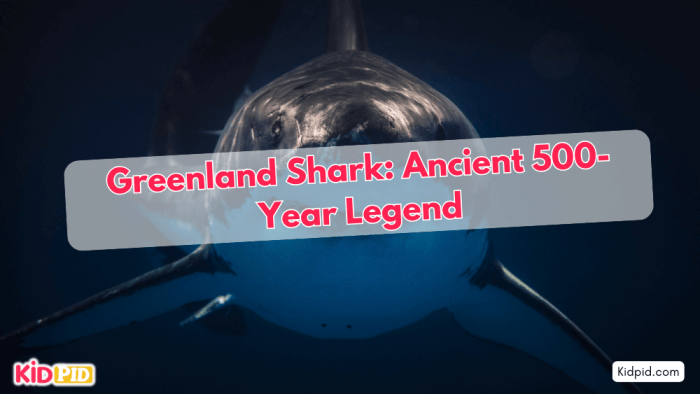
Have you ever heard of a shark that can live for over 500 years? The Greenland shark is a real-life legend of the ocean! Let’s dive into the amazing facts about this incredible creature.
- What is a Greenland Shark: The Greenland shark is a large, slow-moving shark found in the cold waters of the Arctic.
- Incredible Lifespan: These sharks can live for more than 500 years, making them one of the oldest living animals on Earth!
- Unique Features: They have thick, dark skin and small eyes, which help them see in the dark ocean depths.
- Eating Habits: Greenland sharks eat fish, squid, and even dead animals they find in the water. They have a special way of hunting in the dark.
- Mysterious Creatures: Because they live so deep in the ocean, many things about them are still a mystery to scientists.
Contents
- Greenland Shark: Legendary Creature, Over 500 Years as the Oldest Shark
- Related MCQ’S
- 1. How old can a Greenland shark live?
- 2. How do scientists determine the age of a Greenland shark?
- 3. At what age do Greenland sharks reach the baby-making stage?
- 4. What is the speed of a Greenland shark?
- 5. What substance helps Greenland sharks survive in freezing waters?
- 6. How big can a Greenland shark grow?
- You may like these:
Greenland Shark: Legendary Creature, Over 500 Years as the Oldest Shark

Related MCQ’S
1. How old can a Greenland shark live?
A) 150 years
B) 400 years
C) 100 years
D) 300 years
Answer: B) 400 years
Explanation: Greenland sharks are known to have the longest lifespan of any vertebrate, living up to 400 years.
2. How do scientists determine the age of a Greenland shark?
A) By counting rings on its vertebrae
B) By examining its teeth
C) By peeling layers of its islands
D) By using radiocarbon dating on its tissues
Answer: D) By using radiocarbon dating on its tissues
Explanation: Greenland sharks do not have rings in their vertebrae. Instead, scientists use radiocarbon dating on their lens tissues to determine their age.
3. At what age do Greenland sharks reach the baby-making stage?
A) 100 years
B) 50 years
C) 150 years
D) 200 years
Answer: C) 150 years
Explanation: Greenland sharks are slow-growing and typically do not reach sexual maturity until they are about 150 years old.
4. What is the speed of a Greenland shark?
A) 10 feet per second
B) 1.12 feet per second
C) 2.5 feet per second
D) 5 feet per second
Answer: B) 1.12 feet per second
Explanation: Greenland sharks are known for their slow speed, moving at only 1.12 feet per second.
5. What substance helps Greenland sharks survive in freezing waters?
A) Antifreeze-like substances
B) A thick layer of fat
C) Special enzymes
D) Extra skin layers
Answer: A) Antifreeze-like substances
Explanation: Greenland sharks produce antifreeze-like substances in their bodies that prevent ice crystals from forming, allowing them to survive in cold Arctic waters.
6. How big can a Greenland shark grow?
A) Up to 5 feet
B) Up to 10 feet
C) Up to 23 feet
D) Up to 50 feet
Answer: C) Up to 23 feet
Explanation: Greenland sharks can grow up to an impressive 23 feet in length and weigh around 1.5 tons.
You may like these:
Nutrition in Animals
Animals obtain nutrition through ingestion of food, which is then digested and absorbed to provide energy, growth, and maintenance for bodily functions.
Reproduction in Animals
Reproduction in animals involves the production of offspring through sexual or asexual means, ensuring species survival through genetic transfer from parents to offspring.
How do sharks find prey?
Sharks locate prey using acute senses, including smell, detecting blood from miles away, electroreception for sensing movements, and exceptional hearing for distant vibrations.
What If There Were No Sharks?
Without sharks, marine ecosystems would collapse, disrupting food chains, causing prey overpopulation, habitat destruction, and imbalances, ultimately threatening ocean health and biodiversity globally.