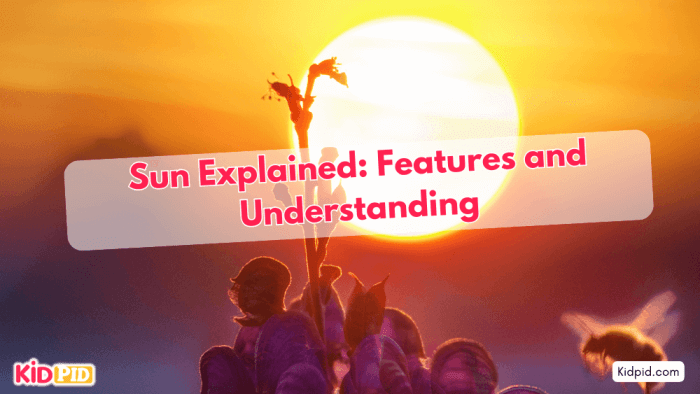
The Sun is the star at the center of our solar system. It gives us light, heat, and helps life grow on Earth. Let’s learn about the Sun, what it’s made of, and how it affects our planet!
- The Sun is a huge ball of hot gases that provides light and heat to Earth.
- It’s mostly made of hydrogen and helium gases that burn very hot.
- The Sun helps plants grow, gives us warmth, and makes our day bright.
- The Sun is incredibly hot! Its core can reach temperatures as high as 27 million degrees Fahrenheit!
- Sunspots are dark patches on the Sun’s surface where it’s a little cooler.
- The Sun’s energy makes the Earth warm enough for us to live, but too much energy can also cause problems like sunburns.
- The Sun’s Role in the Solar System: The Sun keeps all the planets in orbit around it, including Earth!
Contents
- Sun 101: Exploring All Aspects Of The Sun And Its Characteristics.
- Related MCQ’S
- 1. How was the sun formed?
- 2. What is the primary fuel of the sun?
- 3. What causes the sunspots to appear darker?
- 4. Which type of radiation is primarily responsible for sunburns?
- 5. What would happen if the sun turned into a black hole?
- 6. What is a solar eclipse?
- 7. Which layer of the sun is the hottest?
- 8. What can happen if we are exposed to too much UV-A radiation?
- 9. What is a supernova?
- 10. How long can a total solar eclipse last?
- You may like these:
Sun 101: Exploring All Aspects Of The Sun And Its Characteristics.

Related MCQ’S
1. How was the sun formed?
A) By the explosion of a nearby star
B) Through the collapse of a solar nebula made of gas and dust
C) By lightning striking a cloud of gas
D) From the dust in the Earth’s atmosphere
Answer: B) Through the collapse of a solar nebula made of gas and dust
Explanation: The sun formed from the collapse of a solar nebula, which was a cloud of gas and dust that eventually condensed into a burning ball of gas.
2. What is the primary fuel of the sun?
A) Carbon
B) Hydrogen
C) Oxygen
D) Helium
Answer: B) Hydrogen
Explanation: The sun is made up mostly of hydrogen, which serves as its fuel for nuclear fusion.
3. What causes the sunspots to appear darker?
A) They are areas of higher temperature
B) They are cooler regions compared to the surrounding areas
C) They are areas of lower gravity
D) They are located in the sun’s core
Answer: B) They are cooler regions compared to the surrounding areas
Explanation: Sunspots are cooler than the surrounding areas on the sun’s surface, which is why they appear darker.
4. Which type of radiation is primarily responsible for sunburns?
A) UV-A rays
B) UV-B rays
C) Infrared rays
D) Gamma rays
Answer: B) UV-B rays
Explanation: UV-B rays can penetrate the skin and cause damage, including sunburns and skin cancer.
5. What would happen if the sun turned into a black hole?
A) The Earth would be sucked into the black hole immediately
B) The Earth’s orbit would be unaffected, but the planet would freeze
C) The black hole would make Earth spin faster
D) The sun would emit more light
Answer: B) The Earth’s orbit would be unaffected, but the planet would freeze
Explanation: If the sun became a black hole, the Earth would continue orbiting it, but without sunlight, Earth would freeze.
6. What is a solar eclipse?
A) When the moon comes between the Earth and the Sun, blocking the Sun’s light
B) When the Earth blocks the Sun’s light from the moon
C) When the sun’s light gets weaker due to a storm
D) When the sun disappears for a day
Answer: A) When the moon comes between the Earth and the Sun, blocking the Sun’s light
Explanation: A solar eclipse occurs when the moon passes between the Earth and the Sun, blocking the Sun’s light for a short time.
7. Which layer of the sun is the hottest?
A) Corona
B) Core
C) Chromosphere
D) Photosphere
Answer: B) Core
Explanation: The core of the sun is the hottest part, with temperatures reaching around 15 million degrees Celsius.
8. What can happen if we are exposed to too much UV-A radiation?
A) It can cause skin cancer and wrinkles
B) It can cause sudden skin burns
C) It increases the Earth’s temperature
D) It causes hair loss
Answer: A) It can cause skin cancer and wrinkles
Explanation: UV-A rays penetrate deep into the skin, causing damage to collagen and leading to wrinkles and an increased risk of skin cancer.
9. What is a supernova?
A) A star that turns into a black hole
B) A massive explosion at the end of a star’s life
C) A large solar flare on the sun
D) A rapid rotation of a star
Answer: B) A massive explosion at the end of a star’s life
Explanation: A supernova is the explosive death of a star, releasing a huge amount of energy.
10. How long can a total solar eclipse last?
A) 1 hour
B) 7.5 minutes
C) 15 minutes
D) 1 day
Answer: B) 7.5 minutes
Explanation: A total solar eclipse can last up to 7.5 minutes at most.
You may like these:
How does sunscreen work?
Sunscreen protects skin by absorbing or reflecting harmful UV rays. It contains ingredients that form a barrier, preventing skin damage, premature aging, and sunburns.
How Do Sun Produce Light?
The Sun produces light through nuclear fusion in its core, where hydrogen atoms fuse into helium, releasing vast amounts of energy, including light and heat.
Life of a Star : Birth & Death of Stars
Stars are born from gas clouds, fusing hydrogen into helium. They grow, burn through fuel, and eventually die, creating novas, black holes, or white dwarfs.
Why is the Sun hot?
The Sun is hot because of nuclear fusion occurring in its core, where hydrogen atoms fuse into helium, releasing immense energy that heats the Sun’s surface.