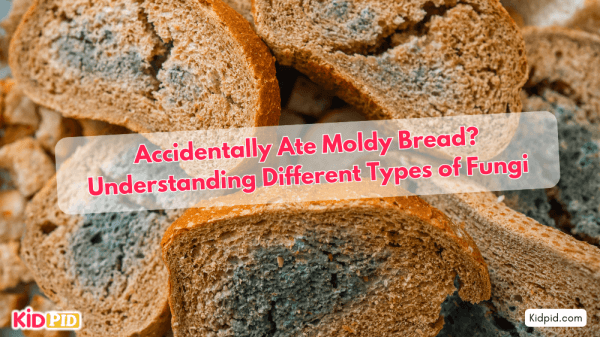
Have you ever wondered what happens if you eat bread with mold on it? Mold is a type of fungus that can grow on food, and it might look harmless, but there’s more to it than meets the eye. Let’s learn about mold and why it’s important to be careful with food.
- Moldy bread isn’t safe to eat: Cutting off the moldy part doesn’t make the rest safe because mold spreads through tiny roots (called hyphae) inside the bread.
- Mold spreads easily: The fuzzy part on the surface is just the tip of the iceberg—mold can release spores that spread through the whole loaf.
- Some fungi are helpful: Yeast helps make bread, and other fungi help create medicines and sauces like soy sauce.
- Some molds are harmful: Certain molds can make you sick, causing nausea, vomiting, or more serious health problems like allergies or toxin exposure.
- What to do if you eat moldy bread: If it’s a small bite, don’t worry too much—your body can handle it. But if you eat a lot, watch out for signs like stomach problems or allergic reactions.
- Tips to prevent mold: Store bread in a cool, dry place and throw away any food with visible mold.
Contents
- “Accidentally Ate Moldy Bread? Understanding Different Types of Fungi”
- Related MCQ’S
- 1. Why is it not safe to eat the “clean” part of moldy bread?
- 2. What are sporangium?
- 3. What could happen if you eat a large quantity of bread contaminated with harmful molds?
- 4. Which type of mold can produce harmful toxins like mycotoxins?
- 5. What is the best way to prevent mold growth on bread?
- 6. Why is it difficult to determine which molds are safe to eat?
- 7. What should you do if you find mold on one slice of bread in a loaf?
- 8. What is the largest living thing on Earth?
- You may like these:
“Accidentally Ate Moldy Bread? Understanding Different Types of Fungi”

Related MCQ’S
1. Why is it not safe to eat the “clean” part of moldy bread?
a) The mold is visible only on the surface.
b) Bread doesn’t taste good when moldy.
c) Mold has underground roots that spread throughout the bread.
d) Moldy bread smells bad.
Answer: c) Mold has underground roots that spread throughout the bread.
Explanation: Mold’s roots, called hyphae, extend beyond what is visible, making the entire bread unsafe to eat.
2. What are sporangium?
a) Roots of mold.
b) The reproductive structures of mold.
c) A type of edible fungus.
d) A chemical used to prevent mold growth.
Answer: b) The reproductive structures of mold.
Explanation: Sporangium release spores, which are the seeds of mold, enabling it to spread.
3. What could happen if you eat a large quantity of bread contaminated with harmful molds?
a) It will always taste bad.
b) You might experience nausea, vomiting, or diarrhea.
c) Your body will easily process it without harm.
d) The bread will cause no issues because all fungi are harmless.
Answer: b) You might experience nausea, vomiting, or diarrhea.
Explanation: Some molds produce harmful toxins that can lead to health problems, including digestive issues.
4. Which type of mold can produce harmful toxins like mycotoxins?
a) Penicillium crustaceum.
b) Rhizopus stolonifer.
c) Aspergillus.
d) Yeast.
Answer: c) Aspergillus.
Explanation: Aspergillus can produce mycotoxins, which may cause serious health issues such as liver damage and respiratory problems.
5. What is the best way to prevent mold growth on bread?
a) Store bread in a warm place.
b) Keep bread in a cool and dry place.
c) Eat bread quickly before it molds.
d) Avoid eating bread.
Answer: b) Keep bread in a cool and dry place.
Explanation: Storing bread in a cool and dry environment slows mold growth.
6. Why is it difficult to determine which molds are safe to eat?
a) All molds look the same.
b) There are thousands of mold types, some harmless and others harmful.
c) Harmful molds are always invisible.
d) Molds cannot be studied.
Answer: b) There are thousands of mold types, some harmless and others harmful.
Explanation: Different molds have varying effects, making it challenging to identify safe and unsafe types.
7. What should you do if you find mold on one slice of bread in a loaf?
a) Eat the rest of the loaf.
b) Discard the entire loaf.
c) Remove the moldy slice and keep the rest.
d) Smell the bread to check for mold.
Answer: b) Discard the entire loaf.
Explanation: Mold spreads spores throughout the loaf, even if other slices appear clean.
8. What is the largest living thing on Earth?
a) A blue whale.
b) A giant tree.
c) The honey mushroom fungus.
d) The Great Barrier Reef.
Answer: c) The honey mushroom fungus.
Explanation: The honey mushroom fungus in Oregon spans nearly 10 square kilometers, making it the largest living organism.
You may like these:
Fungi
Fungi are organisms, including molds, yeasts, and mushrooms, that play crucial ecological roles by decomposing organic matter and forming symbiotic relationships with plants.
Microorganisms: Friend and Foe
Microorganisms are tiny organisms, some beneficial like gut bacteria, and others harmful, causing diseases. Their role in health and ecosystems is both vital and complex.