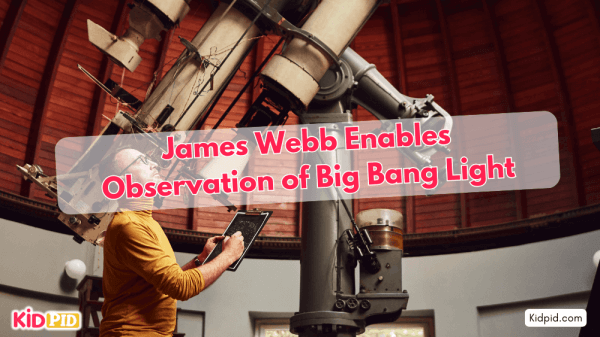
The James Webb Telescope is a powerful space tool. It helps scientists learn more about the universe, even from the past. One of its amazing abilities is to see the light from the Big Bang, which happened billions of years ago.
- James Webb’s Mission: The James Webb Telescope helps astronomers study space like never before. It can look at light from the Big Bang, which happened about 13 billion years ago.
- What It Can Do: The telescope can see galaxies and stars formed a long time ago. It helps us understand how the universe started and how it has changed.
- Why It’s Important: The telescope lets scientists look back in time to the very beginning of the universe. It helps us learn about stars, planets, and galaxies that are far away.
Contents
- James Webb’s Mission Allows Astronomers To View The Big Bang’s Light.
- Related MCQ’s
- 1. When was the James Webb Telescope launched?
- 2. What is the main purpose of the James Webb Telescope?
- 3. How long does it take light from the Sun to reach Earth?
- 4. What makes the James Webb Telescope special?
- 5. Why do astronomers need powerful telescopes like the James Webb Telescope?
- 6. Who is the James Webb Telescope named after?
- You may like these:
James Webb’s Mission Allows Astronomers To View The Big Bang’s Light.
Related MCQ’s
1. When was the James Webb Telescope launched?
a) December 25th, 2020
b) December 25th, 2021
c) January 1st, 2022
d) November 20th, 2021
2. What is the main purpose of the James Webb Telescope?
a) To look for treasure
b) To study distant galaxies, stars, and planets
c) To study Earth’s oceans
d) To take pictures of the Sun
3. How long does it take light from the Sun to reach Earth?
a) 5 minutes
b) 8 minutes and 20 seconds
c) 10 minutes
d) 20 minutes
4. What makes the James Webb Telescope special?
a) It looks at objects 200 million years old
b) It can see things in the future
c) It only looks at the Sun
d) It can travel through space
5. Why do astronomers need powerful telescopes like the James Webb Telescope?
a) To see the future
b) To study invisible light that is blocked by dust
c) To look at nearby stars
d) To see the Earth’s surface clearly
6. Who is the James Webb Telescope named after?
a) Albert Einstein
b) James E Webb
c) Neil Armstrong
d) Galileo Galilei
You may like these:
Stars and the Solar System
Stars are giant glowing balls of gas, and our solar system has planets, moons, and the Sun. Together, they make up space’s wonders and mysteries.
Solar System Flashcards
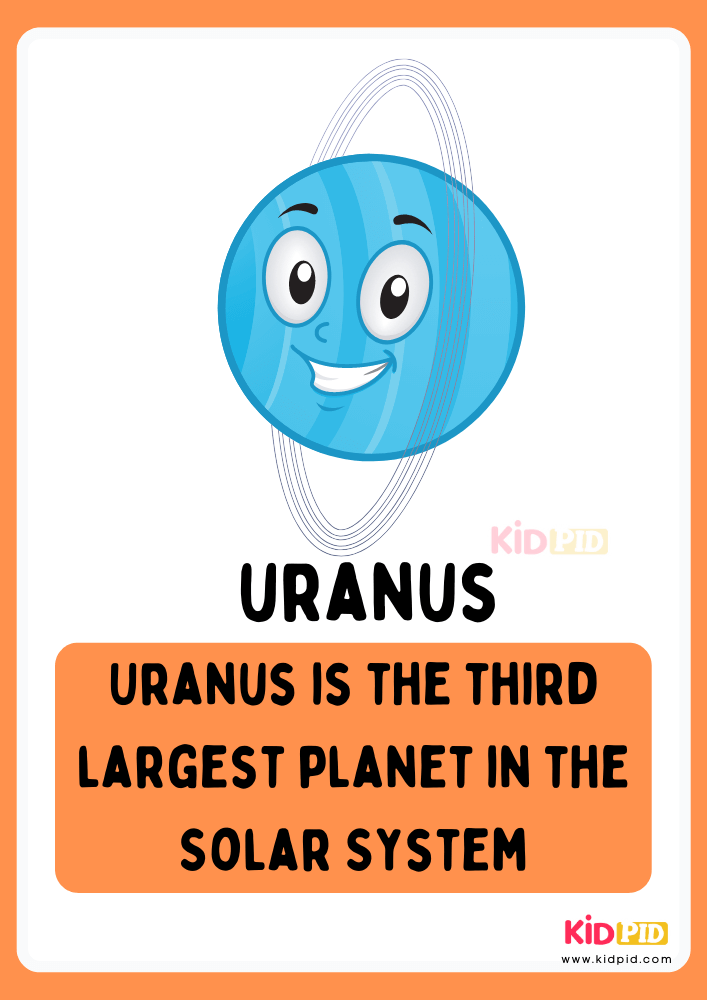
Solar system flashcards feature planets, the Sun, and other celestial bodies. These educational tools help children learn planet names, sizes, and characteristics, enhancing their space knowledge.
Basic understanding of the solar system
The solar system consists of the Sun and its orbiting planets, moons, and other objects. Understanding its structure helps children grasp basic astronomy and planetary science concepts.
Space Crafts For Kids
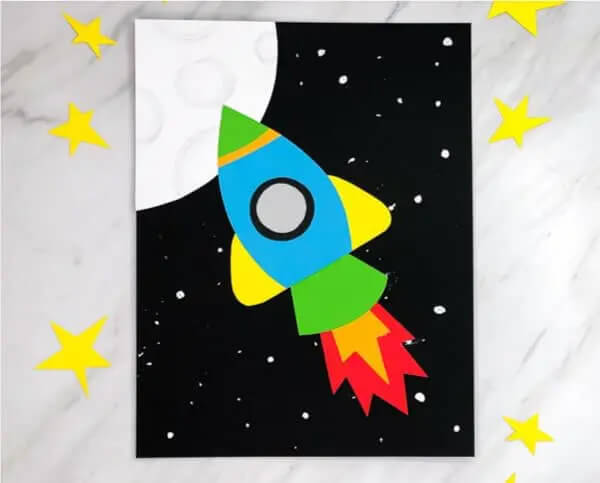
Create your own space adventure with fun crafts! Make planets, rockets, and stars using easy materials, and bring the mysteries of space into your home.