Julius Caesar was a famous Roman general and leader. This essay shares 10 key points about his life, achievements, and death. It also includes simple questions to help kids learn more about Julius Caesar’s story in history. Learn about his role, power, battles, and the people around him.
Contents
10 Pointers About Julius Caesar
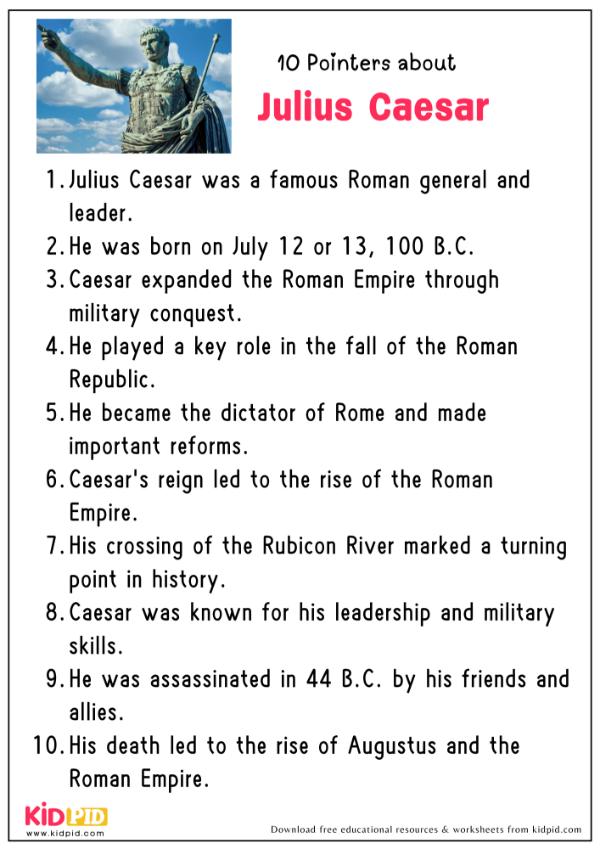

- Julius Caesar was a famous Roman general and leader.
- He was born on July 12 or 13, 100 B.C.
- Caesar expanded the Roman Empire through military conquest.
- He played a key role in the fall of the Roman Republic.
- He became the dictator of Rome and made important reforms.
- Caesar’s reign led to the rise of the Roman Empire.
- His crossing of the Rubicon River marked a turning point in history.
- Caesar was known for his leadership and military skills.
- He was assassinated in 44 B.C. by his friends and allies.
- His death led to the rise of Augustus and the Roman Empire.
Short Essay On Julius Caesar
Essay On Julius Caesar in 100 Words
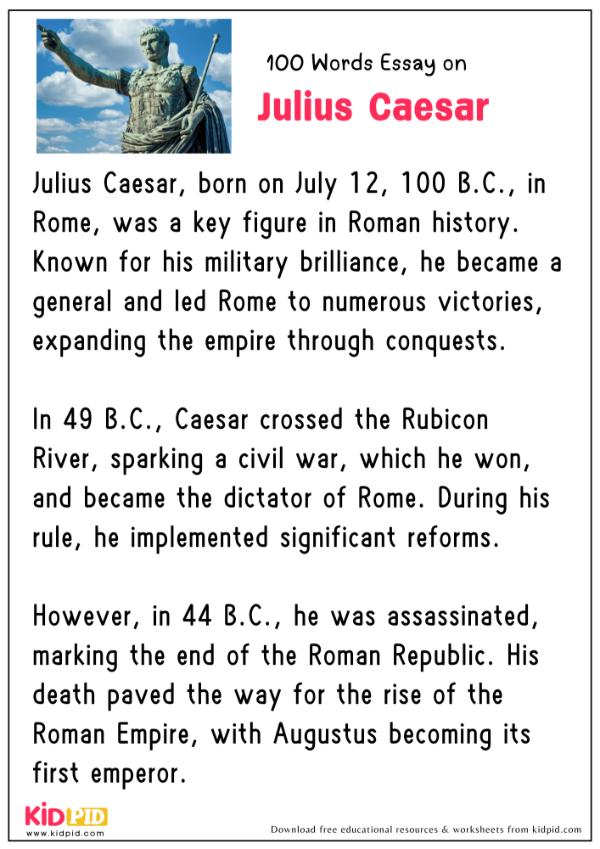
Julius Caesar, born on July 12, 100 B.C., in Rome, was a key figure in Roman history. Known for his military brilliance, he became a general and led Rome to numerous victories, expanding the empire through conquests. In 49 B.C., Caesar crossed the Rubicon River, sparking a civil war, which he won, and became the dictator of Rome. During his rule, he implemented significant reforms. However, in 44 B.C., he was assassinated, marking the end of the Roman Republic. His death paved the way for the rise of the Roman Empire, with Augustus becoming its first emperor.
Essay On Julius Caesar in 200 Words

Julius Caesar was a brilliant general and leader in ancient Rome. Born on July 12, 100 B.C., he grew up in a time of political chaos. Caesar became famous for his military skills, particularly his campaigns in Gaul (modern-day France). His victories expanded the Roman Empire, and he gained the respect of his soldiers and the Roman people.
In 49 B.C., Caesar made a bold decision that changed Roman history. He crossed the Rubicon River with his army, which led to a civil war. After winning, Caesar became the dictator of Rome. As ruler, he made several reforms, including changing the calendar and improving the government. However, his rise to power angered many Roman senators, who feared he was becoming too powerful.
In 44 B.C., Caesar was assassinated by a group of senators led by Brutus and Cassius. His death led to the end of the Roman Republic. Despite his assassination, Caesar’s legacy continued through the rise of his adopted heir, Augustus, who became the first Roman emperor and started the Roman Empire. Caesar’s influence on Roman history is still felt today.
Essay On Julius Caesar in 300 Words
Julius Caesar was one of the most influential figures in the history of Rome. Born in 100 B.C., he grew up during a time when Rome was struggling with political problems and conflicts between powerful generals and the Senate. Despite this, Caesar’s early career was marked by his ambition and skill in military leadership. His campaigns in Gaul, which lasted from 58 to 50 B.C., were particularly successful, greatly expanding the Roman Empire and earning Caesar widespread fame.
In 49 B.C., Caesar made a significant decision that would change the course of Roman history. Faced with opposition from the Senate, he crossed the Rubicon River with his army, famously declaring, “The die is cast.” This action sparked a civil war, and Caesar emerged victorious. He returned to Rome as a hero and declared himself dictator for life, a move that led to significant reforms in Rome, including a new calendar and land redistribution for veterans.
However, Caesar’s rise to power alarmed many senators who feared he would become a king. In 44 B.C., a group of senators, including some of Caesar’s closest allies, assassinated him on the Ides of March. His death led to the end of the Roman Republic and the beginning of the Roman Empire under his adopted son, Augustus.
Caesar’s legacy is enormous. He is remembered not only for his military victories but also for changing the political structure of Rome. His life and death paved the way for the rise of the Roman Empire, shaping the course of history for centuries.
Long Essay On Julius Caesar in 500 Words
Introduction
Julius Caesar is one of the most important figures in Roman history. His life and death had a profound impact on the Roman Republic and the Roman Empire that followed. Known for his military brilliance, leadership, and reforms, Caesar’s actions changed the course of history. Born on July 12, 100 B.C., he rose from a young politician to one of the most powerful men in the Roman world. His story is one of ambition, power struggles, and lasting change.
Early Life and Military Career
Caesar’s early life was marked by his ambition and determination. Coming from a noble but not wealthy family, he worked his way up through the ranks of Roman politics. By the time he was in his thirties, he had already gained recognition as a military leader. His most famous military campaigns were in Gaul, where he spent several years conquering tribes and expanding Rome’s territory. His success in Gaul brought him immense popularity among his soldiers and the people of Rome. Through his military conquests, Caesar was able to solidify his status as one of the most respected leaders in the Roman world.
The Crossing of the Rubicon and the Civil War
In 49 B.C., Caesar was in a power struggle with the Roman Senate, particularly with a rival general named Pompey. The Senate ordered Caesar to disband his army and return to Rome, but Caesar chose to march his army across the Rubicon River, which was considered an act of rebellion. This moment is famous for Caesar’s declaration, “The die is cast.” His crossing of the Rubicon sparked a civil war between Caesar’s supporters and Pompey’s forces. After a series of victories, Caesar emerged as the sole ruler of Rome, marking a significant turning point in Roman history.
Reforms and Dictatorship
As the dictator of Rome, Caesar implemented several important reforms. He reorganized the Roman government, introduced a new calendar (the Julian calendar), and passed laws to help the poor and veterans. Caesar also gave land to his soldiers, making them loyal to him. However, his concentration of power angered many senators, who feared that Caesar would become a tyrant. His reforms and absolute control over Rome eventually led to his downfall, as many saw his rise as a threat to the traditional Roman Republic.
Assassination and Legacy
In 44 B.C., Caesar’s growing power led to his assassination. A group of senators, including some of his closest allies, stabbed him to death on the Ides of March. They hoped his death would restore the power of the Senate and save the Republic. However, Caesar’s assassination led to further civil wars, which eventually resulted in the rise of his adopted son, Octavian (later Augustus), who became the first emperor of Rome.
Despite his death, Julius Caesar’s legacy lived on. His military achievements, political reforms, and centralization of power paved the way for the Roman Empire. Caesar’s actions set the stage for the end of the Roman Republic and the beginning of imperial rule, influencing the future of Rome for centuries. Today, he is remembered as one of the greatest military leaders in history, and his impact on Rome continues to be felt.
Conclusion
Julius Caesar’s life and death played a key role in shaping the history of Rome. His military genius, reforms, and leadership forever changed the Roman world. Though he was assassinated by those who feared his power, his influence continued long after his death, leading to the rise of the Roman Empire. Caesar remains a towering figure in history, remembered not just for his victories but for his lasting impact on Roman society and governance.


FAQs on Julius Caesar
Q1. When was Julius Caesar born?
Ans. Julius Caesar was born on July 12, 100 B.C.
Q2. Which military campaign is Julius Caesar most famous for?
Ans. Julius Caesar is most famous for his campaigns in Gaul.
Q3. What famous event did Julius Caesar cause in 49 B.C.?
Ans. In 49 B.C., Caesar crossed the Rubicon River, leading to a civil war.
Q4. What was the declaration Caesar made when crossing the Rubicon?
Ans. Caesar declared, “The die is cast.”
Q5. What title did Julius Caesar hold after winning the civil war?
Ans. Julius Caesar became the dictator of Rome.
Q6. What major reform did Caesar introduce during his rule?
Ans. Caesar introduced the Julian calendar.
Q7. How did Julius Caesar die?
Ans. Julius Caesar was assassinated by a group of senators on the Ides of March, 44 B.C.
Q8. Who became the first emperor of Rome after Caesar’s death?
Ans. Caesar’s adopted son, Octavian (later Augustus), became the first emperor of Rome.
Q9. What was the outcome of Caesar’s assassination?
Ans. Caesar’s assassination led to further civil wars, which resulted in the rise of the Roman Empire.
Q10. What lasting impact did Julius Caesar have on Rome?
Ans. Julius Caesar’s military achievements, political reforms, and centralization of power paved the way for the Roman Empire.
Julius Caesar was a brave Roman leader whose life teaches us about power, politics, and loyalty. This essay, with 10 pointers and questions, helps kids understand their important role in history. To discover more, visit our website for paragraphs, essays, worksheets, flashcards, Quizzes, and other interactive resources. Remember to follow us on YouTube & Facebook.
You might also like
Essay – Chandra Shekhar Azad: The Young Revolutionary


Chandra Shekhar Azad was a brave Indian freedom fighter. He fought against British rule with courage and never got caught. His patriotism and sacrifice inspired many in India’s independence movement.
Essay – Vinoba Bhave: The Bhoodan Movement Leader
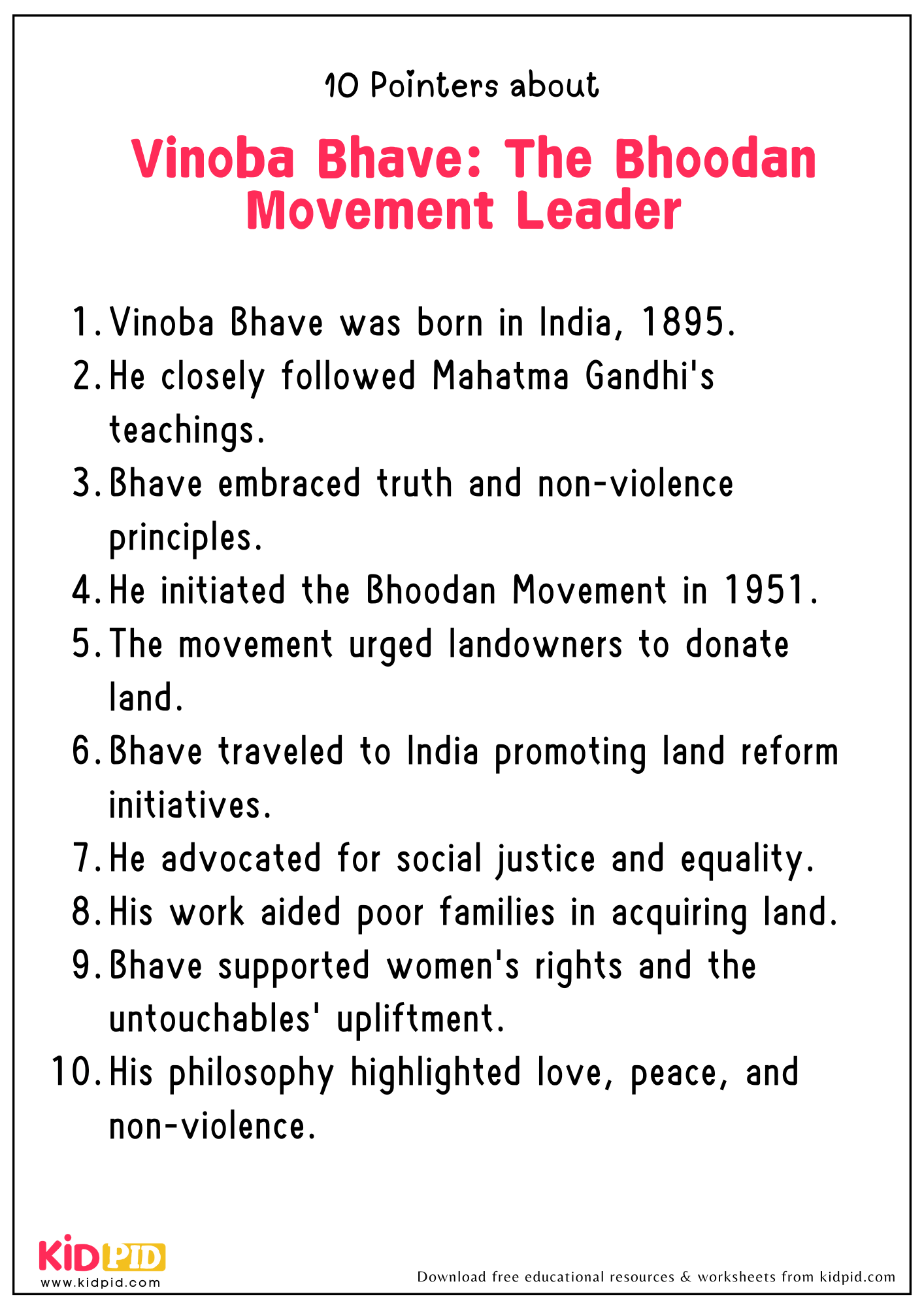
Vinoba Bhave was a great Indian freedom fighter and social reformer. He started the Bhoodan Movement, helping poor people get land. His peaceful ideas and work inspired many across India.
Essay – Rajiv Gandhi: The Tech-Savvy Prime Minister

Rajiv Gandhi was the youngest Prime Minister of India. He worked to improve technology and education. His leadership and modern ideas helped shape India’s future after his mother, Indira Gandhi.
Essay – Zubin Mehta: The Renowned Conductor

Zubin Mehta is a famous Indian music conductor. He led many world orchestras with talent and passion. His love for classical music made him respected across the world and in India.
Essay – R. K. Narayan: The Chronicler Of Indian Life


R.K. Narayan was a famous Indian writer known for his simple stories and unique characters. His books, like Malgudi Days, made Indian life and culture popular around the world.