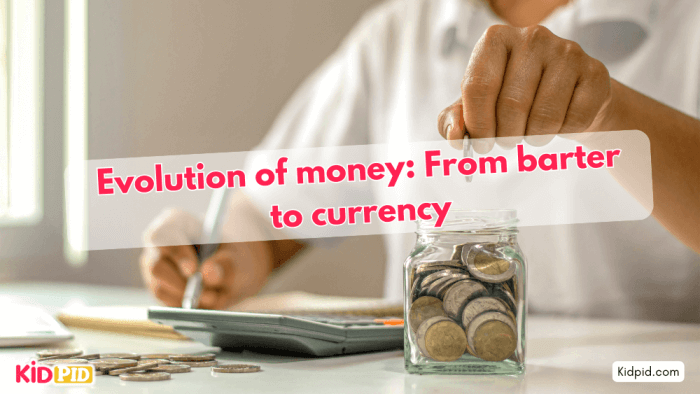
Have you ever wondered how people bought things before money was invented? A long time ago, there was no money—no coins, paper notes, or digital payments! People used a system called barter, where they traded things they had for things they needed. Over time, this system changed and grew into the money systems we use today.
- Barter System: People exchanged goods or services directly (e.g., a sack of wheat for a pair of shoes).
- Limitations of Barter: It was hard to trade if both people didn’t need what the other had, and there was no fixed value for items.
- Early Money: Around 1200 BCE, people began using items like cowry shells, beads, and stones as money because they were portable and valuable.
- Metallic Coins: Around 600 BCE, metallic coins made of gold and silver were first used in Lydia, an ancient kingdom in Turkey.
- Paper Money: Around 618 CE in China, people started using paper money because carrying coins was heavy and inconvenient.
- Modern Money: Today, we use coins, paper notes, and even digital payments on phones and computers.
Contents
- “The Origins of Money: Exploring the History of Barter”
- Related MCQ’S
- 1. What was the first system used by people to purchase things before money was invented?
- 2. What was one limitation of the barter system?
- 3. What were some of the first items used as money around 1200 BCE?
- 4. Where were the first metallic coins made?
- 5. Why did paper money become popular in China around 618 CE?
- 6. What is paper money actually made of?
- 7. What is one modern way of paying for things mentioned in the text?
- You may like these:
“The Origins of Money: Exploring the History of Barter”
Related MCQ’S
1. What was the first system used by people to purchase things before money was invented?
a) Coins
b) Paper money
c) Barter
d) Digital payment
2. What was one limitation of the barter system?
a) It was too easy to use.
b) Goods and services were not easily traded or valued.
c) It required coins to function.
d) It worked in all cases.
3. What were some of the first items used as money around 1200 BCE?
a) Coins
b) Digital payments
c) Cowry shells, beads, and stones
d) Credit cards
4. Where were the first metallic coins made?
a) China
b) Lydia
c) Egypt
d) India
5. Why did paper money become popular in China around 618 CE?
a) It was heavier than coins.
b) It was more convenient to carry than coins.
c) It was made of gold.
d) It was colorful.
6. What is paper money actually made of?
a) Plastic
b) Regular paper
c) Cotton and linen
d) Wool
7. What is one modern way of paying for things mentioned in the text?
a) Trading goods
b) Using digital money via phones
c) Bartering services
d) Using cowry shells
You may like these:
The History of Money
The history of money traces its evolution from bartering to coins, paper currency, and digital payments, reflecting human innovation in trade and economy.
5 Most Important Money Lessons to Teach Your Kids

Teaching kids essential money lessons includes saving, budgeting, distinguishing needs from wants, investing wisely, and understanding the value of hard work for financial independence.
Types of Goods
Goods are categorized into consumer goods (for personal use), capital goods (used in production), durable goods (long-lasting), and non-durable goods (short-lived).
Micro Vs Macro & Money Vs Barter
Microeconomics focuses on individual decisions, while macroeconomics examines overall economic trends. Money facilitates trade, unlike barter, which directly exchanges goods without currency.