

‘Dandi March’ is one of the important topics on which students can be asked to write a paragraph in exams in school. The Dandi March was a pivotal event in India’s fight for independence, led by Mahatma Gandhi in 1930 to protest British salt taxes. Please check the various versions (100 words, 150 words, 200 words, and 300 words) provided below for the paragraph.
Contents
- Paragraph on ‘Dandi March’ in 100 Words
- Paragraph on ‘Dandi March’ in 150 Words
- Paragraph on ‘Dandi March’ in 200 Words
- Paragraph on ‘Dandi March’ in 300 Words
- MCQs on ‘Dandi March’
- 1. Who led the Dandi March?
- 2. When did the Dandi March begin?
- 3. How many miles did Gandhi and his followers walk during the Dandi March?
- 4. What was the main purpose of the Dandi March?
- 5. Where did the Dandi March end?
- 6. What law did Gandhi break at Dandi?
- 7. How long did the Dandi March last?
- 8. What did the Dandi March prove to the world?
- 9. What happened after the Dandi March?
- 10. Why is the Dandi March important in Indian history?
- You may like these:
Paragraph on ‘Dandi March’ in 100 Words


The Dandi March was an important event in India’s freedom struggle. It was led by Mahatma Gandhi in 1930. The march started from Sabarmati Ashram to Dandi, a village in Gujarat. Gandhi and his followers walked 240 miles to protest against the British salt tax. They made salt from seawater to break the law. This march was peaceful but very powerful. Many people joined Gandhi on the way. It showed the strength of non-violent protest. The British arrested many people, but India’s fight for freedom grew stronger. The Dandi March inspired the world and brought India closer to independence.
Paragraph on ‘Dandi March’ in 150 Words

The Dandi March was a historic event in India’s fight for freedom. In 1930, Mahatma Gandhi started this march to protest against the unfair salt tax by the British. He walked 240 miles from Sabarmati Ashram to Dandi, a coastal village in Gujarat. Many people joined him along the way. After reaching Dandi, he made salt from seawater, breaking the British law. This peaceful protest became a major movement against British rule. The British arrested thousands of people, but the movement did not stop. The Dandi March showed the power of truth and non-violence. It made people more determined to fight for independence. This march inspired many freedom fighters and brought India closer to freedom. It also gained attention worldwide. The Dandi March remains a great example of courage and unity in history.
Paragraph on ‘Dandi March’ in 200 Words

The Dandi March was an important movement in India’s fight for freedom. It was led by Mahatma Gandhi on March 12, 1930. The march started from Sabarmati Ashram in Gujarat and ended in Dandi, a coastal village, covering 240 miles. Gandhi and his followers walked for 24 days to protest against the British salt tax. The British had put a high tax on salt, which was unfair to the common people. Gandhi wanted to show that Indians could make their salt without paying taxes.
On April 6, 1930, after reaching Dandi, Gandhi picked up salt from the beach, breaking British law. This act encouraged many Indians to make their salt and protest against British rule. The British arrested thousands of people, including Gandhi, but the movement did not stop. The Dandi March became a symbol of India’s struggle for independence. It showed the power of non-violent resistance and inspired many people around the world. This event played a big role in India’s journey to freedom.
Paragraph on ‘Dandi March’ in 300 Words

The Dandi March was a major event in India’s freedom struggle. It was led by Mahatma Gandhi on March 12, 1930, to protest against the unfair salt tax imposed by the British. The British had made it illegal for Indians to make their own salt and forced them to buy expensive salt from the British government. Gandhi decided to break this law peacefully.
He started the march from Sabarmati Ashram with 78 followers. They walked 240 miles over 24 days to reach Dandi, a village on the seashore in Gujarat. Many people joined Gandhi along the way. When they reached Dandi on April 6, Gandhi picked up salt from the beach and made his salt, breaking British law. This simple act sent a strong message that Indians would not accept unfair rules. Soon, people across India started making salt and protesting peacefully.
The British were alarmed and arrested thousands of people, including Gandhi. But the movement continued to grow. The Dandi March became a powerful symbol of India’s struggle for independence. It showed the strength of truth and non-violence. The world admired Gandhi’s peaceful protest. This march united people and gave them the courage to fight for freedom. Finally, after many years of struggle, India became independent in 1947. The Dandi March remains a proud moment in Indian history.
MCQs on ‘Dandi March’
1. Who led the Dandi March?
a) Jawaharlal Nehru
b) Sardar Patel
c) Mahatma Gandhi
d) Subhas Chandra Bose
Answer: c) Mahatma Gandhi
Explanation: Mahatma Gandhi led the Dandi March in 1930 to protest against the British salt tax.
2. When did the Dandi March begin?
a) January 26, 1930
b) March 12, 1930
c) August 15, 1947
d) October 2, 1930
Answer: b) March 12, 1930
Explanation: Gandhi and his followers started the march from Sabarmati Ashram on March 12, 1930.
3. How many miles did Gandhi and his followers walk during the Dandi March?
a) 100 miles
b) 240 miles
c) 500 miles
d) 50 miles
Answer: b) 240 miles
Explanation: The march covered a distance of 240 miles from Sabarmati Ashram to Dandi.
4. What was the main purpose of the Dandi March?
a) To collect donations
b) To protest against British rule
c) To fight in a war
d) To promote education
Answer: b) To protest against British rule
Explanation: The Dandi March was a non-violent protest against the British salt tax.
5. Where did the Dandi March end?
a) Delhi
b) Mumbai
c) Dandi, Gujarat
d) Kolkata
Answer: c) Dandi, Gujarat
Explanation: Gandhi and his followers reached Dandi, a coastal village in Gujarat, to make salt.
6. What law did Gandhi break at Dandi?
a) Land tax law
b) British salt law
c) Education law
d) Voting law
Answer: b) British salt law
Explanation: Gandhi made salt from seawater, which was illegal under British rule.
7. How long did the Dandi March last?
a) 10 days
b) 24 days
c) 50 days
d) 5 days
Answer: b) 24 days
Explanation: The march lasted for 24 days, from March 12 to April 6, 1930.
8. What did the Dandi March prove to the world?
a) The strength of British rule
b) The power of non-violent protest
c) The need for war
d) The weakness of India
Answer: b) The power of non-violent protest
Explanation: The march showed that non-violence could be a strong weapon against injustice.
9. What happened after the Dandi March?
a) Gandhi and many others were arrested
b) India got independence immediately
c) The British reduced the salt tax
d) The march was stopped by the police
Answer: a) Gandhi and many others were arrested
Explanation: The British arrested thousands of protesters, including Gandhi, after the march.
10. Why is the Dandi March important in Indian history?
a) It was a military victory
b) It united people in the fight for freedom
c) It helped the British rule longer
d) It ended all taxes
Answer: b) It united people in the fight for freedom
Explanation: The march brought Indians together and strengthened the independence movement.


I hope you enjoyed the paragraphs on the topic ‘Dandi March’ written by our team of experienced teachers. Keep visiting our website and explore more paragraphs, essays, worksheets, flashcards, Quizzes, and many other interactive resources. Don’t forget to follow us on YouTube & Facebook.
You may like these:
Short Paragraph on ‘Mahatma Gandhi’


Mahatma Gandhi was a leader in India’s struggle for independence from British rule. Known for his philosophy of nonviolence and civil disobedience, he inspired movements for civil rights worldwide.
Simple Paragraph on ‘Freedom Fighters’

Freedom fighters are individuals who resist oppression and fight for independence. They play a crucial role in shaping a nation’s history, often sacrificing their lives for the rights and freedoms of others.
Write a Paragraph on ‘Gandhi Jayanti’
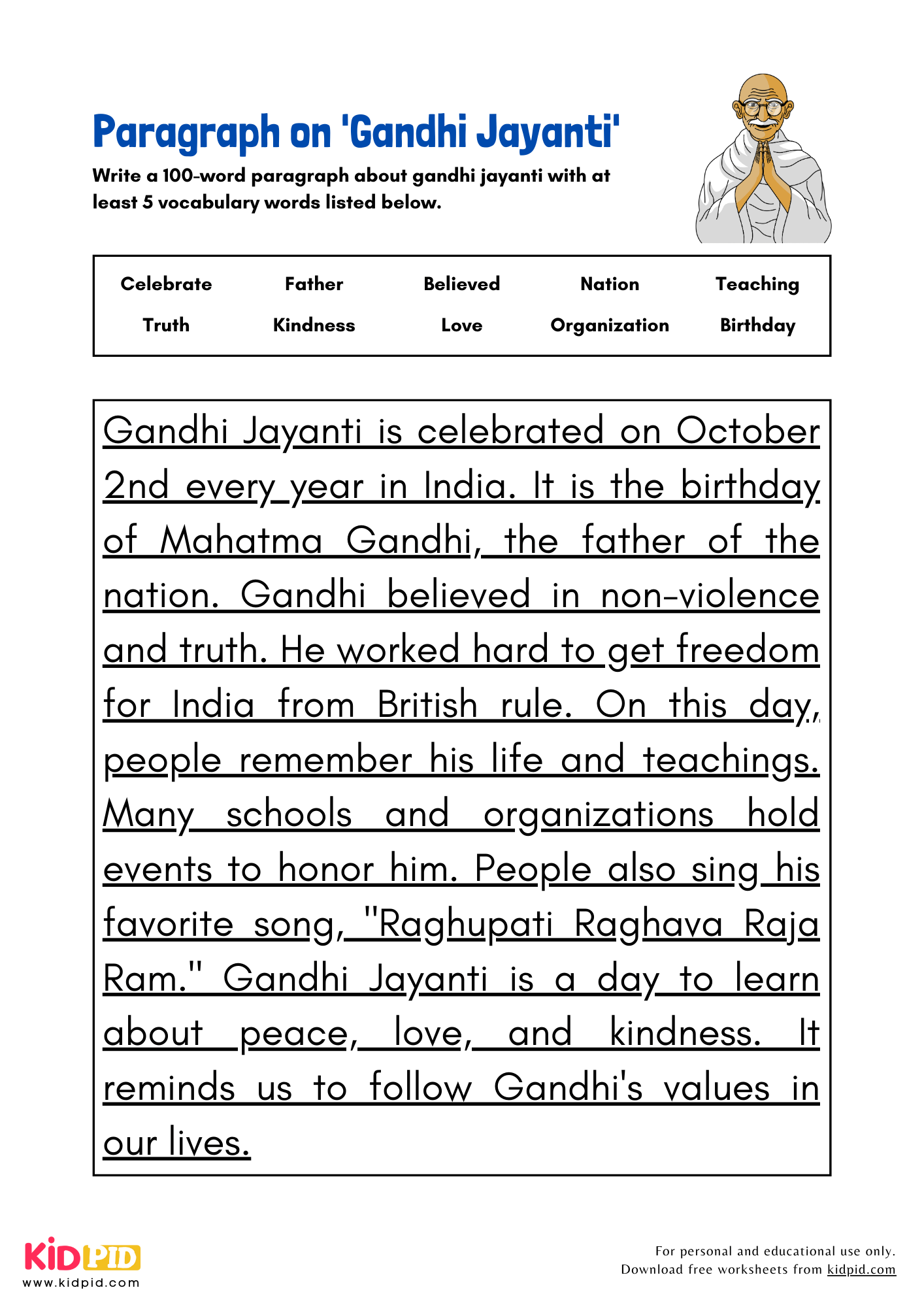
Gandhi Jayanti, celebrated on October 2nd, honors Mahatma Gandhi’s birthday. This national holiday in India promotes peace, nonviolence, and social harmony, inspiring people to follow Gandhi’s principles in everyday life.
Easy Paragraph on ‘Indira Gandhi’

Indira Gandhi was the first woman Prime Minister of India, serving from 1966 to 1977 and again from 1980 until her assassination in 1984. She was known for her leadership and determination.
Paragraph – ‘Bhagat Singh’

Bhagat Singh was a prominent Indian revolutionary who fought against British colonial rule. Known for his bravery, he became a symbol of resistance. His sacrifice inspired a generation to seek freedom through revolutionary means.


