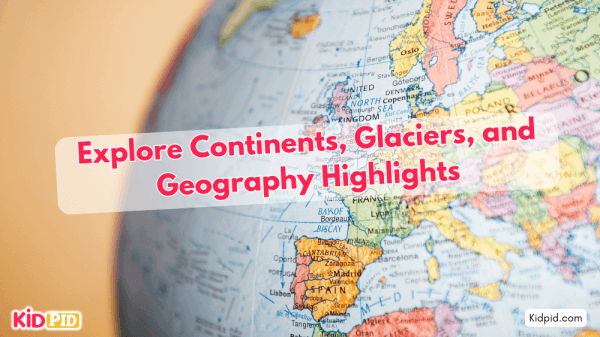
In this fun geography adventure, we will discover the amazing features of our planet, including continents, glaciers, and much more! Get ready to learn about the land we live on and the icy wonders that shape our world.
- What Are Continents: Continents are large areas of land where we find different countries, cultures, and environments.
- The Seven Continents: There are seven continents: Asia, Africa, Europe, North America, South America, Australia, and Antarctica.
- What Are Glaciers: Glaciers are huge masses of ice that move slowly over land. They can be found in cold places like Antarctica and Greenland.
- Why Are Glaciers Important: Glaciers store a lot of fresh water and help keep our planet’s climate balanced.
- Earth’s Landforms: Along with continents and glaciers, Earth has mountains, valleys, plains, and deserts, each with unique features.
- Learning About Nature: By exploring these geography topics, we learn how our planet works and why it’s important to protect it!
Contents
- Discover Continents, Glaciers, And More In This Geography Collection.
- Related MCQ’S
- 1. What was Pangea?
- 2. Who proposed the theory of continental drift?
- 3. What do we call the process where tectonic plates move?
- 4. How many continents are there on Earth?
- 5. What happens at convergent boundaries?
- 6. What are the four domains of Earth?
- 7. What is a glacier?
- 8. What is permafrost?
- 9. Why are glaciers important to the Earth?
- 10. What can happen if glaciers melt?
- You may like these:
Discover Continents, Glaciers, And More In This Geography Collection.
Related MCQ’S
1. What was Pangea?
A) A type of dinosaur
B) A giant supercontinent
C) A famous ocean
D) A planet
2. Who proposed the theory of continental drift?
A) Isaac Newton
B) Alfred Wegener
C) Marie Curie
D) Galileo Galilei
3. What do we call the process where tectonic plates move?
A) Continental drift
B) Ocean currents
C) Erosion
D) Pollution
4. How many continents are there on Earth?
A) 5
B) 6
C) 7
D) 8
5. What happens at convergent boundaries?
A) Plates move apart
B) Plates slide past each other
C) Plates collide and form mountains
D) Plates float on water
6. What are the four domains of Earth?
A) Land, water, air, and fire
B) Lithosphere, hydrosphere, atmosphere, and biosphere
C) Mountains, rivers, deserts, and forests
D) Continents, oceans, climates, and seasons
7. What is a glacier?
A) A type of mountain
B) A large mass of ice
C) A river
D) A desert
8. What is permafrost?
A) Frozen ground that never thaws
B) A type of glacier
C) A warm area in the tundra
D) A kind of rock
9. Why are glaciers important to the Earth?
A) They help plants grow
B) They store fresh water
C) They make weather
D) They are good for fishing
10. What can happen if glaciers melt?
A) It gets colder
B) Sea levels rise
C) More ice forms
D) Animals get more food
You may like these:
What happens when continents collide?
When continents collide, tectonic plates converge, forming towering mountain ranges, earthquakes, and metamorphic rocks, reshaping Earth’s surface through immense pressure and heat over time.
American Revolution
The American Revolution was a historic struggle where American colonies fought for independence from British rule, leading to the creation of the United States.
How do glaciers form?
Glaciers form when snow accumulates over time, compressing into dense ice layers under pressure, moving slowly due to gravity in cold climates.
Stars and the Solar System
Stars are massive celestial bodies emitting light and heat, while the Solar System includes the Sun, planets, moons, and other objects orbiting our star.