
“The Formation of Mountains” is a key topic on which students may be asked to write a paragraph in their school exams. Mountains form through natural forces like tectonic plate movement, volcanic eruptions, and uplift, shaping Earth’s surface over time. Please check the various versions (in 100 words, 150 words, 200 words, and 300 words) provided below for the paragraph.
Contents
- Paragraph on ‘The Formation of Mountains’ in 100 Words
- Paragraph on ‘The Formation of Mountains’ in 150 Words
- Paragraph on ‘The Formation of Mountains’ in 200 Words
- Paragraph on ‘The Formation of Mountains’ in 300 Words
- MCQ’s on ‘The Formation of Mountains’
- 1. How are mountains primarily formed?
- 2. What are the three main types of mountains?
- 3. What causes fold mountains to form?
- 4. Which mountain is an example of a volcanic mountain?
- 5. What are uplifted mountains formed from?
- 6. Which mountain range is an example of fold mountains?
- 7. How do mountains affect weather?
- 8. Why are mountains important for ecosystems?
- 9. What is an example of an uplifted mountain?
- 10. Why do mountains provide opportunities for adventure?
- You may like these:
Paragraph on ‘The Formation of Mountains’ in 100 Words

Mountains are formed when the Earth’s surface changes over time. There are three main ways mountains form. One way is when tectonic plates, large pieces of the Earth’s crust, push against each other. This force causes the land to rise, forming mountains. Another way is through volcanic eruptions. Lava and ash from the volcano build up to create volcanic mountains. The third way is uplift, where rocks are pushed up from inside the Earth. This process happens very slowly over millions of years. Mountains are important for plants, animals, and people. They give us water, air, and beautiful landscapes.
Paragraph on ‘The Formation of Mountains’ in 150 Words
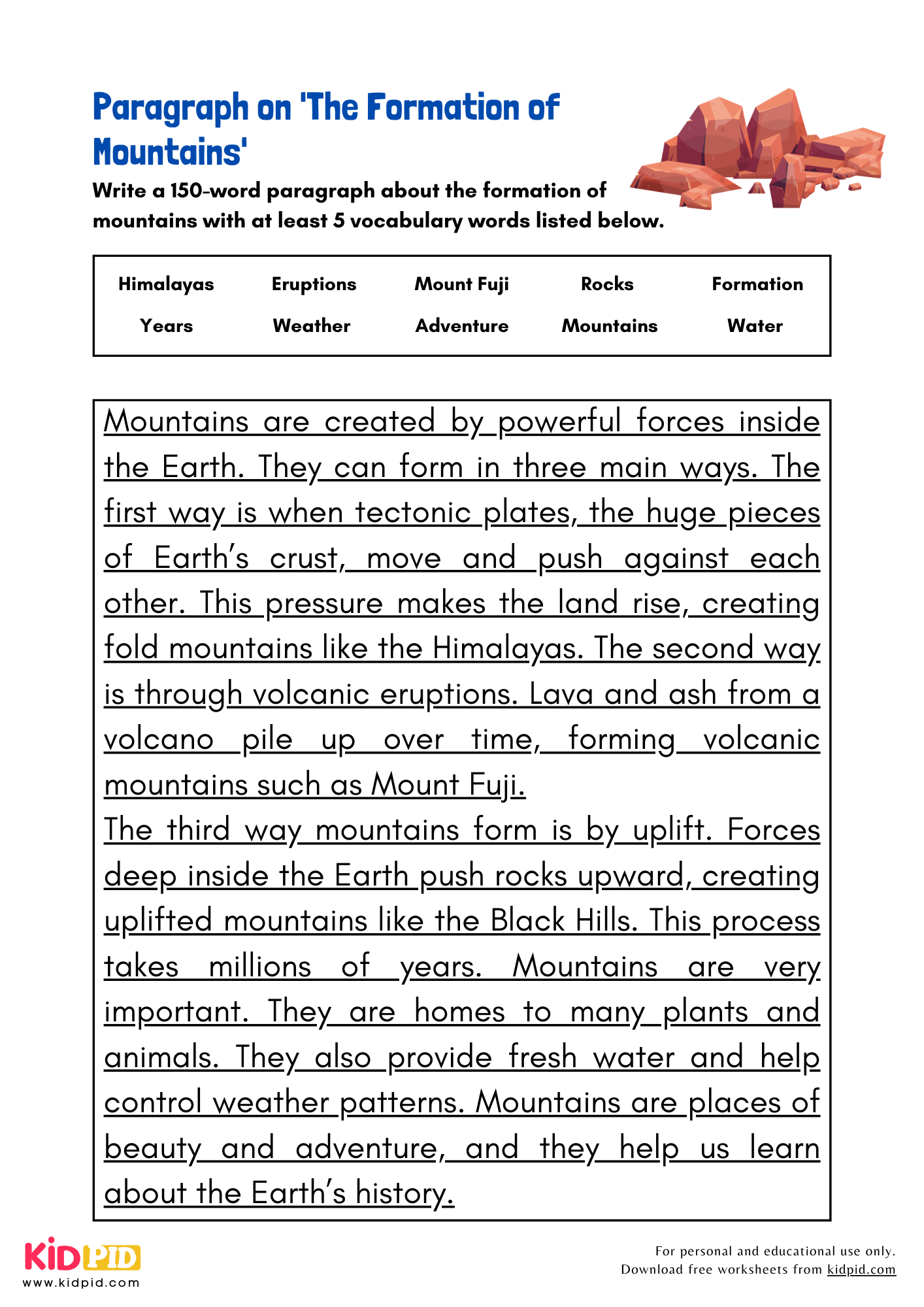
Mountains are created by powerful forces inside the Earth. They can form in three main ways. The first way is when tectonic plates, the huge pieces of Earth’s crust, move and push against each other. This pressure makes the land rise, creating fold mountains like the Himalayas. The second way is through volcanic eruptions. Lava and ash from a volcano pile up over time, forming volcanic mountains such as Mount Fuji.
The third way mountains form is by uplift. Forces deep inside the Earth push rocks upward, creating uplifted mountains like the Black Hills. This process takes millions of years. Mountains are very important. They are homes to many plants and animals. They also provide fresh water and help control weather patterns. Mountains are places of beauty and adventure, and they help us learn about the Earth’s history.
Paragraph on ‘The Formation of Mountains’ in 200 Words
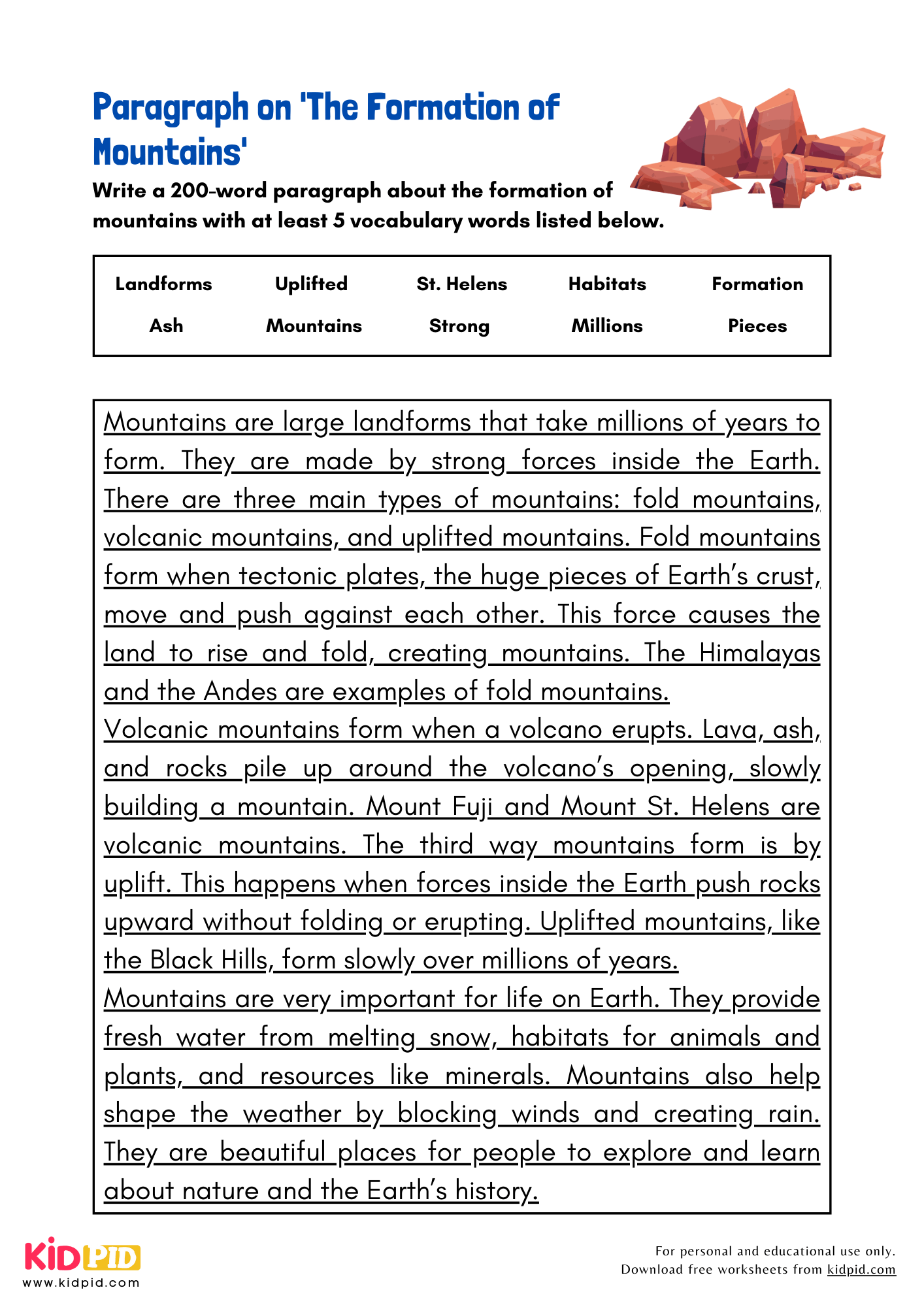
Mountains are large landforms that take millions of years to form. They are made by strong forces inside the Earth. There are three main types of mountains: fold mountains, volcanic mountains, and uplifted mountains. Fold mountains form when tectonic plates, the huge pieces of Earth’s crust, move and push against each other. This force causes the land to rise and fold, creating mountains. The Himalayas and the Andes are examples of fold mountains.
Volcanic mountains form when a volcano erupts. Lava, ash, and rocks pile up around the volcano’s opening, slowly building a mountain. Mount Fuji and Mount St. Helens are volcanic mountains. The third-way mountains form is by uplift. This happens when forces inside the Earth push rocks upward without folding or erupting. Uplifted mountains, like the Black Hills, form slowly over millions of years.
Mountains are very important for life on Earth. They provide fresh water from melting snow, habitats for animals and plants, and resources like minerals. Mountains also help shape the weather by blocking winds and creating rain. They are beautiful places for people to explore and learn about nature and the Earth’s history.
Paragraph on ‘The Formation of Mountains’ in 300 Words
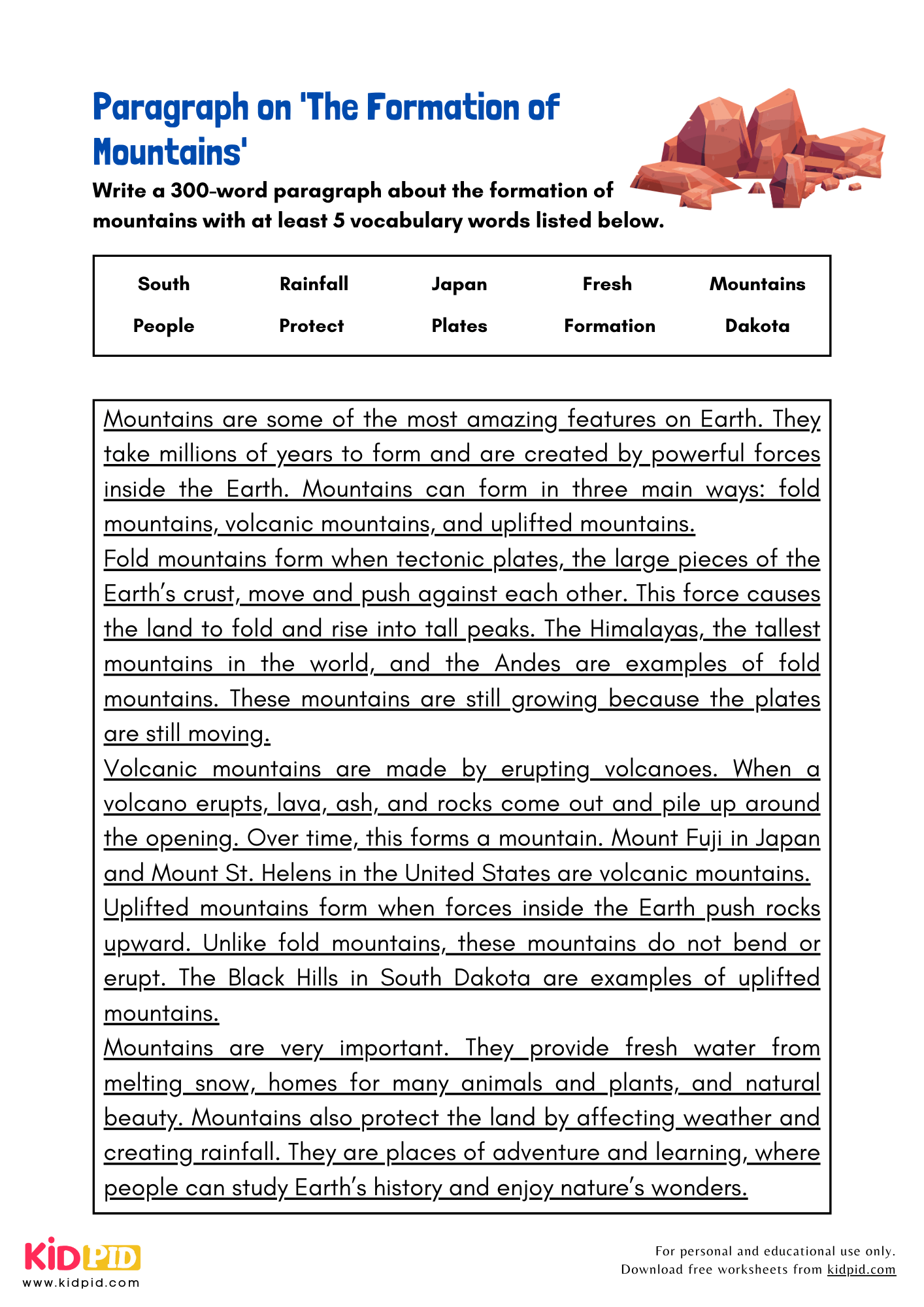
Mountains are some of the most amazing features on Earth. They take millions of years to form and are created by powerful forces inside the Earth. Mountains can form in three main ways: fold mountains, volcanic mountains, and uplifted mountains.
Fold mountains form when tectonic plates, the large pieces of the Earth’s crust, move and push against each other. This force causes the land to fold and rise into tall peaks. The Himalayas, the tallest mountains in the world, and the Andes are examples of fold mountains. These mountains are still growing because the plates are still moving.
Volcanic mountains are made by erupting volcanoes. When a volcano erupts, lava, ash, and rocks come out and pile up around the opening. Over time, this forms a mountain. Mount Fuji in Japan and Mount St. Helens in the United States are volcanic mountains.
Uplifted mountains form when forces inside the Earth push rocks upward. Unlike fold mountains, these mountains do not bend or erupt. The Black Hills in South Dakota are examples of uplifted mountains.
Mountains are very important. They provide fresh water from melting snow, homes for many animals and plants, and natural beauty. Mountains also protect the land by affecting weather and creating rainfall. They are places of adventure and learning, where people can study Earth’s history and enjoy nature’s wonders.
MCQ’s on ‘The Formation of Mountains’
1. How are mountains primarily formed?
A) By erosion
B) By wind
C) By powerful forces inside the Earth
D) By human activity
2. What are the three main types of mountains?
A) Fold, volcanic, and uplifted
B) Tall, short, and medium
C) Rocky, sandy, and grassy
D) Flat, hilly, and steep
3. What causes fold mountains to form?
A) Erosion by water
B) Tectonic plates pushing against each other
C) Volcanic eruptions
D) Weathering
4. Which mountain is an example of a volcanic mountain?
A) The Himalayas
B) The Andes
C) Mount Fuji
D) The Black Hills
5. What are uplifted mountains formed from?
A) Erosion
B) Forces pushing rocks upward
C) Volcanic activity
D) Sediments settling
6. Which mountain range is an example of fold mountains?
A) The Rockies
B) The Himalayas
C) The Appalachian Mountains
D) The Sierra Nevada
7. How do mountains affect weather?
A) They do not affect the weather
B) They create rain and block winds
C) They cause earthquakes
D) They change the temperature of the ocean
8. Why are mountains important for ecosystems?
A) They are too high for life
B) They provide habitats and freshwater
C) They are only good for mining
D) They have no natural resources
9. What is an example of an uplifted mountain?
A) Mount St. Helens
B) Mount Fuji
C) The Black Hills
D) The Andes
10. Why do mountains provide opportunities for adventure?
A) They are mostly flat
B) They are isolated from nature
C) They offer diverse landscapes for exploration
D) They have no access to visitors

We hope you enjoyed the paragraphs on the topic “The Formation of Mountains” written by our team of skilled teachers. Keep visiting our website and explore more paragraphs, essays, worksheets, flashcards, Quizzes, and many other interactive resources. Don’t forget to follow us on YouTube & Facebook.
You may like these:
Write a Paragraph on ‘The Rock Cycle’

The rock cycle constantly changes rocks. Heat, pressure, and weathering transform rocks into igneous, sedimentary, or metamorphic types, shaping Earth’s surface over time.
Short Paragraph on ‘Types of Rocks and Minerals’

Rocks are igneous, sedimentary, or metamorphic. Igneous form from lava, sedimentary from layers, and metamorphic from heat and pressure. Minerals are natural substances in rocks.
Write a Paragraph on ‘What are the Causes Volcanoes to Erupt?’
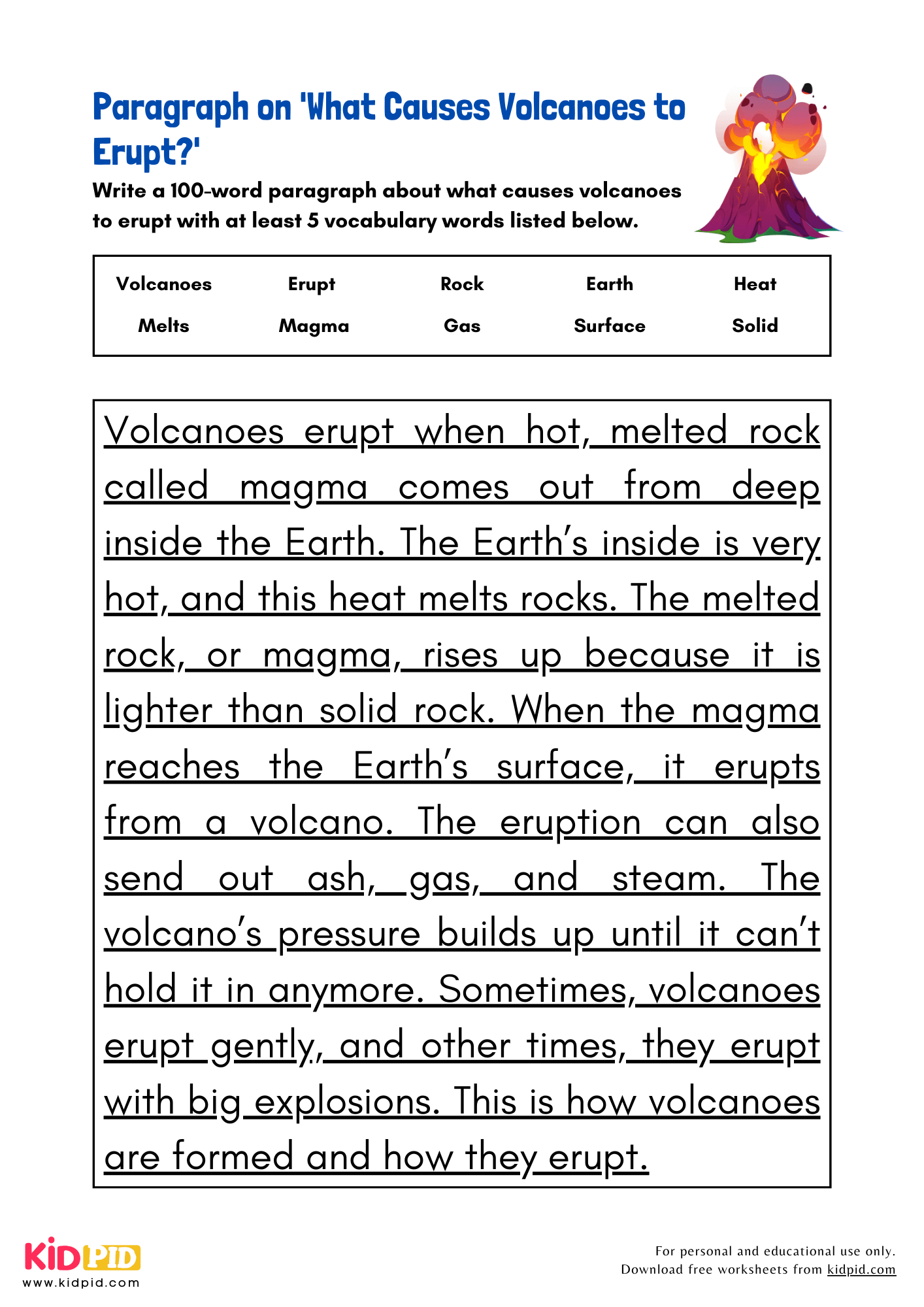
Volcanoes erupt when magma, gases, and pressure build up inside Earth. When the pressure becomes too high, magma escapes through openings, forming lava, ash, and smoke.
Paragraph- ‘The Formation of Caves’

Caves form when water dissolves rock over time. Rainwater, mixed with carbon dioxide, creates acid that slowly erodes limestone, creating underground passages and caverns.
Short Paragraph on ‘The Formation of Galaxies’

Galaxies form when gravity pulls stars, gas, and dust together. Over billions of years, these cosmic materials cluster into different shapes, creating vast star systems.


