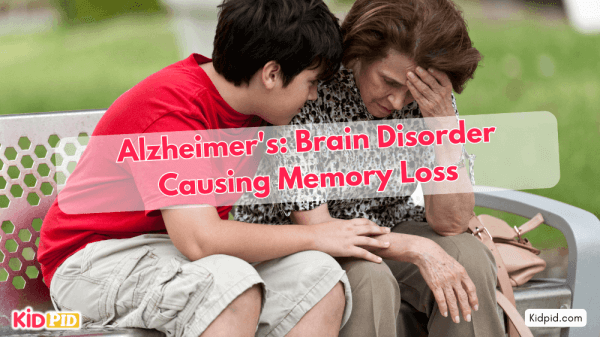
Alzheimer’s disease is a sickness that affects the brain. It makes it hard for people to remember things and think clearly. The disease slowly changes the way people act and remember things. Alzheimer’s mostly happens in older people, but it can start earlier too.
It happens when parts of the brain stop working properly. There is no cure for Alzheimer’s, but doctors are working on ways to help people with it.
- Alzheimer’s disease affects the brain and causes memory problems.
- It happens mostly in older people and makes it hard to think clearly.
- There is no cure yet, but doctors are trying to help people with it.
Contents
- What Is Alzheimer’s Disease? A Neurodegenerative Condition.
- Related MCQ’S
- 1. What is Alzheimer’s disease?
- 2. At what age does Alzheimer’s disease usually start affecting people?
- 3. What are some symptoms of Alzheimer’s disease?
- 4. Who discovered Alzheimer’s disease?
- 5. What causes the brain to break down in Alzheimer’s disease?
- 6. What can help delay the start of Alzheimer’s disease?
- 7. What should you do if someone you know is suffering from Alzheimer’s disease?
- 8. How many Americans are currently living with Alzheimer’s?
- You may like these:
What Is Alzheimer’s Disease? A Neurodegenerative Condition.

Related MCQ’S
1. What is Alzheimer’s disease?
a) A disease that causes forgetfulness
b) A disease that causes sudden headaches
c) A disease that causes fever
d) A disease that causes stomach problems
Answer: a) A disease that causes forgetfulness
Explanation: Alzheimer’s is a condition that causes severe memory loss and difficulty with thinking and carrying out simple tasks.
2. At what age does Alzheimer’s disease usually start affecting people?
a) After the age of 30
b) After the age of 50
c) After the age of 60
d) At any age
Answer: c) After the age of 60
Explanation: Alzheimer’s disease commonly affects people after the age of 60.
3. What are some symptoms of Alzheimer’s disease?
a) Loss of memory and the ability to complete tasks
b) Sudden weight gain
c) Frequent headaches
d) Increased energy levels
Answer: a) Loss of memory and the ability to complete tasks
Explanation: People with Alzheimer’s may forget names, lose memory, and have trouble completing simple tasks like tying shoelaces.
4. Who discovered Alzheimer’s disease?
a) Dr. Sigmund Freud
b) Dr. Aloys Alzheimer
c) Dr. John Hopkins
d) Dr. Edward Jenner
Answer: b) Dr. Aloys Alzheimer
Explanation: Dr. Aloys Alzheimer, a German psychiatrist, discovered the condition after studying the brain of a patient with unusual mental illness.
5. What causes the brain to break down in Alzheimer’s disease?
a) Misfolded proteins and neurofibrillary tangles
b) Lack of sleep
c) Lack of exercise
d) High sugar intake
Answer: a) Misfolded proteins and neurofibrillary tangles
Explanation: Misfolded proteins (plagues) and bundles of fibers (neurofibrillary tangles) block brain signals and communication, causing the brain to break down.
6. What can help delay the start of Alzheimer’s disease?
a) Eating unhealthy food
b) Playing video games
c) Exercising, eating healthy, and keeping the mind active
d) Sleeping a lot
Answer: c) Exercising, eating healthy, and keeping the mind active
Explanation: Scientists believe that exercise, healthy eating, meditation, and mental activities like puzzles may help delay the start of Alzheimer’s disease.
7. What should you do if someone you know is suffering from Alzheimer’s disease?
a) Ignore them
b) Be kind, patient, and show more love
c) Shout at them
d) Let them handle everything on their own
Answer: b) Be kind, patient, and show more love
Explanation: It’s important to be kind, patient, and loving to those with Alzheimer’s as their behavior is not intentional.
8. How many Americans are currently living with Alzheimer’s?
a) 1 million
b) 3 million
c) 6 million
d) 10 million
Answer: c) 6 million
Explanation: More than 6 million Americans are living with Alzheimer’s, and this number is expected to rise to nearly 13 million by 2050.
You may like these:
Learning from smallpox: How to eradicate a disease
Smallpox was eradicated through global vaccination campaigns. Lessons from its success guide efforts to eliminate other diseases, demonstrating the power of collaboration and medical science.
How Computer Memory Works?
Computer memory stores data temporarily or permanently. RAM holds data temporarily for quick access, while hard drives store information long-term, enabling programs to run efficiently.
What does my brain do?
Your brain controls thoughts, emotions, and actions. It processes information, helps you learn, and regulates bodily functions like breathing and heartbeat, ensuring your survival and well-being.
Aphasia: The disorder that makes you lose your words
Aphasia is a language disorder affecting speech and comprehension. It occurs after brain damage, making it difficult to speak, understand, read, or write effectively.