Learning odd and even numbers is one of the first important math skills for children. Understanding the difference between even numbers and odd numbers helps kids build a strong foundation in early mathematics, number recognition, counting skills, and basic arithmetic. An even number can be divided into two equal groups without any leftovers, while an odd number always leaves one extra item.
This fun and educational rhyme makes it easy for preschoolers, kindergarten students, and elementary learners to identify odd and even numbers. Through simple examples, catchy patterns, and memorable verses, children can quickly learn how to recognize numbers based on their last digit and improve their math confidence.
Contents
- About Even and Odd Numbers with Fun Rhymes for Kids
- Odd and Even Numbers
- Why Learning Odd and Even Numbers Is Important
- FAQs
- Q1. What are odd and even numbers?
- Q2. How can kids identify an even number?
- Q3. How can kids identify an odd number?
- Q4. Is 0 an odd or even number?
- Q5. Why is learning odd and even numbers important?
- Q6. What are the first 10 even numbers?
- Q7. What are the first 10 odd numbers?
- Q8. Can a number be both odd and even?
- Q9. Is 100 an odd or even number?
About Even and Odd Numbers with Fun Rhymes for Kids

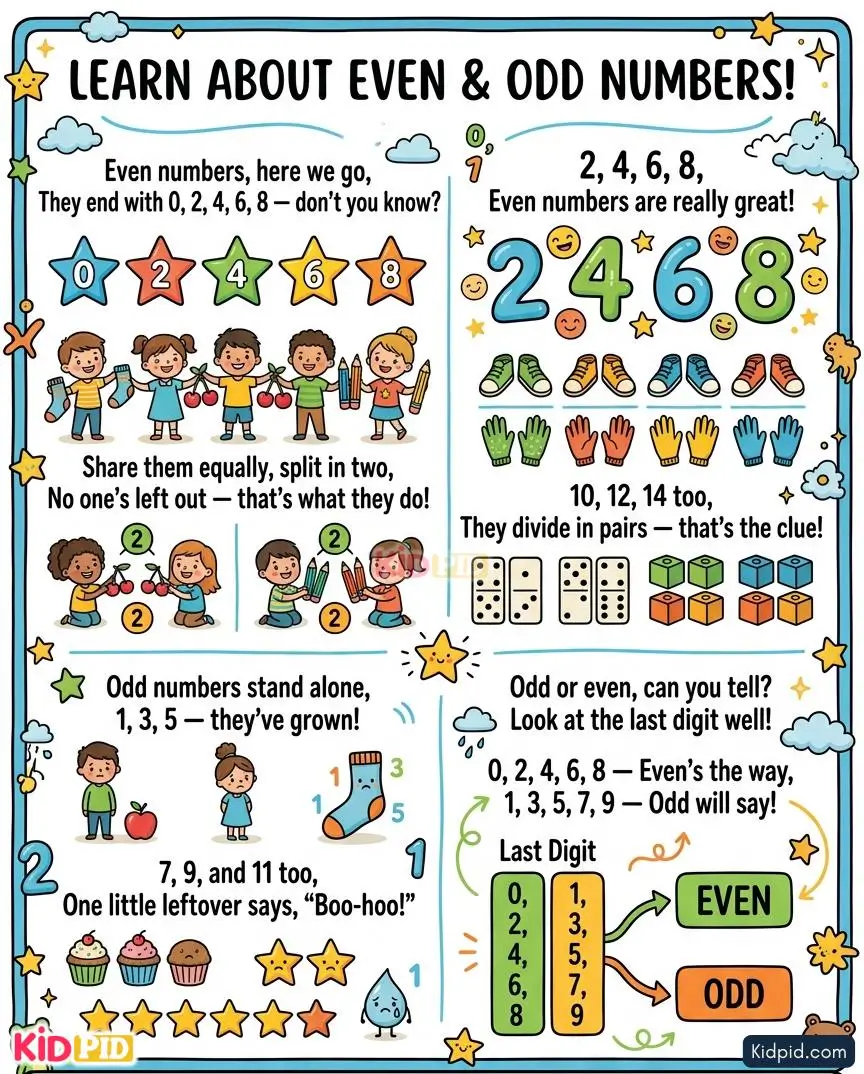
This engaging even and odd numbers rhyme poster helps children identify number patterns, understand pairing concepts, and remember key math rules through fun rhymes, colorful illustrations, and easy-to-follow examples.
This bright and cheerful learning poster introduces children to even and odd numbers using catchy rhymes and colorful visuals. Kids learn that even numbers can be divided into equal pairs, while odd numbers leave one item unpaired. The illustrations make abstract math concepts easier to understand and remember for early learners.
Odd and Even Numbers
- Even Numbers can be divided equally by 2 with no remainder.
- Examples: 2, 4, 6, 8, 10, 12, 14, 16, 18, 20
- Odd Numbers cannot be divided equally by 2 and always leave 1 remainder.
- Examples: 1, 3, 5, 7, 9, 11, 13, 15, 17, 19
- Real-Life Examples
- Even: 2 shoes, 4 car wheels, 10 fingers, 12 eggs
- Odd: 1 nose, 3 traffic lights, 5 fingers, 7 days in a week
- Quick Tip:
- Numbers ending in 0, 2, 4, 6, 8 are even.
- Numbers ending in 1, 3, 5, 7, 9 are Odd.
Examples: 24 → Even, 37 → Odd, 102 → Even, 155 → Odd.
Why Learning Odd and Even Numbers Is Important
Understanding odd and even numbers helps children:
- Improve counting skills.
- Learn multiplication and division more easily.
- Develop logical thinking.
- Prepare for advanced math concepts.
- Build confidence in classroom activities and math games.
FAQs
Q1. What are odd and even numbers?
Answer: Odd and even numbers are types of whole numbers. Even numbers can be divided equally by 2 without a remainder, while odd numbers leave a remainder of 1 when divided by 2.
Q2. How can kids identify an even number?
Answer: A number is even if it ends in 0, 2, 4, 6, or 8. For example, 12, 24, 36, and 48 are even numbers.
Q3. How can kids identify an odd number?
Answer: A number is odd if it ends in 1, 3, 5, 7, or 9. For example, 11, 23, 35, and 47 are odd numbers.
Q4. Is 0 an odd or even number?
Answer: Zero is an even number because it can be divided by 2 exactly without any remainder.
Q5. Why is learning odd and even numbers important?
Answer: Learning odd and even numbers helps children develop strong math skills, recognize number patterns, improve counting abilities, and prepare for multiplication and division.
Q6. What are the first 10 even numbers?
Answer: The first 10 even numbers are 2, 4, 6, 8, 10, 12, 14, 16, 18, and 20.
Q7. What are the first 10 odd numbers?
Answer: The first 10 odd numbers are 1, 3, 5, 7, 9, 11, 13, 15, 17, and 19.
Q8. Can a number be both odd and even?
Answer: No. A number can only be either odd or even, never both at the same time.
Q9. Is 100 an odd or even number?
Answer: 100 is an even number because it ends in 0 and is divisible by 2.
Odd and even numbers are essential building blocks in mathematics. By learning that even numbers end in 0, 2, 4, 6, or 8 and odd numbers end in 1, 3, 5, 7, or 9, children can quickly identify number patterns and improve their math skills. This fun rhyme, along with practical examples and activities, makes learning enjoyable and memorable. Keep practicing odd and even numbers every day, and soon recognizing them will become as easy as counting from one to ten! Keep learning and having fun with our latest rhymes, paragraphs, essays, worksheets, flashcards, quizzes, and more on our website. Don’t forget to follow us on YouTube & Facebook for exciting daily videos and educational activities tailored for kids.