Learning the states of matter is easy and fun with rhymes! These engaging states of matter rhymes for kids help children understand solids, liquids, and gases through simple words and catchy rhythms. Perfect for early learners, these science rhymes make basic chemistry concepts exciting, memorable, and enjoyable while supporting classroom and home learning.
Contents
- States of Matter for Kids: Learn About Solids, Liquids, and Gases Through a Fun Science Poem
- States of Matter Rhymes for Kids – Learn Solids, Liquids, and Gases
- What Are the Three States of Matter?
- How Matter Changes State
- Educational Benefits of Learning States of Matter
- Fun Facts About Matter
- FAQs
- Q1. What are the three states of matter?
- Q2. What is matter?
- Q3. What are examples of solids, liquids, and gases?
- Q4. How does a solid change into a liquid?
- Q5. How does a liquid change into a gas?
- Q6. Why is learning about states of matter important?
- Q7. Is this poem suitable for elementary students?
- Q8. Can matter change from one state to another?
- Q9. What is the easiest way for kids to learn the states of matter?
States of Matter for Kids: Learn About Solids, Liquids, and Gases Through a Fun Science Poem
Understanding the states of matter is one of the first and most important concepts in elementary science education. Everything around us is made of matter, and matter exists in three main forms: solid, liquid, and gas. Learning about these states helps children understand how objects behave, change, and interact in the world around them.
This fun and educational states of matter poem for kids introduces young learners to the basic properties of solids, liquids, and gases using simple rhymes and relatable examples. Through engaging verses, children can easily remember how matter changes from one state to another through processes such as melting, freezing, and evaporation. Whether used in the classroom, homeschooling lessons, or science activities, this poem makes learning physical science enjoyable and memorable.
States of Matter Rhymes for Kids – Learn Solids, Liquids, and Gases
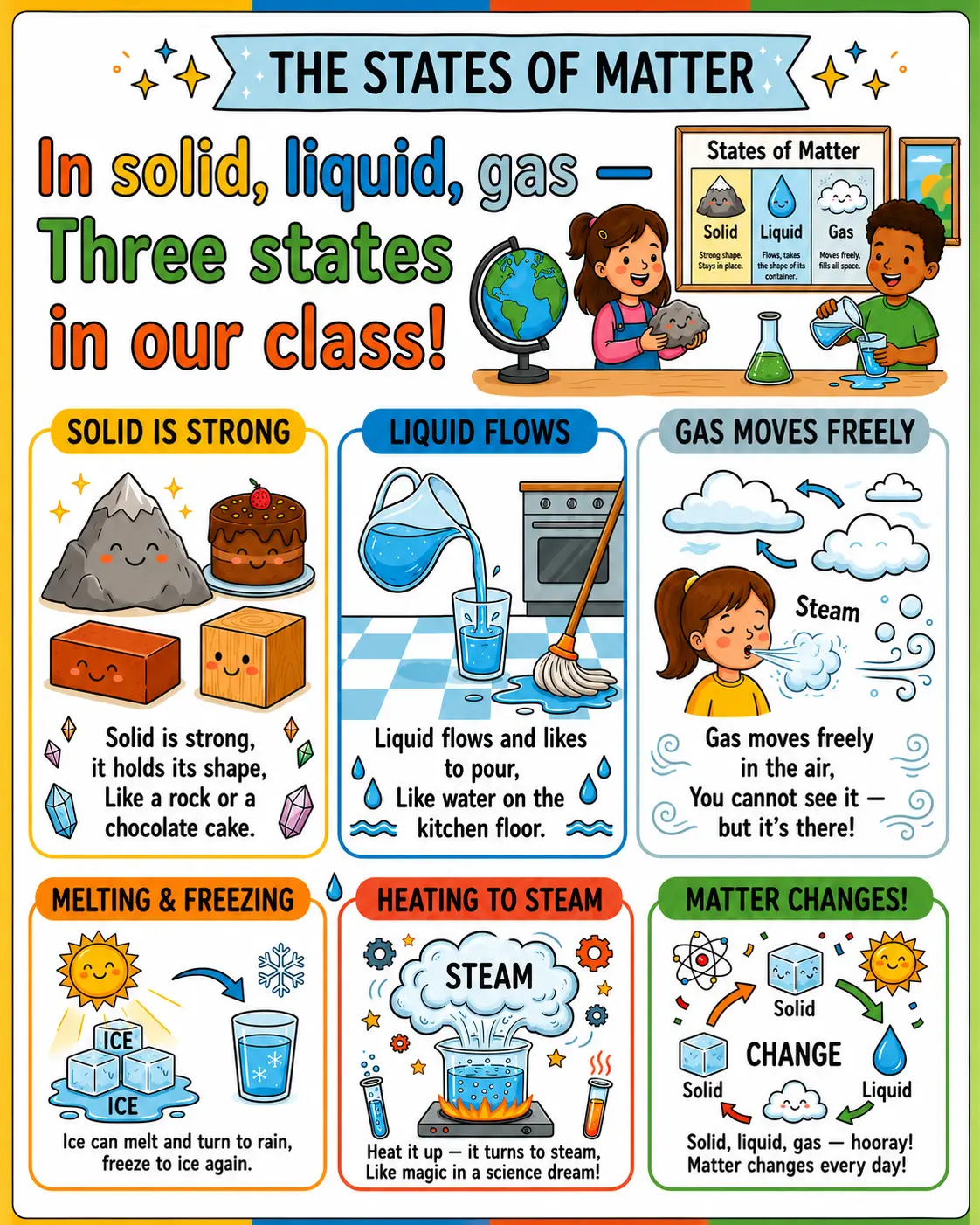
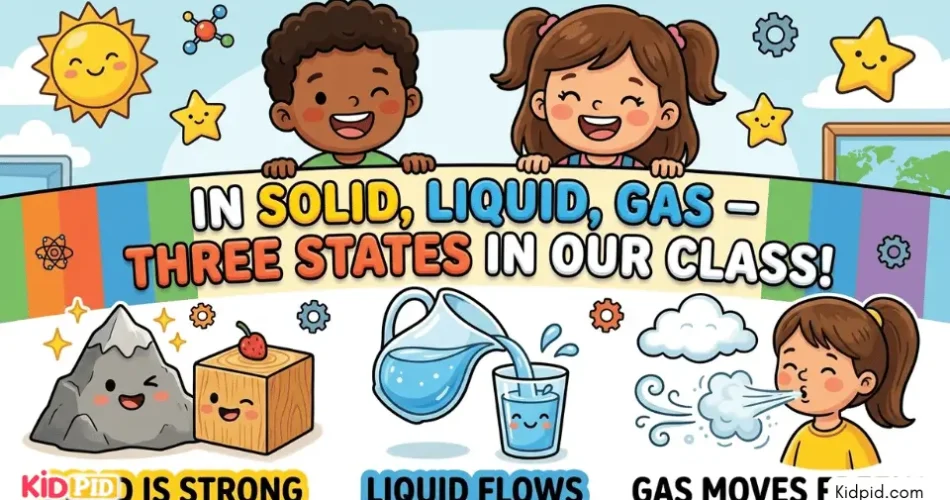
This interactive States of Matter rhyme introduces solids, liquids, and gases while making basic science concepts fun, visual, and easy for children to understand.
Introduce young learners to the fascinating world of science with this colorful States of Matter rhyme poster. Children discover how solids keep their shape, liquids flow, and gases move freely through simple explanations and cheerful illustrations. The rhyme also explains melting, freezing, and evaporation, helping kids understand how matter changes from one state to another.
What Are the Three States of Matter?
Matter is anything that has mass and takes up space. Scientists classify matter into three common states:
- Solid: A solid has a definite shape and volume. The particles in a solid are packed closely together, making it strong and stable. Examples include rocks, books, ice cubes, and tables.
- Liquid: A liquid has a definite volume, but changes shape depending on its container. Water, milk, juice, and oil are common examples of liquids.
- Gas: A gas does not have a fixed shape or volume. Gas particles move freely and spread out in the air. Examples include oxygen, water vapor, and helium.
How Matter Changes State
Matter can change from one state to another when heat is added or removed:
- Melting: Solid changes into liquid.
- Freezing: Liquid changes into solid.
- Evaporation: Liquid changes into gas.
- Condensation: Gas changes into liquid.
Educational Benefits of Learning States of Matter
Learning about solids, liquids, and gases helps children:
- Develop basic science knowledge.
- Understand physical changes in matter.
- Improve observation and critical-thinking skills.
- Connect classroom science lessons to real-life experiences.
- Build a foundation for advanced chemistry and physics topics.
Fun Facts About Matter
- Water is one of the few substances that naturally exists as a solid, liquid, and gas on Earth.
- Clouds are made of tiny water droplets and ice crystals.
- Air is a mixture of different gases.
- Ice takes up more space than liquid water, which is why ice floats.
FAQs
Q1. What are the three states of matter?
Answer: The three main states of matter are solid, liquid, and gas. Solids keep their shape, liquids flow and take the shape of their container, and gases spread freely in the air.
Q2. What is matter?
Answer: Matter is anything that has mass and takes up space. Everything around us, including water, air, plants, animals, and objects, is made of matter.
Q3. What are examples of solids, liquids, and gases?
Answer: Solids: Rock, ice, pencil, table
- Liquids: Water, milk, juice, oil
- Gases: Oxygen, carbon dioxide, water vapor
Q4. How does a solid change into a liquid?
Answer: A solid changes into a liquid through a process called melting. For example, ice melts into water when it is heated.
Q5. How does a liquid change into a gas?
Answer: A liquid changes into a gas through evaporation. When water is heated, it turns into water vapor or steam.
Q6. Why is learning about states of matter important?
Answer: Learning about the states of matter helps children understand scientific concepts, observe changes in nature, and build a strong foundation for future science studies.
Q7. Is this poem suitable for elementary students?
Answer: Yes. This science poem is written specifically for young learners and elementary students. The simple language, rhymes, and examples make it easy to understand and remember.
Q8. Can matter change from one state to another?
Answer: Yes. Matter can change states when heat is added or removed. Common changes include melting, freezing, evaporation, and condensation.
Q9. What is the easiest way for kids to learn the states of matter?
Answer: Poems, songs, hands-on experiments, and visual examples are some of the best ways for children to learn about solids, liquids, and gases while having fun.
This poem makes learning about solids, liquids, and gases enjoyable and easy. Through rhymes and examples, children build scientific understanding, strengthen memory, and develop curiosity about matter and its changes. Visit our website regularly for new rhymes, paragraphs, essays, worksheets, flashcards, quizzes, and a variety of engaging educational content. Stay connected with us on YouTube & Facebook for daily learning videos and interactive activities designed especially for children.