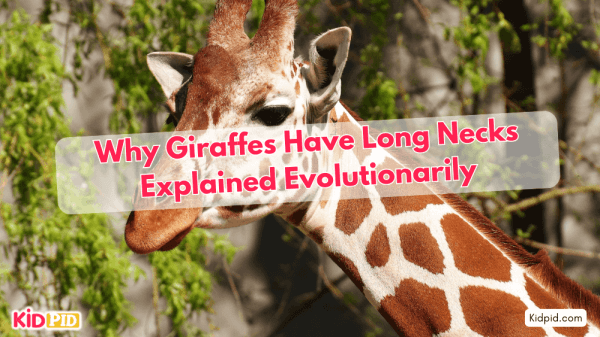
Have you ever wondered why giraffes have such long necks? Let’s explore a fascinating idea from history called the Theory of Evolution to understand this better. This theory helps explain how animals, including giraffes, change over time.
- Long Necks and Food: Giraffes’ ancestors had shorter necks, but they stretched them to reach leaves high in trees. Over time, their necks grew longer.
- Lamarck’s Idea: A scientist named Jean-Baptiste Lamarck believed animals could pass changes like longer necks to their babies.
- Use and Disuse: He said the more an animal uses a body part, the stronger it gets. If they don’t use it, it becomes weak.
- Environmental Changes: Lamarck also thought animals change to adapt to their surroundings, like dogs developing webbed feet to swim.
- Modern Science: Today, we know some of Lamarck’s ideas were incorrect, but they were important in understanding evolution.
Contents
- The Evolutionary Reason Behind Giraffes’ Long Necks Explained
- Related MCQ’S
- 1. Who proposed the first full-blown theory of evolution?
- 2. What is an example Lamarck used to explain “change through use and disuse”?
- 3. What did Lamarck believe about acquired characteristics?
- 4. According to Lamarck, what role does the environment play in evolution?
- 5. Why was Lamarck’s theory eventually replaced?
- 6. What was Lamarck’s book “Philosophie Zoologique” about?
- You may like these:
The Evolutionary Reason Behind Giraffes’ Long Necks Explained

Related MCQ’S
1. Who proposed the first full-blown theory of evolution?
a) Charles Darwin
b) Jean-Baptiste Lamarck
c) Isaac Newton
d) Gregor Mendel
Answer: b) Jean-Baptiste Lamarck
Explanation: Lamarck proposed the first complete theory of evolution, explaining how organisms change over generations.
2. What is an example Lamarck used to explain “change through use and disuse”?
a) Birds learning to fly
b) Giraffes stretching their necks
c) Fish growing fins
d) Plants growing taller
Answer: b) Giraffes stretching their necks
Explanation: Lamarck suggested that giraffes’ ancestors stretched their necks to eat leaves on taller trees, leading to longer necks over time.
3. What did Lamarck believe about acquired characteristics?
a) They are lost over time.
b) They are inherited by offspring.
c) They are not influenced by the environment.
d) They disappear after one generation.
Answer: b) They are inherited by offspring.
Explanation: Lamarck proposed that traits an organism develops during its life, like a blacksmith’s strong arms, are passed to their children.
4. According to Lamarck, what role does the environment play in evolution?
a) It has no impact on organisms.
b) It directly influences physical changes in organisms.
c) It determines the lifespan of organisms.
d) It only affects plants, not animals.
Answer: b) It directly influences physical changes in organisms.
Explanation: Lamarck believed that environmental changes could cause modifications in organisms, like dogs developing webbed toes to swim.
5. Why was Lamarck’s theory eventually replaced?
a) It was too complex to understand.
b) It had many flaws, such as acquired traits not being inherited.
c) It explained evolution only in plants.
d) It was never accepted by anyone.
Answer: b) It had many flaws, such as acquired traits not being inherited.
Explanation: Scientists later discovered that traits like strong muscles from exercise are not passed to offspring, making Darwin’s theory of natural selection more accurate.
6. What was Lamarck’s book “Philosophie Zoologique” about?
a) Explaining the laws of motion
b) Discussing the organization of living bodies and evolution
c) Proposing the idea of natural selection
d) Describing the study of stars and planets
Answer: b) Discussing the organization of living bodies and evolution
Explanation: Lamarck’s book detailed his theory of evolution and how living organisms adapt and change over time.
You may like these:
Do giraffes get dizzy when they bend over?
Giraffes don’t get dizzy when bending over due to special adaptations in their circulatory system, including unique blood vessels and valves that manage blood flow.
Label the Giraffe Body Parts Worksheet

A worksheet to label key giraffe body parts, such as the head, neck, legs, tail, and hooves, helping students understand giraffe anatomy and physiology.