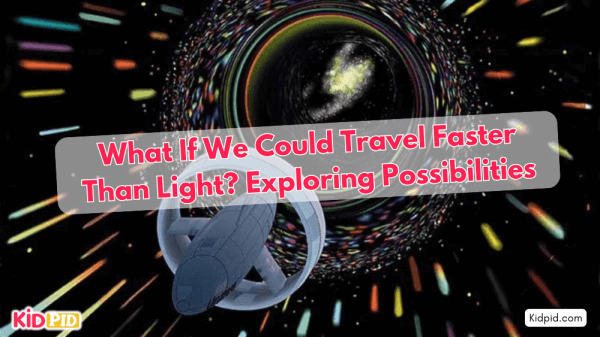
Have you ever wondered what would happen if we could travel faster than light? Even though it’s impossible right now, let’s imagine the fun and amazing things that could happen. Here’s a simple summary of what we know and the exciting possibilities:
- Light is Super Fast: Light travels at 186,187 meters per second, making it the fastest thing in the universe.
- Einstein’s Rule: According to Einstein, nothing with mass can travel faster than light because it would need infinite energy.
- Time Slows Down: If we could travel close to the speed of light, time would slow down for us compared to people on Earth.
- Doppler Effect: Stars would change colors—red behind us and blue ahead—because of the Doppler effect.
- Length Contraction: As we get faster, distances seem shorter, and the universe appears to shrink in the direction we’re going.
- Collisions: Traveling at such high speeds would be dangerous, but we can imagine having a special shield to protect us.
- View at Light Speed: As we approach light speed, our view shrinks to a bright spot in front and darkness behind.
Contents
- What If We Could Travel Faster Than Light? Exploring Possibilities
- Related MCQ’s
- 1. What is light made of?
- 2. What is the speed of light in a vacuum?
- 3. What is length contraction?
- 4. What happens to the universe when you travel near light speed?
- 5. What would happen to time if you traveled close to the speed of light?
- 6. What effect would cause the stars behind you to appear red and the stars ahead of you to look blue?
- You may like these:
What If We Could Travel Faster Than Light? Exploring Possibilities
Related MCQ’s
1. What is light made of?
a) Electrons
b) Photons
c) Protons
d) Neutrons
2. What is the speed of light in a vacuum?
a) 1,000 meters per second
b) 10,000 meters per second
c) 300,000 meters per second
d) 186,187 meters per second
3. What is length contraction?
a) Objects get longer as you approach light speed.
b) Objects appear shorter as you approach light speed.
c) Distance between objects increases
d) Objects disappear as you approach light-speed
4. What happens to the universe when you travel near light speed?
a) The universe stays the same
b) The universe looks smaller in the direction you’re going
c) The universe expands
d) The universe disappears
5. What would happen to time if you traveled close to the speed of light?
a) Time would speed up
b) Time would slow down for you
c) Time would stop
d) Time would stay the same
6. What effect would cause the stars behind you to appear red and the stars ahead of you to look blue?
a) Doppler Effect
b) Light Speed Effect
c) Color Shift
d) Redshift and Blueshift
You may like these:
What’s the Difference Between Speed and Velocity?
Speed measures how fast something moves, while velocity also includes direction. Velocity is a vector quantity, while speed is a scalar quantity.
What is Time Travel? Is it possible?
Time travel refers to moving through time, either forward or backward. While theoretically possible based on physics, practical time travel remains speculative and unachievable with current technology.
Why Do Stars Twinkle At Night?
Stars twinkle because their light passes through Earth’s turbulent atmosphere, causing rapid changes in brightness and color as the light bends at different angles.
What is Big Bang Theory?
The Big Bang Theory explains that the universe began as a singularity about 13.8 billion years ago, expanding rapidly into the vast cosmos we observe today.