
Forests are an essential part of our environment. They provide oxygen, shelter to animals, and balance nature. Forests give us wood, fruits, and medicines. They also control rainfall and prevent soil erosion. Protecting forests is very important for life on Earth, as they are the lungs of our planet.
Contents
10 Pointers About Forest 
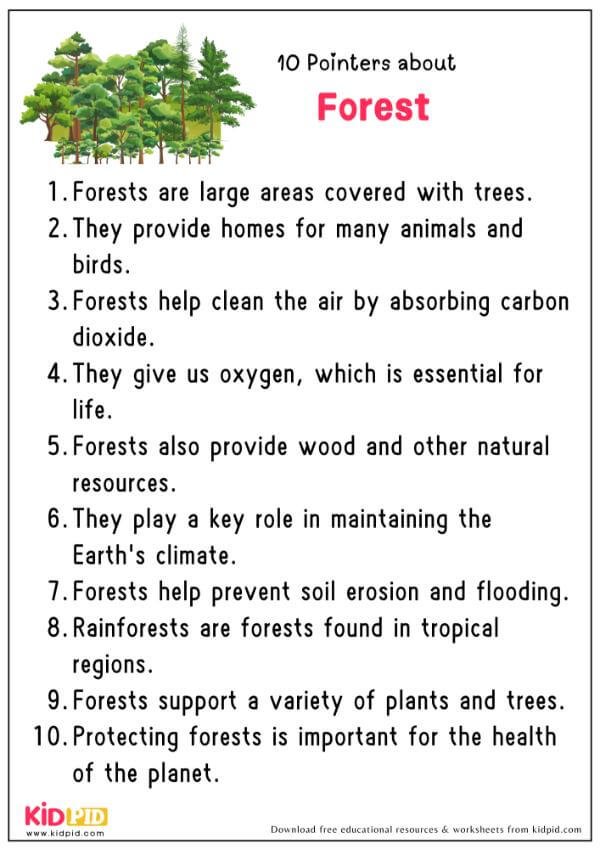
- Forests are large areas covered with trees.
- They provide homes for many animals and birds.
- Forests help clean the air by absorbing carbon dioxide.
- They give us oxygen, which is essential for life.
- Forests also provide wood and other natural resources.
- They play a key role in maintaining the Earth’s climate.
- Forests help prevent soil erosion and flooding.
- Rainforests are forests found in tropical regions.
- Forests support a variety of plants and trees.
- Protecting forests is important for the health of the planet.
Short Essay On Forest
Essay On Forest in 100 Words

Forests are important parts of our planet. They are large areas filled with trees and other plants. Forests give homes to animals, birds, and insects. They help clean the air by taking in carbon dioxide and giving us oxygen. Forests also protect the soil by preventing erosion. They help balance the Earth’s climate by absorbing heat. Forests provide wood, fruits, and other natural resources. Rainforests, which are found in tropical regions, are very rich in plants and animals. We need to protect forests to keep the Earth healthy and safe for future generations.
Essay On Forest in 200 Words
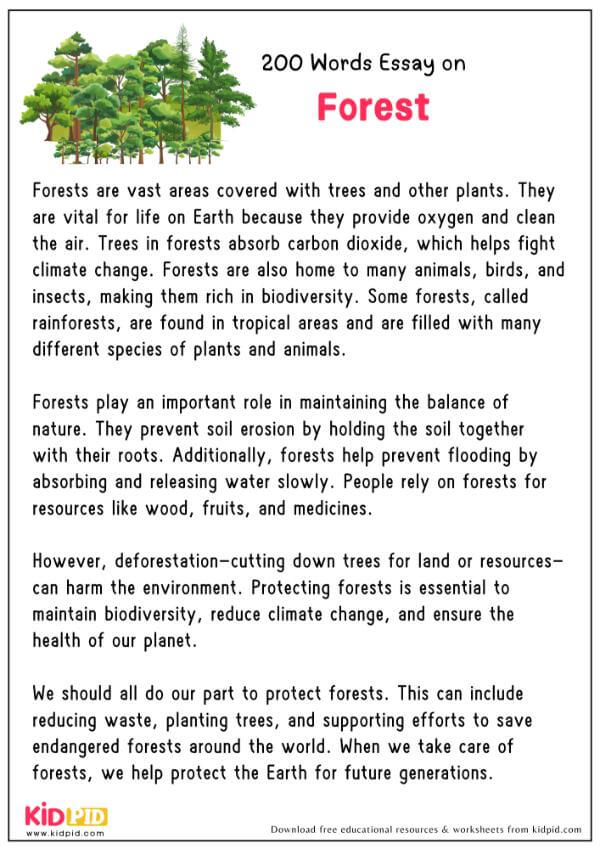
Forests are vast areas covered with trees and other plants. They are vital for life on Earth because they provide oxygen and clean the air. Trees in forests absorb carbon dioxide, which helps fight climate change. Forests are also home to many animals, birds, and insects, making them rich in biodiversity. Some forests, called rainforests, are found in tropical areas and are filled with many different species of plants and animals.
Forests play an important role in maintaining the balance of nature. They prevent soil erosion by holding the soil together with their roots. Additionally, forests help prevent flooding by absorbing and releasing water slowly. People rely on forests for resources like wood, fruits, and medicines. However, deforestation, cutting down trees for land or resources, can harm the environment. Protecting forests is essential to maintain biodiversity, reduce climate change, and ensure the health of our planet.
We should all do our part to protect forests. This can include reducing waste, planting trees, and supporting efforts to save endangered forests around the world. When we take care of forests, we help protect the Earth for future generations.
Essay On Forest in 300 Words
Forests are essential to life on Earth. They are large areas covered with trees, plants, and animals. Forests can be found all over the world, from tropical rainforests near the equator to cold temperate forests in the northern regions. Forests are home to many creatures, such as monkeys, bears, birds, and insects, and provide shelter and food for them. These forests are crucial for maintaining the balance of nature and supporting the web of life.
One of the most important things forests do is provide oxygen. Trees take in carbon dioxide, a gas that can harm the environment, and release oxygen, which we need to breathe. Without forests, the air would not be as clean or healthy. Forests also help control the Earth’s temperature by absorbing heat and providing shade.
Another important role forests play is preventing soil erosion. The roots of trees hold the soil in place, stopping it from washing away when it rains. This is especially important for preventing landslides and protecting crops in nearby areas. Forests also absorb water, preventing floods and keeping rivers and lakes from rising too high.
Forests are valuable resources for humans. They provide wood for building, fruits, medicines, and many other products. However, deforestation, the cutting down of trees, is a serious problem. As more forests are destroyed, the planet’s climate is affected, and many species lose their homes. We must work together to protect and restore forests. Planting trees, reducing waste, and using resources wisely can help save our forests and ensure they continue to benefit all life on Earth.
Long Essay On Forest in 500 Words
Introduction
Forests are vital ecosystems that cover large areas of the Earth. They are made up of trees, plants, and wildlife. Forests are found on every continent and play a critical role in maintaining the health of our planet. They provide many benefits to both the environment and humans. In this essay, we will explore the importance of forests, their role in the environment, the different types of forests, and why it is crucial to protect them.
Importance of Forests
Forests are essential for life on Earth. They help maintain the balance of the environment by providing oxygen, cleaning the air, and supporting a variety of wildlife. Trees in the forest absorb carbon dioxide, a harmful gas, and release oxygen, which is necessary for humans and animals to survive. Forests are often called the “lungs of the Earth” because of this vital function. In addition, forests help control the climate by absorbing heat and keeping temperatures stable.
Role of Forests in the Environment
Forests play an essential role in regulating the Earth’s water cycle. Trees absorb rainwater and release it back into the atmosphere, helping to maintain balanced water levels in rivers and lakes. This process also helps prevent floods by absorbing excess water. The roots of trees also prevent soil erosion, which can occur during heavy rains. Without the strong roots of trees, the soil can wash away, leading to landslides and damage to farmland. Forests also provide homes for a wide variety of animals, birds, and insects, supporting biodiversity.
Different Types of Forests
There are many different types of forests around the world, each with its own unique features. The three main types of forests are tropical rainforests, temperate forests, and boreal forests.
- Tropical Rainforests: These forests are found near the equator and are known for their warm climate and high levels of rainfall. They are home to many plant and animal species and are considered the most biodiverse ecosystems in the world.
- Temperate Forests: Found in regions with four seasons, temperate forests have trees that lose their leaves in the fall. These forests can be found in places like Europe, North America, and parts of Asia.
- Boreal Forests: Also known as taiga, these forests are located in cold regions near the Arctic. They are home to coniferous trees like pine, spruce, and fir, and support animals such as moose, wolves, and bears.
Threats to Forests
Despite their importance, forests are under threat from human activities. Deforestation, which involves clearing large areas of forest for farming, logging, and development, is a major issue. As forests are cut down, the animals and plants that live there lose their homes, and the environment is harmed. Deforestation also contributes to climate change, as trees are crucial in absorbing carbon dioxide. Without forests, the Earth will face many environmental challenges.
Conclusion
Forests are an essential part of our planet’s ecosystem. They provide oxygen, support wildlife, regulate the water cycle, and help maintain the Earth’s climate. However, forests are under threat, and we need to protect them. By reducing waste, planting trees, and supporting efforts to conserve forests, we can help ensure that forests continue to thrive for future generations. The health of our planet depends on it.

FAQs on Forest
Q1. What are forests?
Ans. Forests are large areas covered with trees and other plants. They provide homes for animals and help maintain the balance of nature.
Q2. How do forests help the environment?
Ans. Forests help by providing oxygen, cleaning the air, preventing soil erosion, and regulating the Earth’s temperature and water cycle.
Q3. What is the role of trees in forests?
Ans. Trees absorb carbon dioxide and release oxygen, which helps clean the air and provide the oxygen humans and animals need.
Q4. What are rainforests?
Ans. Rainforests are tropical forests that receive a lot of rainfall and are rich in biodiversity, with many species of plants and animals.
Q5. How do forests prevent flooding?
Ans. Forests help prevent flooding by absorbing and slowly releasing water, which maintains water levels in rivers and lakes.
Q6. What is deforestation?
Ans. Deforestation is the process of cutting down trees and clearing forests for land, farming, or other resources, which can harm the environment.
Q7. Why are forests called “lungs of the Earth”?
Ans. Forests are called “lungs of the Earth” because they absorb carbon dioxide and release oxygen, which is essential for life on Earth.
Q8. What are the three main types of forests?
Ans. The three main types of forests are tropical rainforests, temperate forests, and boreal forests.
Q9. How do forests help with soil erosion?
Ans. The roots of trees in forests hold the soil together, preventing it from washing away during heavy rains.
Q10. What can we do to protect forests?
Ans. We can reduce waste, plant trees, and support efforts to conserve forests to protect them for future generations.
Forests are precious resources that support humans, animals, and nature. Conserving forests ensures a healthy environment and sustainable future. Everyone must take responsibility to protect and preserve forests. Check our website for interactive resources like paragraphs, essays, worksheets, flashcards, Quizzes, and other interactive resources. Keep in touch by following us on YouTube & Facebook.
You might also like
Essay – Madhuri Dixit: The Dancing Diva of Bollywood

An uplifting essay on Madhuri Dixit, the “Dancing Diva” of Bollywood, celebrates her graceful dance moves, iconic films, multiple awards, and enduring charm.
Essay – N. R. Narayana Murthy: The Pioneer Of IT In India

A clear essay on N. R. Narayana Murthy, Infosys founder, highlights his visionary leadership, ethical values, global delivery model, and inspiring contributions to India’s IT industry.
Essay – Homi J. Bhabha: The Father Of Indian Nuclear Science

An inspiring essay on Homi J. Bhabha, India’s nuclear pioneer, highlights his founding of TIFR, building India’s nuclear energy program, and his scientific legacy.
Essay – Aristotle
 An insightful essay on Aristotle, the ancient Greek philosopher who shaped science, ethics, and politics by promoting purpose, balance, and the four causes.
Essay – Valentina Tereshkova

A historic essay on Valentina Tereshkova, the first woman in space, recounts her Vostok 6 mission in 1963 that inspired courage and women’s achievements.