

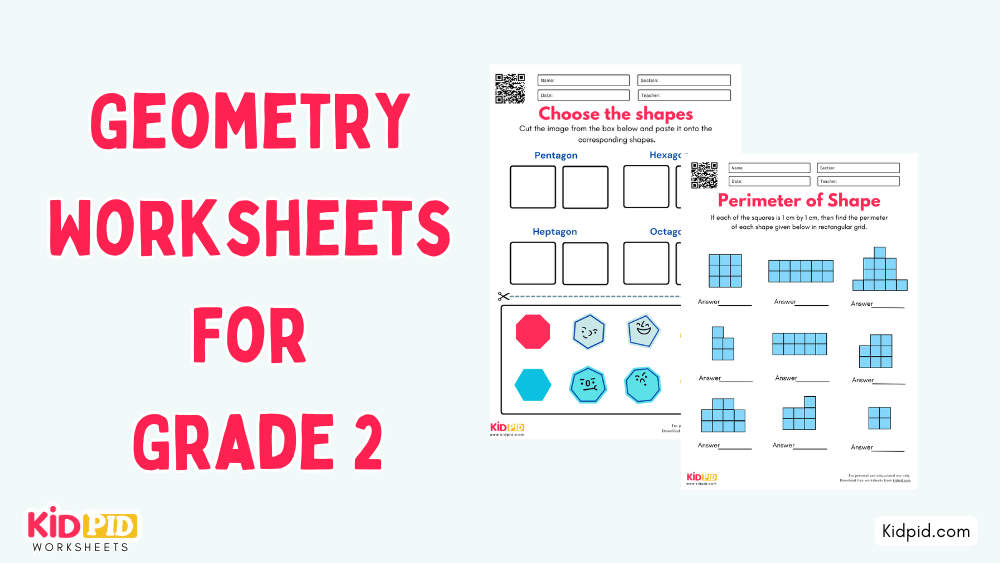
Enhance 2nd-grade math skills with fun geometry worksheets. Includes shape recognition, angles, lines, and patterns to improve spatial reasoning and understanding of basic geometry concepts.
Contents
- Second Grade Geometry Worksheets & Free Printables
- Shapes Sorting Activity Worksheet For Grade 2
- Geometric Shapes Description Worksheet For Grade 2
- 2D Shapes Matching Activity Worksheet For Grade 2
- 3D Geometric Shape Flashcard For Grade 2
- Perimeters of Shapes on Grid Worksheet For Grade 2
- Area of a Rectangle Worksheet For Grade 2
- Creating Squares and Rectangles Worksheet For Grade 2
- 2D Shape Pictures Math Activity Worksheet For Grade 2
- Key Facts About Geometry Worksheets for Grade 2
- Parts/Types/Examples of Geometry Worksheets for Grade 2
- How Do Geometry Worksheets for Grade 2 Work?
- Benefits of Learning About Geometry Worksheets for Grade 2
- Learning Objectives
- Worksheet Instructions
- Interesting Facts About Geometry Worksheets for Grade 2
- Vocabulary Words
- Real-Life Applications
- FAQs
- Q1. What are Geometry Worksheets for Grade 2?
- Q2. Why are geometry worksheets important?
- Q3. What shapes do Grade 2 students learn?
- Q4. How often should children practice geometry?
- Q5. Are geometry worksheets suitable for homeschooling?
- Q6. How do geometry worksheets improve critical thinking?
- Q7. Can geometry be taught through real-life examples?
- Q8. What skills can children gain from geometry worksheets?
- Read More:
Second Grade Geometry Worksheets & Free Printables
Read More: Shapes Crosswords Worksheet For Grade 2
Shapes Sorting Activity Worksheet For Grade 2

This shapes sorting worksheet helps 2nd graders categorize and identify 2D shapes like squares, circles, and triangles, boosting shape recognition and classification skills.
Geometric Shapes Description Worksheet For Grade 2

Help 2nd graders describe and understand geometric shapes with this worksheet. Activities focus on identifying properties of 2D shapes such as triangles, circles, and squares.
2D Shapes Matching Activity Worksheet For Grade 2

Fun 2D shapes matching worksheet for grade 2 students. Perfect for improving shape recognition, students match shapes like circles, squares, and rectangles with their names.
3D Geometric Shape Flashcard For Grade 2

These 3D geometric shape flashcards introduce cubes, spheres, pyramids, and more to grade 2 students, enhancing their understanding of 3D shapes and spatial reasoning.
Perimeters of Shapes on Grid Worksheet For Grade 2

Teach 2nd graders about perimeters with this engaging worksheet. Students calculate the perimeter of various shapes on grids, reinforcing basic geometry concepts and measurement skills.
Area of a Rectangle Worksheet For Grade 2

This worksheet helps grade 2 students learn how to calculate the area of rectangles, strengthening their multiplication, measurement, and geometry skills with hands-on activities.
Creating Squares and Rectangles Worksheet For Grade 2

Engage 2nd graders in creating squares and rectangles. This worksheet improves shape drawing, recognition, and spatial skills while teaching the properties of these geometric shapes.
2D Shape Pictures Math Activity Worksheet For Grade 2

Key Facts About Geometry Worksheets for Grade 2
Geometry worksheets for Grade 2 help young learners understand basic shapes, spatial relationships, symmetry, and geometric attributes. These worksheets are designed to strengthen visual thinking and problem-solving skills through engaging activities and hands-on practice.
Key Highlights:
- Suitable for children aged 7–8 years.
- Covers 2D and introductory 3D shapes.
- Develops spatial awareness and logical reasoning.
- Supports classroom learning and homeschooling.
- Includes activities such as shape identification, sorting, matching, drawing, and symmetry exercises.
- Aligns with elementary math curriculum standards.
Parts/Types/Examples of Geometry Worksheets for Grade 2
Geometry worksheets come in various formats to address different learning objectives.
Common Types
1. Shape Identification Worksheets
Students recognize and name shapes such as circles, squares, rectangles, triangles, pentagons, and hexagons.
2. Shape Properties Worksheets
Children learn about sides, vertices (corners), and edges.
3. Symmetry Worksheets
Students identify lines of symmetry and complete symmetrical figures.
4. 3D Shape Worksheets
Introduces cubes, spheres, cones, cylinders, and rectangular prisms.
5. Shape Sorting Activities
Learners categorize shapes based on their attributes.
Examples
- Count the sides of each shape.
- Circle all triangles in a picture.
- Match 3D objects with real-life items.
- Draw the missing half of a symmetrical image.
How Do Geometry Worksheets for Grade 2 Work?
Geometry worksheets provide structured practice that gradually builds geometric understanding.
Learning Process
- Introduce basic geometric concepts.
- Practice identifying shapes and attributes.
- Complete visual and hands-on exercises.
- Apply geometry concepts to real-world examples.
- Reinforce learning through repetition and review.
These worksheets help students connect abstract geometric ideas with everyday objects and experiences.
Benefits of Learning About Geometry Worksheets for Grade 2
Geometry plays an important role in developing mathematical thinking and visual reasoning.
Benefits Include:
- Improves shape recognition skills.
- Enhances spatial awareness.
- Builds critical thinking and observation skills.
- Strengthens problem-solving abilities.
- Encourages attention to detail.
- Supports future math topics such as measurement and fractions.
- Increases confidence in mathematical learning.
Learning Objectives
By completing geometry worksheets, Grade 2 students can:
- Identify common 2D and 3D shapes.
- Describe shape attributes such as sides and vertices.
- Recognize lines of symmetry.
- Compare and classify shapes.
- Understand spatial relationships.
- Apply geometry concepts to everyday situations.
- Develop visual reasoning and analytical skills.
Worksheet Instructions
To complete the geometry worksheets successfully:
- Read each question carefully.
- Observe the shapes shown in the activity.
- Count sides, corners, or edges when required.
- Use a pencil and ruler for drawing tasks.
- Follow directions for coloring, matching, or sorting activities.
- Double-check answers before moving to the next section.
- Ask for guidance if a concept is unfamiliar.
Interesting Facts About Geometry Worksheets for Grade 2
- Geometry comes from Greek words meaning “earth measurement.”
- Many everyday objects are based on geometric shapes.
- Honeycombs are naturally formed in hexagon patterns.
- Traffic signs use geometric shapes for easy recognition.
- Architects and engineers rely heavily on geometry.
- Snowflakes often display symmetrical patterns.
- Geometry helps create maps, buildings, and digital designs.
Vocabulary Words
Understanding geometry vocabulary helps students master key concepts.
| Word | Meaning |
|---|---|
| Shape | A figure with a specific form |
| Side | A straight edge of a shape |
| Vertex | A corner where two sides meet |
| Symmetry | When two halves match exactly |
| Circle | A round shape with no corners |
| Triangle | A shape with three sides |
| Rectangle | A four-sided shape with opposite sides equal |
| Square | A four-sided shape with equal sides |
| Cube | A 3D shape with six square faces |
| Sphere | A perfectly round 3D shape |
Real-Life Applications
Geometry is everywhere in daily life and helps children understand the world around them.
Examples:
- Recognizing shapes in road signs.
- Identifying geometric patterns in artwork.
- Understanding building and house designs.
- Arranging furniture in a room.
- Reading maps and directions.
- Playing construction and block-building games.
- Designing crafts and creative projects.
These practical connections make geometry meaningful and engaging for young learners.
FAQs
Q1. What are Geometry Worksheets for Grade 2?
Answer: They are educational activities designed to teach second-grade students about shapes, symmetry, spatial relationships, and basic geometric concepts.
Q2. Why are geometry worksheets important?
Answer: They help develop visual reasoning, problem-solving skills, and a strong foundation for future mathematics learning.
Q3. What shapes do Grade 2 students learn?
Answer: Students typically learn circles, squares, rectangles, triangles, pentagons, hexagons, cubes, spheres, cylinders, and cones.
Q4. How often should children practice geometry?
Answer: Practicing geometry two to three times per week can help reinforce concepts and improve retention.
Q5. Are geometry worksheets suitable for homeschooling?
Answer: Yes. They provide structured learning activities that are ideal for both classroom instruction and homeschooling environments.
Q6. How do geometry worksheets improve critical thinking?
Answer: Students analyze shapes, compare attributes, identify patterns, and solve visual problems, all of which strengthen critical-thinking skills.
Q7. Can geometry be taught through real-life examples?
Answer: Absolutely. Everyday objects, buildings, toys, road signs, and nature provide excellent opportunities to explore geometric concepts.
Q8. What skills can children gain from geometry worksheets?
Answer: Children develop shape recognition, spatial awareness, logical reasoning, observation skills, and mathematical confidence.
Enhance math skills with 2D shape picture worksheets for grade 2. Students identify and draw shapes in everyday objects, improving shape recognition and visual math comprehension. We hope you liked these 2nd-grade geometry worksheets! More free worksheets, quizzes, essays, flashcards, paragraphs, and interactive resources can be found on Kidpid. Regular practice with our resources will help improve your skills. Connect with us on Facebook, Pinterest, YouTube & Telegram.
Made by our Content Team, this worksheet helps students understand concepts better.
Reviewed By Sansriti Pandey
Read More:



