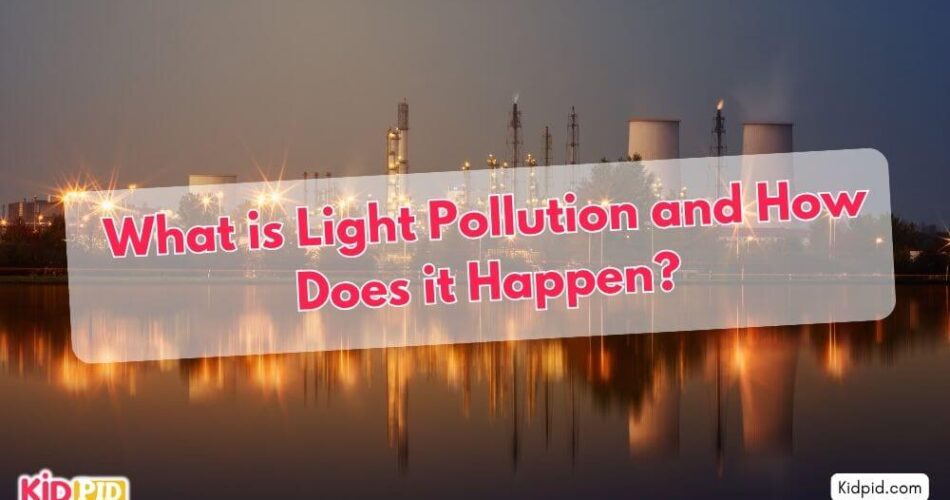
Light pollution is the excessive or misdirected artificial light produced by human activities. It happens when outdoor lights are not properly shielded, allowing light to scatter in unwanted directions, such as up into the sky or across properties, instead of being directed towards the intended areas. This causes a brightening of the night sky, interfering with astronomical observations, disrupting ecosystems, and affecting human health and energy efficiency.

Contents
- MCQs
- Fill in The Blanks
- 1. Light pollution is the excessive and inappropriate use of _____________ at night.
- 2. Light pollution can have negative impacts on the _____________ and human health.
- 3. Light pollution happens when streetlights, billboards, and other sources of light emit too much light into the ____________.
- 4. Light pollution can disrupt the natural cycles of ______________.
- True / False
MCQs
1. Which of the following is a common source of light pollution?
A) Trees
B) Stars
C) Streetlights
D) The Moon
Answer: C) Streetlights
Explanation: Streetlights, along with other outdoor lighting like billboards and decorative lighting, contribute significantly to light pollution by illuminating areas more than necessary.
2. How does light pollution affect animals?
A) It makes them stronger
B) It disrupts their natural behaviors
C) It makes them glow
D) It has no effect on animals
Answer: B) It disrupts their natural behaviors
Explanation: Light pollution can confuse animals that rely on natural light cues for activities like migration, mating, and feeding, leading to harmful consequences.
3. What can you do to reduce light pollution?
A) Turn on more lights
B) Use lower intensity bulbs
C) Paint buildings brighter colors
D) Increase the height of light poles
Answer: B) Use lower intensity bulbs
Explanation: Using lower intensity bulbs and shielding outdoor lights so they don’t shine upward or outward can minimize unnecessary illumination, reducing light pollution.
4. Why is it harder to see stars in a city?
A) Because cities have more trees
B) Because of the high buildings
C) Because of light pollution
D) Because stars move away from cities
Answer: C) Because of light pollution
Explanation: In cities, excessive artificial lighting makes the night sky brighter, which diminishes the visibility of stars, a phenomenon directly related to light pollution.
Fill in The Blanks
Choose from These Words: artificial light,environment,night sky,plants and animals.
1. Light pollution is the excessive and inappropriate use of _____________ at night.
Answer: artificial light
2. Light pollution can have negative impacts on the _____________ and human health.
Answer: environment
3. Light pollution happens when streetlights, billboards, and other sources of light emit too much light into the ____________.
Answer: night sky
4. Light pollution can disrupt the natural cycles of ______________.
Answer: plants and animals
True / False
1. Light pollution only affects humans (True / False)
False: Light pollution can have negative impacts on wildlife, disrupting their natural behaviors and habitats.
2. Light pollution is caused by natural sources of light (True / False)
False: Light pollution is caused by excessive or misdirected artificial light.
3. Light pollution can disrupt the sleep patterns of animals (True / False)
True: Light pollution can interfere with the natural rhythms of wildlife, affecting their sleep and reproduction patterns.
Read More: