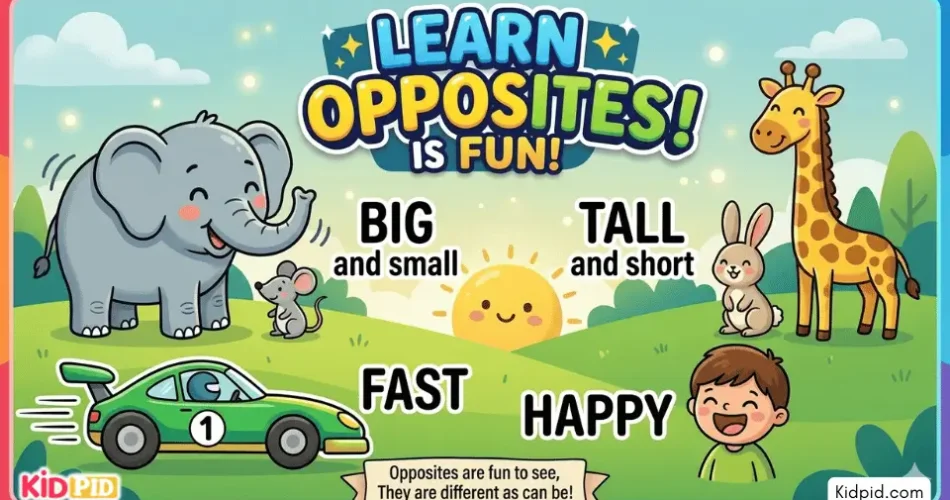
Opposites Rhyme for Kids is a fun and educational rhyme designed to help children learn common opposite words in an easy and memorable way. Through simple rhyming lines and everyday examples, young learners can understand important concepts such as big and small, hot and cold, fast and slow, and day and night. Learning opposites helps children improve their vocabulary, language development, communication skills, reading comprehension, and critical thinking abilities. This rhyme is perfect for preschoolers, kindergarten students, parents, and teachers who want to make early language learning enjoyable and effective.
Contents
What Are Opposite Words?
Opposite words, also known as antonyms, are words that have completely different meanings. They help children understand comparisons and describe people, objects, actions, and feelings more accurately.
Examples of Opposite Words
- Big – Small
- Short – Tall
- Fast – Slow
- Hot – Cold
- Young – Old
- Happy – Sad
- Day – Night
- Open – Close
Understanding opposite words helps children express their ideas more clearly and build stronger language skills.
Opposites Rhyme for Kids
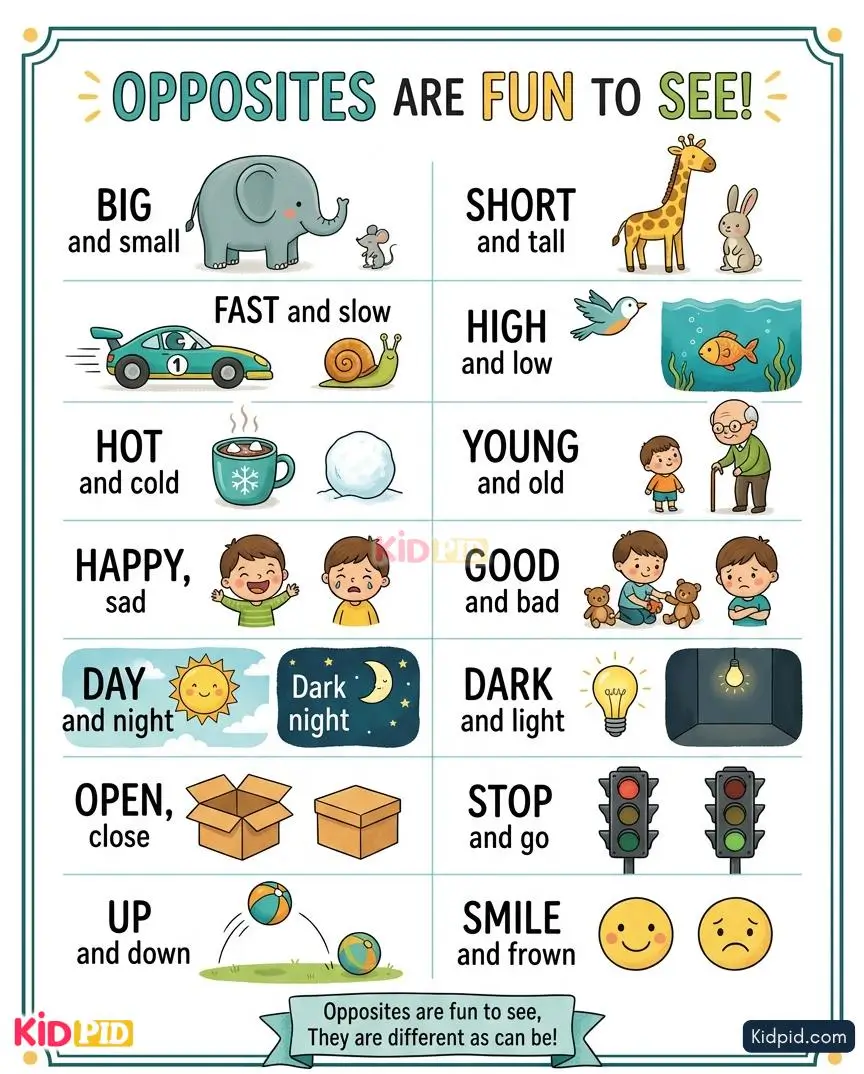
This fun Opposites Rhyme helps children learn opposite words, improve vocabulary, build language skills, and understand basic concepts through engaging visual examples.
The Opposites Rhyme for Kids is a fun and interactive way to introduce children to common opposite words such as big and small, hot and cold, and day and night. The colorful illustrations make learning easy, helping young learners improve vocabulary, observation skills, and early language development. This rhyme encourages children to recognize differences and understand word meanings through simple, memorable examples.
Why is it Important for Kids to Learn Opposites?
Learning opposite words supports early childhood development by helping children understand differences, make comparisons, and improve communication.
Benefits of Learning Opposites
- Builds vocabulary and language skills.
- Improves reading and listening comprehension.
- Enhances observation and comparison abilities.
- Develops critical thinking and reasoning skills.
- Strengthens speaking and sentence-building confidence.
Educational Benefits of This Rhyme
- Encourages early language development.
- Helps children remember opposite words through repetition.
- Supports phonics and vocabulary learning.
- Improves memory and concentration.
- Makes learning fun through rhythm and rhyme.
- Promotes active participation in classroom activities.
Learning Outcomes
After practicing this rhyme, children will be able to:
- Identify common opposite words.
- Use opposite words correctly in sentences.
- Compare objects, actions, and feelings.
- Improve vocabulary and communication skills.
- Build confidence in everyday conversations.
FAQs
Q1. What are opposite words?
Answer: Opposite words are words that have completely different meanings, such as big and small or hot and cold.
Q2. Why should children learn opposite words?
Answer: Learning opposites helps children improve vocabulary, communication, and understanding of language concepts.
Q3. At what age can children learn opposites?
Answer: Most children can begin learning simple opposite words during preschool and kindergarten.
Q4. How does this rhyme help children learn?
Answer: The rhyme uses repetition, rhythm, and simple examples to make opposite words easy to remember.
Q5. Can parents use this rhyme at home?
Answer: Yes, parents can use this rhyme during reading time, play activities, and daily conversations.
Q6. What skills does learning opposites develop?
Answer: It develops vocabulary, language comprehension, critical thinking, memory, and communication skills.
This Opposites Rhyme for Kids is a simple and engaging way to teach children common opposite words while improving vocabulary, language development, and communication skills. Through fun repetition and easy examples, children can confidently recognize and use opposites in everyday life, creating a strong foundation for future reading and learning success. Explore more fun kids’ rhymes, paragraphs, essays, worksheets, flashcards, quizzes, and educational activities on our website. Follow us on YouTube & Facebook, Pinterest, and Telegram for daily learning resources, exciting videos, and free printable activities for children.