

“India Gate” is a significant topic on which students may be asked to write a paragraph in their school exams. India Gate is a historic monument in New Delhi, built to honor the soldiers who sacrificed their lives in wars. Please check the various versions (in 50 words, 100 words, 150 words, 200 words, and 300 words) provided below for the paragraph.
Contents
- Paragraph on ‘India Gate’ in 50 Words for Class 1 & 2
- Paragraph on ‘India Gate’ in 100 Words for Class 3 & 4
- Paragraph on ‘India Gate’ in 150 Words for Class 5
- Paragraph on ‘India Gate’ in 200 Words for Class 6 & 7
- Paragraph on ‘India Gate’ in 300 Words for Class 8
- MCQ’s on ‘India Gate’
- 1. Where is India Gate located?
- 2. Why was India Gate built?
- 3. What is the height of India Gate?
- 4. What does the “Amar Jawan Jyoti” mean?
- 5. When was India Gate built?
- 6. Who designed India Gate?
- 7. What makes India Gate beautiful at night?
- 8. What event takes place at India Gate every year?
- 9. What does India Gate symbolize?
- 10. What is special about the walls of India Gate?
- History & Design
- National Significance
- You may like these:
Read This Article in Other Languages
- इंडिया गेट पर अनुच्छेद (Hindi / हिंदी)
- Párrafo sobre la India Gate (Spanish / Español)
- Paragraphe sur India Gate (French / Français)
- Absatz über das India Gate (German / Deutsch)
- فقرة عن بوابة الهند (Arabic / العربية)
- ইন্ডিয়া গেট সম্পর্কে অনুচ্ছেদ (Bengali / বাংলা)
- இந்தியா கேட் பற்றி பத்தி (Tamil / தமிழ்)
- ఇండియా గేట్ గురించి పేరా (Telugu / తెలుగు)
- ഇന്ത്യാ ഗേറ്റ് സംബന്ധിച്ചുള്ള പാരഗ്രാഫ് (Malayalam / മലയാളം)
- انڈیا گیٹ پر پیراگراف (Urdu / اردو)
- Parágrafo sobre o India Gate (Portuguese / Português)
Translation Disclaimer: These links use Google Translate, an automated translation service. Translations may vary in accuracy and are provided for convenience only.
Paragraph on ‘India Gate’ in 50 Words for Class 1 & 2
The India Gate is a famous monument in Delhi. It was built to honor brave soldiers. Many people visit it. Children play nearby. At night, it looks beautiful with lights. India Gate teaches us courage, respect, and love for our country.
Paragraph on ‘India Gate’ in 100 Words for Class 3 & 4


India Gate is a famous monument in New Delhi, India. It was built to honor soldiers who died in World War I. The gate is made of stone and is very tall. It looks like a big arch. At the bottom of India Gate, there is a flame called the “Amar Jawan Jyoti,” which burns all the time to remember the soldiers. Many people visit India Gate to take pictures, enjoy the gardens around it, and learn about history. At night, the gate is lit up with bright lights, making it look beautiful. India Gate is a symbol of bravery.
Paragraph on ‘India Gate’ in 150 Words for Class 5
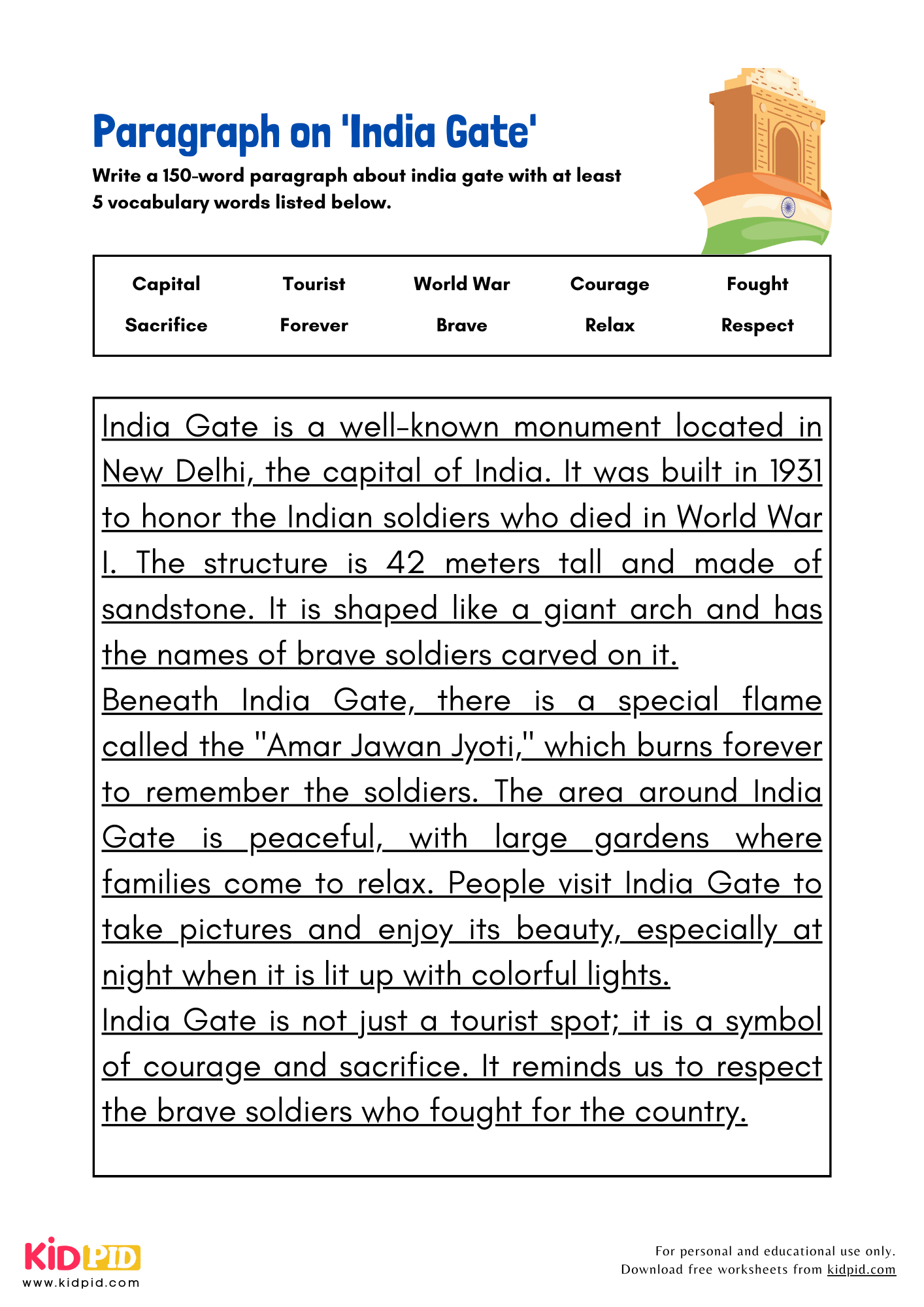
India Gate is a well-known monument located in New Delhi, the capital of India. It was built in 1931 to honor the Indian soldiers who died in World War I. The structure is 42 meters tall and made of sandstone. It is shaped like a giant arch and has the names of brave soldiers carved on it.
Beneath India Gate, there is a special flame called the “Amar Jawan Jyoti,” which burns forever to remember the soldiers. The area around India Gate is peaceful, with large gardens where families come to relax. People visit India Gate to take pictures and enjoy its beauty, especially at night when it is lit up with colorful lights.
India Gate is not just a tourist spot; it is a symbol of courage and sacrifice. It reminds us to respect the brave soldiers who fought for the country.
Paragraph on ‘India Gate’ in 200 Words for Class 6 & 7
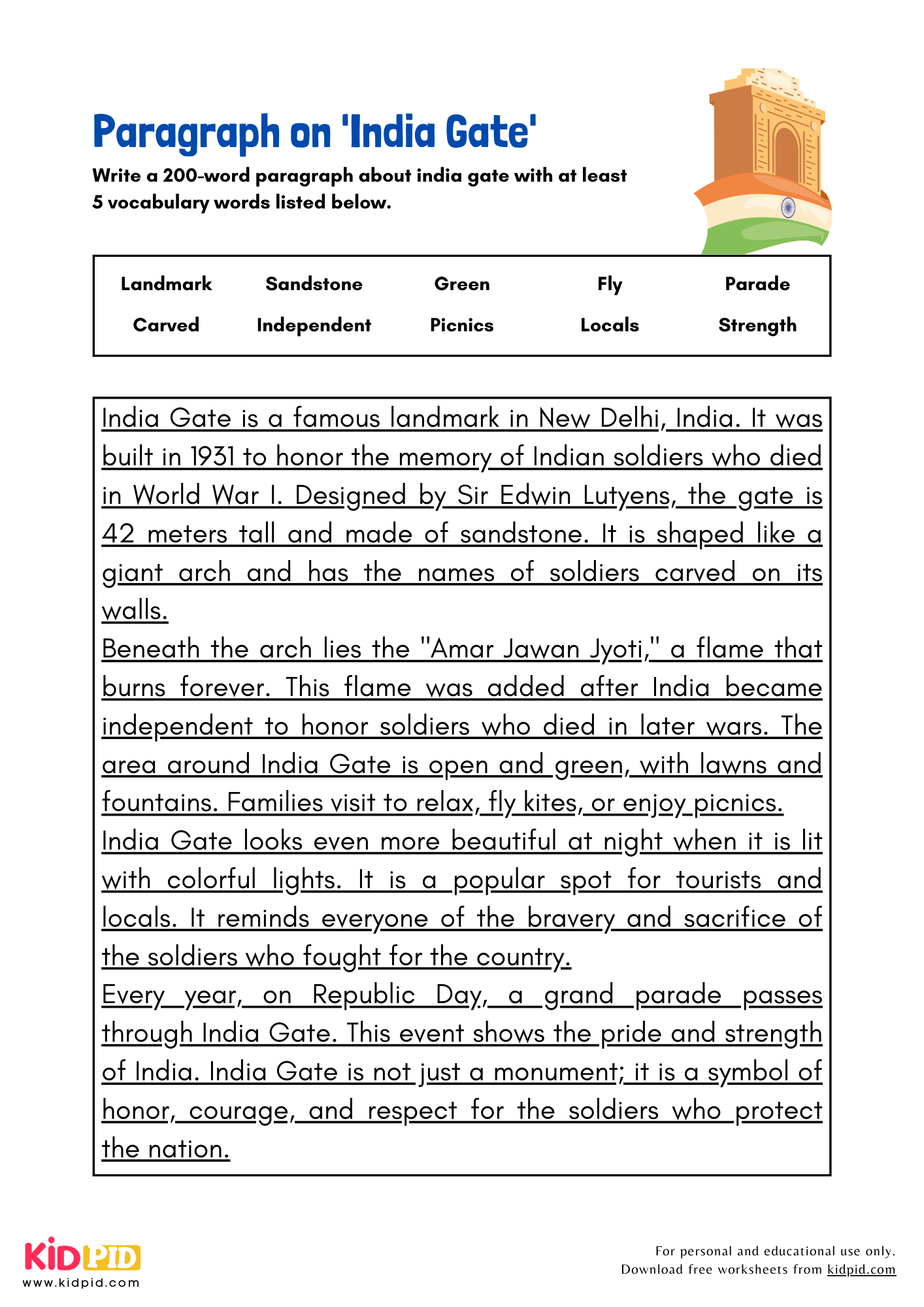
India Gate is a famous landmark in New Delhi, India. It was built in 1931 to honor the memory of Indian soldiers who died in World War I. Designed by Sir Edwin Lutyens, the gate is 42 meters tall and made of sandstone. It is shaped like a giant arch and has the names of soldiers carved on its walls.
Beneath the arch lies the “Amar Jawan Jyoti,” a flame that burns forever. This flame was added after India became independent to honor soldiers who died in later wars. The area around India Gate is open and green, with lawns and fountains. Families visit to relax, fly kites, or enjoy picnics.
India Gate looks even more beautiful at night when it is lit with colorful lights. It is a popular spot for tourists and locals. It reminds everyone of the bravery and sacrifice of the soldiers who fought for the country.
Every year, on Republic Day, a grand parade passes through India Gate. This event shows the pride and strength of India. India Gate is not just a monument; it is a symbol of honor, courage, and respect for the soldiers who protect the nation.
Paragraph on ‘India Gate’ in 300 Words for Class 8
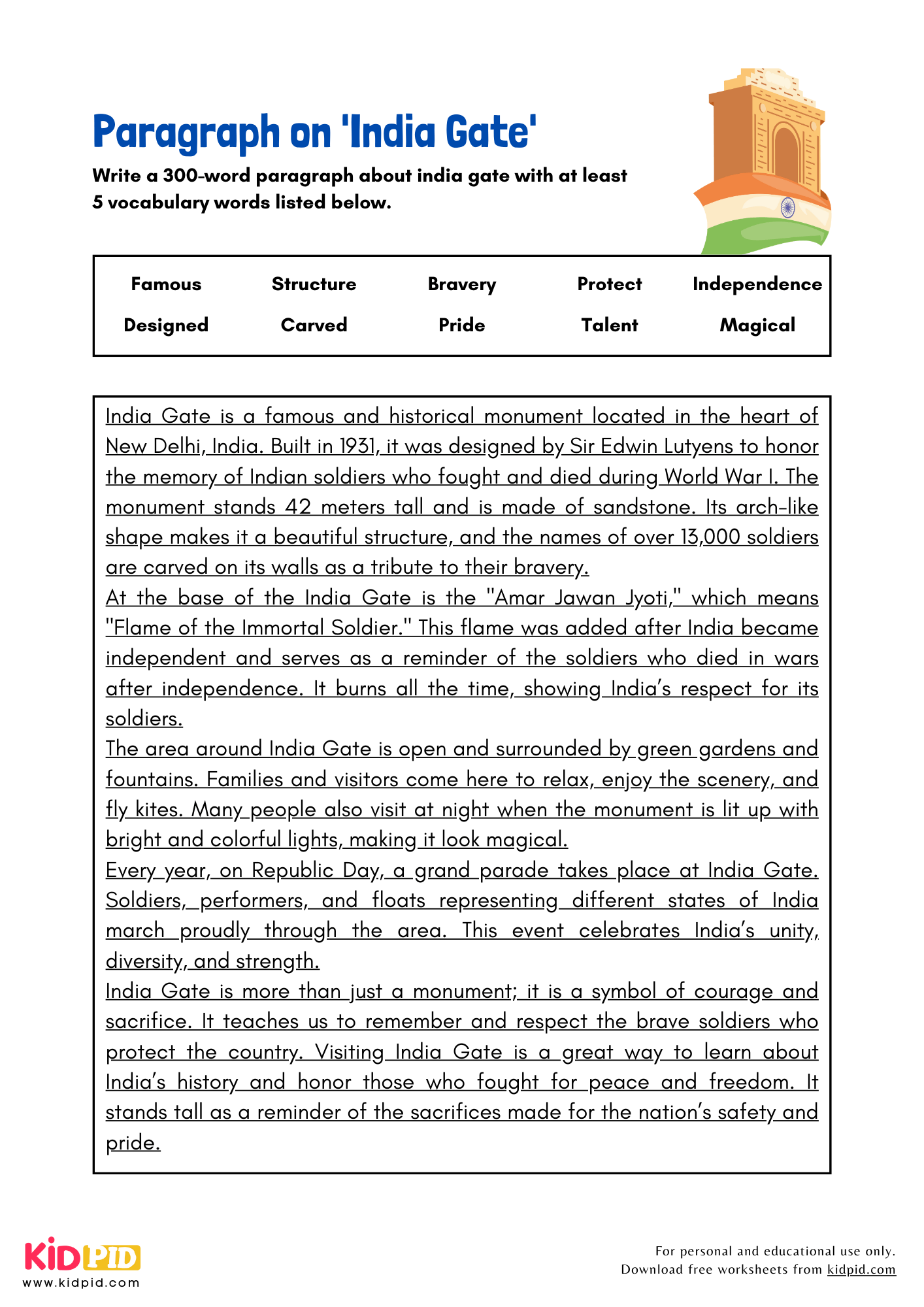
India Gate is a famous and historical monument located in the heart of New Delhi, India. Built in 1931, it was designed by Sir Edwin Lutyens to honor the memory of Indian soldiers who fought and died during World War I. The monument stands 42 meters tall and is made of sandstone. Its arch-like shape makes it a beautiful structure, and the names of over 13,000 soldiers are carved on its walls as a tribute to their bravery.
At the base of the India Gate is the “Amar Jawan Jyoti,” which means “Flame of the Immortal Soldier.” This flame was added after India became independent and serves as a reminder of the soldiers who died in wars after independence. It burns all the time, showing India’s respect for its soldiers.
The area around India Gate is open and surrounded by green gardens and fountains. Families and visitors come here to relax, enjoy the scenery, and fly kites. Many people also visit at night when the monument is lit up with bright and colorful lights, making it look magical.
Every year, on Republic Day, a grand parade takes place at India Gate. Soldiers, performers, and floats representing different states of India march proudly through the area. This event celebrates India’s unity, diversity, and strength.
India Gate is more than just a monument; it is a symbol of courage and sacrifice. It teaches us to remember and respect the brave soldiers who protect the country. Visiting India Gate is a great way to learn about India’s history and honor those who fought for peace and freedom. It stands tall as a reminder of the sacrifices made for the nation’s safety and pride.
MCQ’s on ‘India Gate’
1. Where is India Gate located?
a) Mumbai
b) New Delhi
c) Kolkata
d) Chennai
Answer: b) New Delhi
Explanation: India Gate is a famous monument in the capital city of India, New Delhi.
2. Why was India Gate built?
a) To celebrate independence
b) To honor soldiers who died in World War I
c) To host Republic Day parades
d) To remember famous leaders
Answer: b) To honor soldiers who died in World War I
Explanation: India Gate was built to remember the Indian soldiers who died in the war.
3. What is the height of India Gate?
a) 30 meters
b) 50 meters
c) 42 meters
d) 60 meters
Answer: c) 42 meters
Explanation: India Gate is 42 meters tall and made of sandstone.
4. What does the “Amar Jawan Jyoti” mean?
a) Flame of Freedom
b) Flame of the Immortal Soldier
c) Victory Flame
d) Eternal Light
Answer: b) Flame of the Immortal Soldier
Explanation: The Amar Jawan Jyoti is a flame to honor soldiers who died for the country.
5. When was India Gate built?
a) 1920
b) 1931
c) 1947
d) 1950
Answer: b) 1931
Explanation: India Gate was completed and inaugurated in the year 1931.
6. Who designed India Gate?
a) Sir Edwin Lutyens
b) Mahatma Gandhi
c) Jawaharlal Nehru
d) Rabindranath Tagore
Answer: a) Sir Edwin Lutyens
Explanation: India Gate was designed by the British architect Sir Edwin Lutyens.
7. What makes India Gate beautiful at night?
a) Fireworks
b) Colorful lights
c) Stars
d) Flowers
Answer: b) Colorful lights
Explanation: At night, India Gate is lit up with colorful lights, making it look stunning.
8. What event takes place at India Gate every year?
a) Independence Day celebration
b) Republic Day parade
c) New Year fireworks
d) Sports competitions
Answer: b) Republic Day parade
Explanation: A grand parade is held at India Gate every Republic Day to celebrate India’s unity and strength.
9. What does India Gate symbolize?
a) Wealth and power
b) Courage and sacrifice
c) Freedom and independence
d) Peace and unity
Answer: b) Courage and sacrifice
Explanation: India Gate honors the bravery and sacrifices of soldiers who fought for the country.
10. What is special about the walls of India Gate?
a) They have carvings of flowers
b) They have the names of soldiers carved on them
c) They are painted in gold
d) They are made of marble
Answer: b) They have the names of soldiers carved on them
Explanation: The walls of India Gate have the names of over 13,000 soldiers carved as a tribute to their bravery.


History & Design
- India Gate is a war memorial built in 1931 to honor Indian soldiers who died in World War I. [Source: Britannica – India Gate]
- It was designed by Sir Edwin Lutyens, the chief architect of New Delhi. [Source: Britannica – Edwin Lutyens]
National Significance
- The names of thousands of soldiers are inscribed on the monument to remember their sacrifice. [Source: Delhi Tourism – India Gate]
- The Amar Jawan Jyoti symbolizes respect for soldiers who died for the nation. [Source: National Portal of India – Amar Jawan Jyoti]
We hope you enjoyed the paragraphs on the topic “India Gate” written by our team of skilled educators. Keep visiting our website and explore more paragraphs, essays, worksheets, flashcards, Quizzes and many other interactive resources. Don’t forget to follow us on YouTube & Facebook.
This paragraph is developed by our Content Team for clear learning.
You may like these:
Combustion and Flame
Combustion is a chemical process producing heat and light, often as a flame. It powers engines, provides warmth, and enables essential daily activities.
Cold War
The Cold War was a political and ideological conflict between the United States and the Soviet Union, marked by tensions, propaganda, and the arms race.
World War I
World War I (1914-1918) was a global conflict involving major powers, sparked by alliances, nationalism, and assassination, resulting in immense destruction and political changes.
World War II
World War II (1939-1945) was a global war caused by territorial disputes, fascism, and aggression, involving major nations, reshaping geopolitics, and leading to the United Nations’ formation.


