‘Mahatma Gandhi’ is a vital topic that students may be asked to write a paragraph about in their school exams. Mahatma Gandhi was a great leader who fought for India’s freedom with truth, non-violence, and peaceful resistance. Please check the various version (in 50 words, 100 words, 150 words, 200 words, and 300 words) provided below for the paragraph.
Contents
- Paragraph on ‘Mahatma Gandhi’ in 50 words for Classes 1 & 2
- Paragraph on ‘Mahatma Gandhi’ in 100 words for Classes 3 & 4
- Paragraph on ‘Mahatma Gandhi’ in 150 words for Classes 4 & 5
- Paragraph on ‘Mahatma Gandhi’ in 200 words for Classes 6 & 7
- Paragraph on ‘Mahatma Gandhi’ in 300 words for Classes 8 to 10
- MCQ’s on ‘Mahatma Gandhi’
- 1. When was Mahatma Gandhi born?
- 2. What title is given to Mahatma Gandhi by the people of India?
- 3. Where was Mahatma Gandhi born?
- 4. Which two values did Gandhi strongly believe in?
- 5. Which movement led by Gandhi protested against a tax on salt?
- 6. What type of clothes did Gandhi encourage people to wear?
- 7. Which of these was a goal of Gandhi’s teachings?
- 8. What did Gandhi fight against besides British rule?
- 9. When did India gain its independence?
- 10. What happened to Mahatma Gandhi on January 30, 1948?
- Life and Leadership
- Major Actions and Legacy
- You may like these:
Read This Article in Other Languages
- महात्मा गांधी पर अनुच्छेद (Hindi / हिंदी)
- Párrafo sobre Mahatma Gandhi (Spanish / Español)
- Paragraphe sur Mahatma Gandhi (French / Français)
- Absatz über Mahatma Gandhi (German / Deutsch)
- فقرة عن مهاتما غاندي (Arabic / العربية)
- মহাত্মা গান্ধী সম্পর্কে অনুচ্ছেদ (Bengali / বাংলা)
- மகாத்மா காந்தி பற்றி பத்தி (Tamil / தமிழ்)
- మహాత్మా గాంధీ పై పేరా (Telugu / తెలుగు)
- മഹാത്മാ ഗാന്ധിയെക്കുറിച്ചുള്ള പാരഗ്രാഫ് (Malayalam / മലയാളം)
- مہاتما گاندھی پر پیراگراف (Urdu / اردو)
- Parágrafo sobre Mahatma Gandhi (Portuguese / Português)
Translation Disclaimer: These links use Google Translate, an automated translation service. Translations may vary in accuracy and are provided for convenience only.
Paragraph on ‘Mahatma Gandhi’ in 50 words for Classes 1 & 2
Mahatma Gandhi was the Father of our Nation. He worked hard to make India free from British rule. He believed in peace and truth. People called him Bapu. Gandhi taught us to be kind, honest, and brave. We remember him for his love, simplicity, and courage.
Paragraph on ‘Mahatma Gandhi’ in 100 words for Classes 3 & 4


Mahatma Gandhi was a great leader of India. He was born on October 2, 1869, in Porbandar, Gujarat. People called him the “Father of the Nation.” He fought for India’s freedom from British rule in a peaceful way. Gandhi believed in truth and non-violence. He taught people to live simply and work hard. His famous movements were the Salt March and Quit India. Gandhi always wore simple clothes made of khadi. He wanted people to treat everyone equally. His life and teachings continue to inspire people around the world. He was a kind and humble man who loved peace.
Paragraph on ‘Mahatma Gandhi’ in 150 words for Classes 4 & 5

Mahatma Gandhi was an important leader who helped India gain freedom from British rule. He was born on October 2, 1869, in Porbandar, Gujarat. Gandhi believed in truth, non-violence, and simple living. He led many peaceful protests, like the Salt March, to fight against unfair British laws. Gandhi taught people to be kind and respect everyone, no matter their religion or caste. He believed in making clothes from khadi and encouraged people to work hard and help each other. His peaceful methods inspired many freedom fighters. Because of his great work, people call him the “Father of the Nation.” Gandhi’s ideas of peace and kindness still guide people today.
Paragraph on ‘Mahatma Gandhi’ in 200 words for Classes 6 & 7
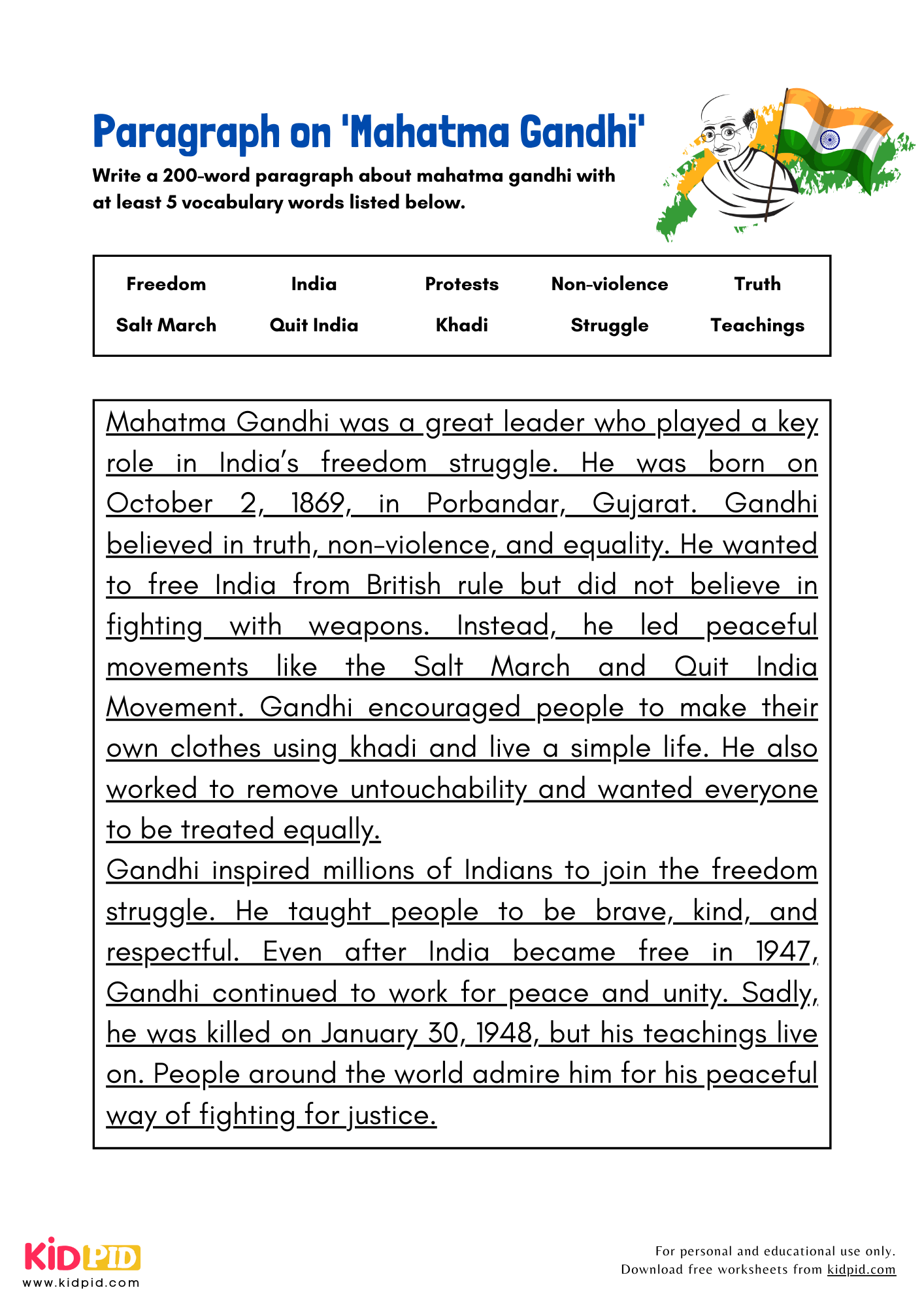
Mahatma Gandhi was a great leader who played a key role in India’s freedom struggle. He was born on October 2, 1869, in Porbandar, Gujarat. Gandhi believed in truth, non-violence, and equality. He wanted to free India from British rule but did not believe in fighting with weapons. Instead, he led peaceful movements like the Salt March and the Quit India Movement. Gandhi encouraged people to make their own clothes using khadi and live a simple life. He also worked to remove untouchability and wanted everyone to be treated equally.
Gandhi inspired millions of Indians to join the freedom struggle. He taught people to be brave, kind, and respectful. Even after India became free in 1947, Gandhi continued to work for peace and unity. Sadly, he was killed on January 30, 1948, but his teachings live on. People around the world admire him for his peaceful way of fighting for justice.
Paragraph on ‘Mahatma Gandhi’ in 300 words for Classes 8 to 10
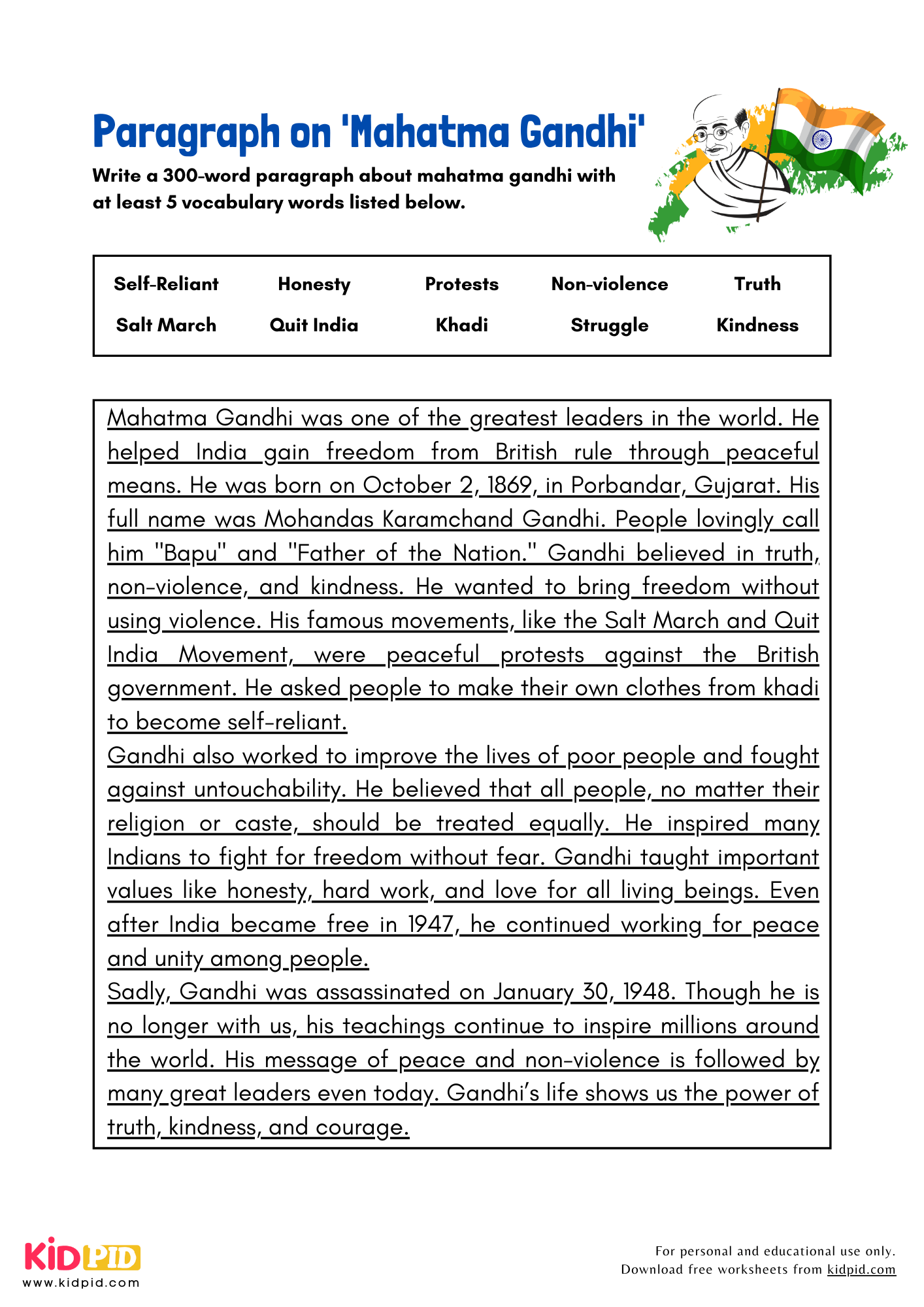
Mahatma Gandhi was one of the greatest leaders in the world. He helped India gain freedom from British rule through peaceful means. He was born on October 2, 1869, in Porbandar, Gujarat. His full name was Mohandas Karamchand Gandhi. People lovingly call him “Bapu” and “Father of the Nation.” Gandhi believed in truth, non-violence, and kindness. He wanted to bring freedom without using violence. His famous movements, like the Salt March and Quit India Movement, were peaceful protests against the British government. He asked people to make their own clothes from khadi to become self-reliant.
Gandhi also worked to improve the lives of poor people and fought against untouchability. He believed that all people, no matter their religion or caste, should be treated equally. He inspired many Indians to fight for freedom without fear. Gandhi taught important values like honesty, hard work, and love for all living beings. Even after India became free in 1947, he continued working for peace and unity among people.
Sadly, Gandhi was assassinated on January 30, 1948. Though he is no longer with us, his teachings continue to inspire millions around the world. His message of peace and non-violence is followed by many great leaders even today. Gandhi’s life shows us the power of truth, kindness, and courage.
MCQ’s on ‘Mahatma Gandhi’
1. When was Mahatma Gandhi born?
A) January 30, 1948
B) October 2, 1869
C) August 15, 1947
D) November 14, 1889
Answer: (B) October 2, 1869
Explanation: Gandhi was born on October 2, 1869, in Porbandar, Gujarat.
2. What title is given to Mahatma Gandhi by the people of India?
A) Prime Minister
B) King of India
C) Father of the Nation
D) President
Answer: (C) Father of the Nation
Explanation: Gandhi is called the “Father of the Nation” for his role in India’s freedom struggle.
3. Where was Mahatma Gandhi born?
A) Delhi
B) Porbandar
C) Mumbai
D) Kolkata
Answer: (B) Porbandar
Explanation: He was born in Porbandar, Gujarat.
4. Which two values did Gandhi strongly believe in?
A) Truth and non-violence
B) Power and wealth
C) Strength and war
D) Fame and fortune
Answer: (A) Truth and non-violence
Explanation: Gandhi believed in truth and non-violence as the best way to achieve freedom.
5. Which movement led by Gandhi protested against a tax on salt?
A) Quit India Movement
B) Non-Cooperation Movement
C) Salt March
D) Dandi March
Answer: (C) Salt March
Explanation: The Salt March was a peaceful protest against the British tax on salt.
6. What type of clothes did Gandhi encourage people to wear?
A) Khadi clothes
B) Silk clothes
C) Western suits
D) Designer clothes
Answer: (A) Khadi clothes
Explanation: Gandhi promoted wearing simple khadi clothes to support local industries.
7. Which of these was a goal of Gandhi’s teachings?
A) To make money
B) To promote violence
C) To promote peace and unity
D) To become a king
Answer: (C) To promote peace and unity
Explanation: Gandhi wanted to promote peace and unity among people.
8. What did Gandhi fight against besides British rule?
A) Untouchability
B) Religion
C) Caste system
D) Both A and C
Answer: (D) Both A and C
Explanation: Gandhi fought against untouchability and caste discrimination.
9. When did India gain its independence?
A) January 26, 1950
B) October 2, 1948
C) August 15, 1947
D) March 12, 1930
Answer: (C) August 15, 1947
Explanation: India became independent on August 15, 1947.
10. What happened to Mahatma Gandhi on January 30, 1948?
A) He became Prime Minister
B) He was assassinated
C) He started a new movement
D) He received a Nobel Prize
Answer: (B) He was assassinated
Explanation: Gandhi was assassinated on January 30, 1948.


Life and Leadership
- Mahatma Gandhi, born Mohandas Karamchand Gandhi on 2 October 1869 in Gujarat, led India’s struggle for independence and is called the Father of the Nation. [Source: Britannica]
- He promoted nonviolent resistance (satyagraha) to fight oppression peacefully. [Source: Government of India]
Major Actions and Legacy
- Gandhi led the Salt March in 1930 to protest the British salt tax. [Source: Government of India]
- His birthday, 2 October, is celebrated as Gandhi Jayanti in India and recognized globally as the International Day of Non‑Violence. [Source: Wikipedia]
- He was assassinated on 30 January 1948 while continuing to promote peace and unity. [Source: Britannica]
We hope you enjoyed the paragraphs on the topic ‘Mahatma Gandhi’ created by our team of expert educators. Keep visiting our website and explore more paragraphs, essays, worksheets, flashcards, Quizzes and many other interactive resources. Don’t forget to follow us on YouTube & Facebook.
This paragraph is written by our Content Team for easy lessons.
You may like these:
Paragraph on ‘Gandhi Jayanti’
Gandhi Jayanti, celebrated on October 2nd, honors Mahatma Gandhi’s birthday. It is observed as a national holiday in India, promoting peace, non-violence, and unity.
Essay – Mahatma Gandhi: The Father Of The Nation


Mahatma Gandhi, the Father of the Nation, led India’s freedom struggle with non-violence and truth. His teachings of peace and equality remain influential worldwide.
Paragraph on ‘Indira Gandhi’
Indira Gandhi, India’s first female Prime Minister, served from 1966-1977 and 1980-1984. Known for her leadership, she played a key role in shaping India’s future.
Paragraph on ‘National Festivals of India’
National festivals of India, like Independence Day, Republic Day, and Gandhi Jayanti, celebrate the country’s history, culture, and unity, bringing people together in national pride.