

“Self Discipline” is an essential topic that students may be asked to write a paragraph about in school exams. Self Discipline is the ability to control your actions and make decisions that help you achieve your goals and success. Please check the various versions (in 100 words, 150 words, 200 words, and 300 words) provided below for the paragraph.
Contents
- Paragraph on ‘Self Discipline’ in 100 words for Grade – 6
- Paragraph on ‘Self Discipline’ in 150 words for Grade – 7
- Paragraph on ‘Self Discipline’ in 200 words for Grade – 8
- Paragraph on ‘Self Discipline’ in 300 words for Grade – 9 & 10
- MCQ’s on ‘Self Discipline’
- 1. What does self-discipline help you do?
- 2. How can self-discipline help in learning a skill?
- 3. What is an example of self-discipline?
- 4. Why is self-discipline important?
- 5. How can you practice self-discipline?
- 6. Which habit shows self-discipline?
- 7. What should you do when you feel upset, according to self-discipline?
- 8. How does self-discipline help in school?
- 9. What happens when you keep your promises to yourself?
- 10. What is a good way to balance fun and work?
- Benefits of Self-Discipline
- Role in Daily Life
- You may like these:
Read This Article in Other Languages
- आत्म-अनुशासन पर अनुच्छेद (Hindi / हिंदी)
- Párrafo sobre la autodisciplina (Spanish / Español)
- Paragraphe sur l’autodiscipline (French / Français)
- Absatz über Selbstdisziplin (German / Deutsch)
- فقرة عن الانضباط الذاتي (Arabic / العربية)
- আত্ম-শৃঙ্খলা সম্পর্কে অনুচ্ছেদ (Bengali / বাংলা)
- சுய-கட்டுப்பாடு பற்றி பத்தி (Tamil / தமிழ்)
- స్వీయ క్రమశిక్షణ గురించి పేరా (Telugu / తెలుగు)
- സ്വയം-ശാലീനതയെക്കുറിച്ചുള്ള പാരഗ്രാഫ് (Malayalam / മലയാളം)
- خود نظم و ضبط پر پیراگراف (Urdu / اردو)
- Parágrafo sobre autodisciplina (Portuguese / Português)
Translation Disclaimer: These links use Google Translate, an automated translation service. Translations may vary in accuracy and are provided for convenience only.
Paragraph on ‘Self Discipline’ in 100 words for Grade – 6
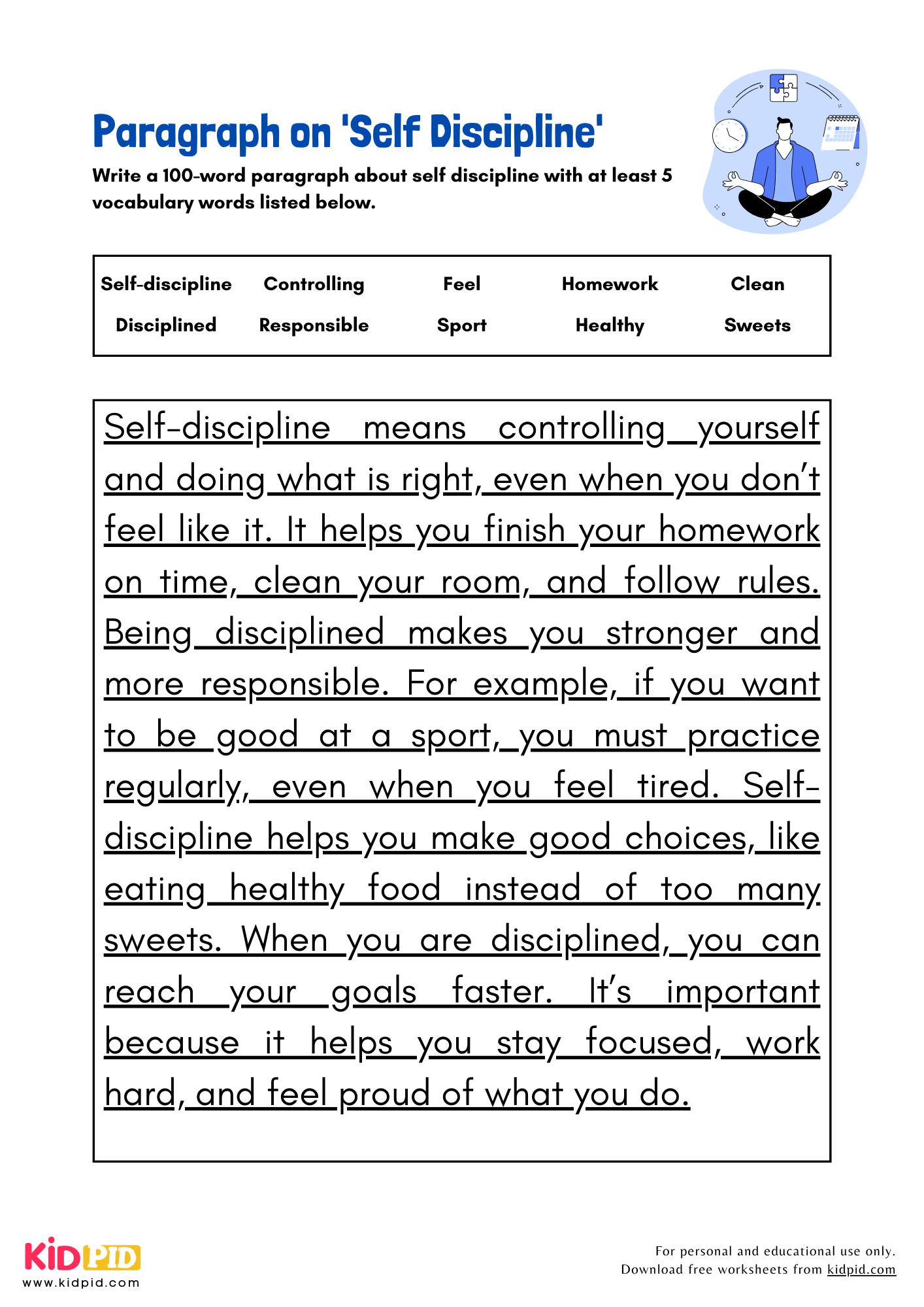

Self-discipline means controlling yourself and doing what is right, even when you don’t feel like it. It helps you finish your homework on time, clean your room, and follow the rules. Being disciplined makes you stronger and more responsible. For example, if you want to be good at a sport, you must practice regularly, even when you feel tired. Self-discipline helps you make good choices, like eating healthy food instead of too many sweets. When you are disciplined, you can reach your goals faster. It’s important because it helps you stay focused, work hard, and feel proud of what you do.
Paragraph on ‘Self Discipline’ in 150 words for Grade – 7
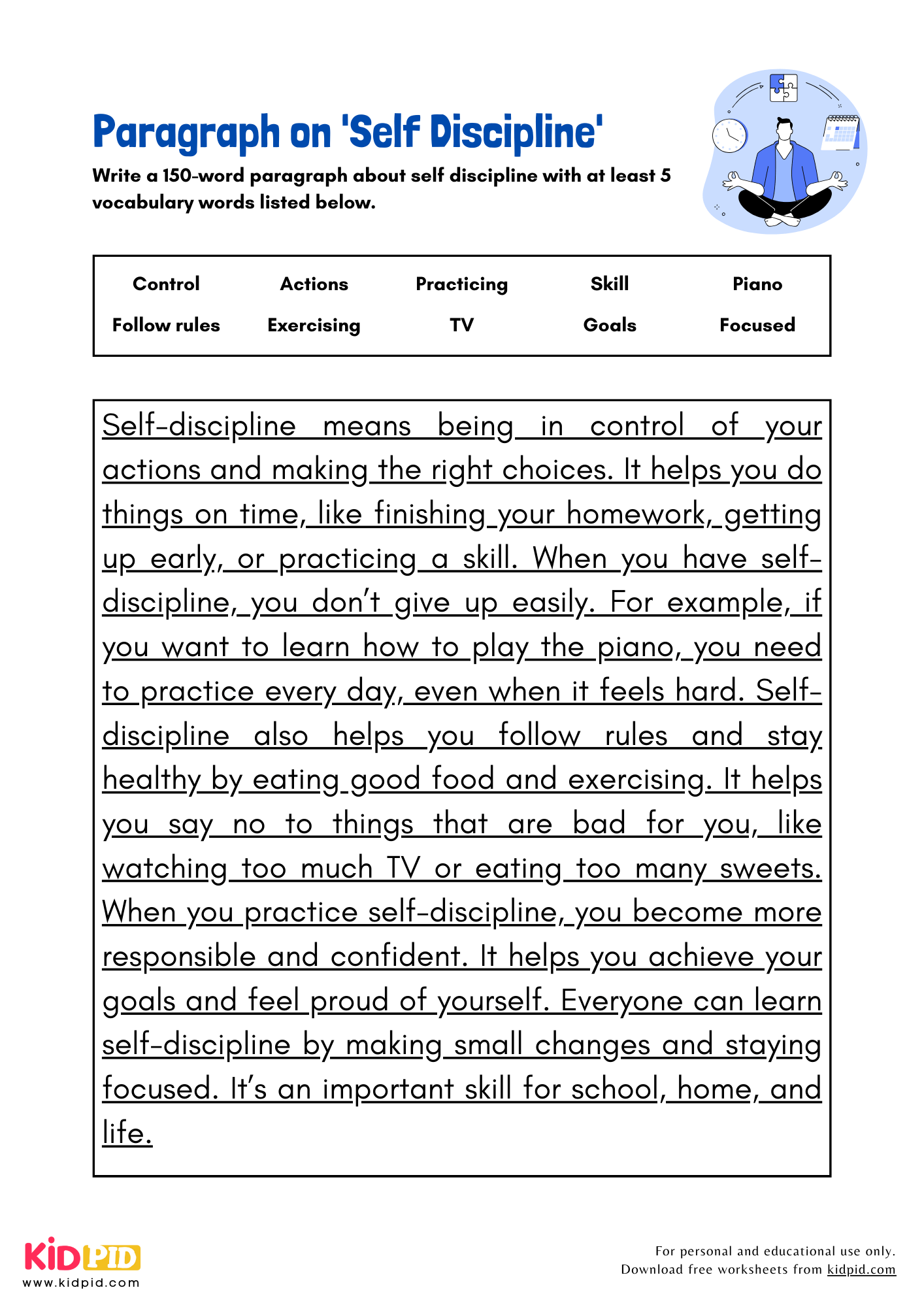
Self-discipline means being in control of your actions and making the right choices. It helps you do things on time, like finishing your homework, getting up early, or practicing a skill. When you have self-discipline, you don’t give up easily. For example, if you want to learn how to play the piano, you need to practice every day, even when it feels hard. Self-discipline also helps you follow rules and stay healthy by eating good food and exercising. It helps you say no to things that are bad for you, like watching too much TV or eating too many sweets. When you practice self-discipline, you become more responsible and confident. It helps you achieve your goals and feel proud of yourself. Everyone can learn self-discipline by making small changes and staying focused. It’s an important skill for school, home, and life.
Paragraph on ‘Self Discipline’ in 200 words for Grade – 8
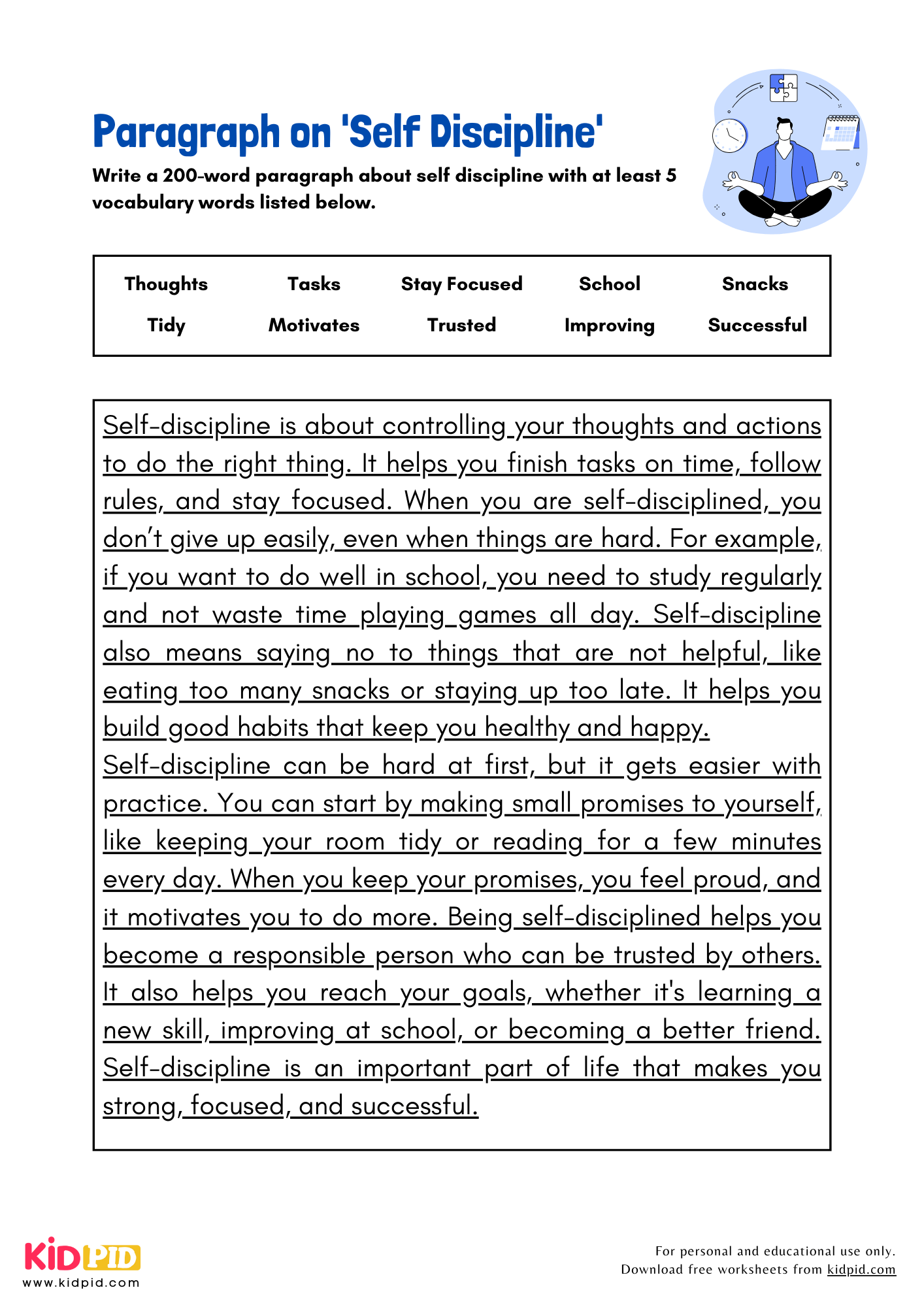
Self-discipline is about controlling your thoughts and actions to do the right thing. It helps you finish tasks on time, follow rules, and stay focused. When you are self-disciplined, you don’t give up easily, even when things are hard. For example, if you want to do well in school, you need to study regularly and not waste time playing games all day. Self-discipline also means saying no to things that are not helpful, like eating too many snacks or staying up too late. It helps you build good habits that keep you healthy and happy.
Self-discipline can be hard at first, but it gets easier with practice. You can start by making small promises to yourself, like keeping your room tidy or reading for a few minutes every day. When you keep your promises, you feel proud, and it motivates you to do more. Being self-disciplined helps you become a responsible person who can be trusted by others. It also helps you reach your goals, whether it’s learning a new skill, improving at school, or becoming a better friend. Self-discipline is an important part of life that makes you strong, focused, and successful.
Paragraph on ‘Self Discipline’ in 300 words for Grade – 9 & 10
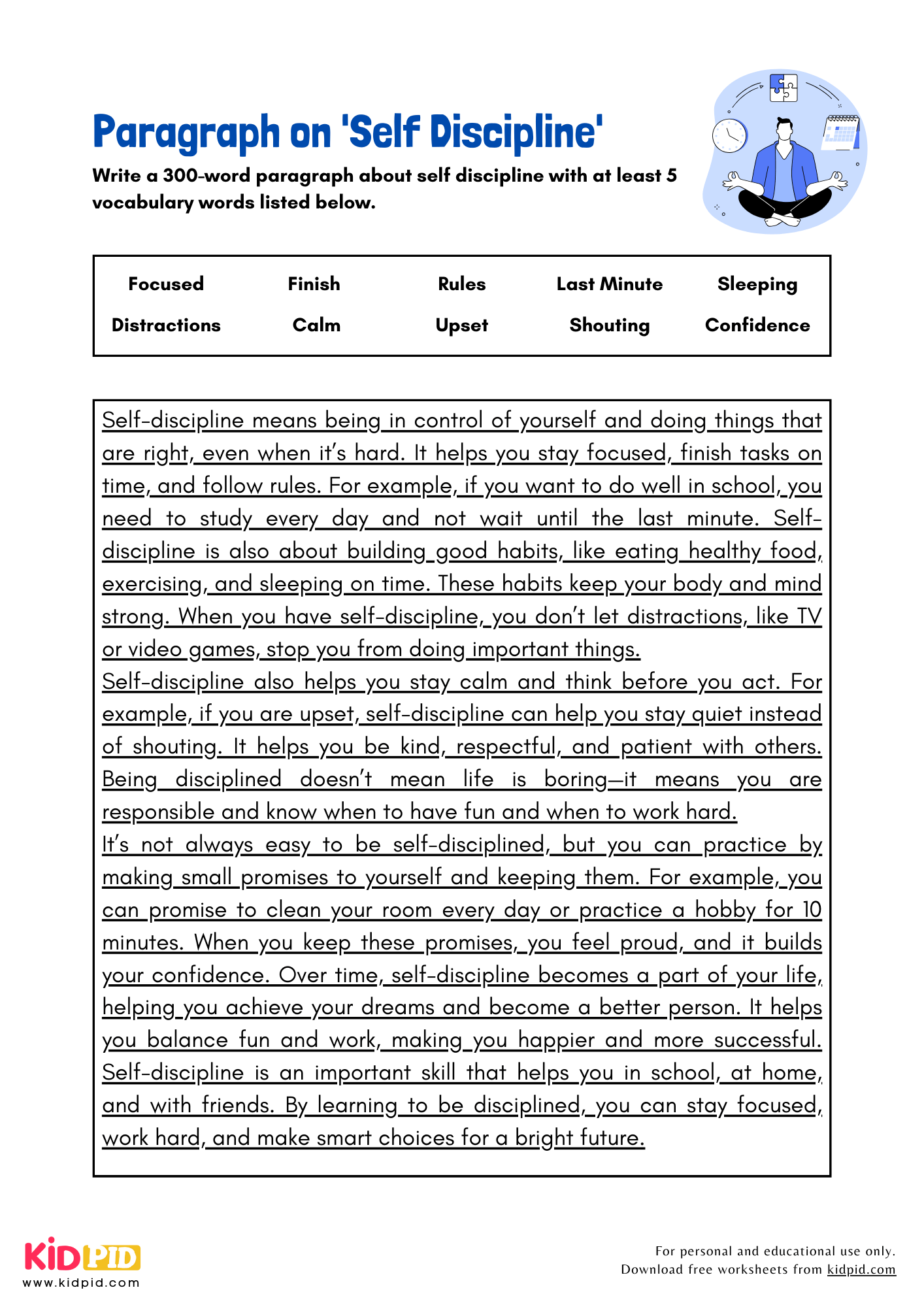
Self-discipline means being in control of yourself and doing things that are right, even when it’s hard. It helps you stay focused, finish tasks on time, and follow rules. For example, if you want to do well in school, you need to study every day and not wait until the last minute. Self-discipline is also about building good habits, like eating healthy food, exercising, and sleeping on time. These habits keep your body and mind strong. When you have self-discipline, you don’t let distractions, like TV or video games, stop you from doing important things.
Self-discipline also helps you stay calm and think before you act. For example, if you are upset, self-discipline can help you stay quiet instead of shouting. It helps you be kind, respectful, and patient with others. Being disciplined doesn’t mean life is boring—it means you are responsible and know when to have fun and when to work hard.
It’s not always easy to be self-disciplined, but you can practice by making small promises to yourself and keeping them. For example, you can promise to clean your room every day or practice a hobby for 10 minutes. When you keep these promises, you feel proud, and it builds your confidence. Over time, self-discipline becomes a part of your life, helping you achieve your dreams and become a better person. It helps you balance fun and work, making you happier and more successful. Self-discipline is an important skill that helps you in school, at home, and with friends. By learning to be disciplined, you can stay focused, work hard, and make smart choices for a bright future.
MCQ’s on ‘Self Discipline’
1. What does self-discipline help you do?
A) Avoid all work
B) Finish tasks on time
C) Always have fun
D) Ignore rules
Answer: B) Finish tasks on time
Explanation: Self-discipline helps you stay focused and finish tasks on time.
2. How can self-discipline help in learning a skill?
A) By practicing only when it’s fun
B) By practicing every day, even when it’s hard
C) By giving up when it’s difficult
D) By waiting for help from others
Answer: B) By practicing every day, even when it’s hard
Explanation: Regular practice, even when it’s hard, is key to learning a skill.
3. What is an example of self-discipline?
A) Watching TV instead of doing homework
B) Eating sweets all day
C) Cleaning your room when promised
D) Ignoring rules
Answer: C) Cleaning your room when promised
Explanation: Keeping promises, like cleaning your room, shows self-discipline.
4. Why is self-discipline important?
A) It makes life boring
B) It helps you reach your goals
C) It helps you avoid responsibilities
D) It allows you to cheat
Answer: B) It helps you reach your goals
Explanation: Self-discipline helps you work hard and reach your goals.
5. How can you practice self-discipline?
A) By making small promises to yourself and keeping them
B) By avoiding all responsibilities
C) By doing only what you enjoy
D) By ignoring tasks
Answer: A) By making small promises to yourself and keeping them
Explanation: Practicing self-discipline starts with keeping small promises.
6. Which habit shows self-discipline?
A) Sleeping late every day
B) Exercising regularly
C) Skipping meals
D) Arguing with friends
Answer: B) Exercising regularly
Explanation: Exercising regularly helps build self-discipline.
7. What should you do when you feel upset, according to self-discipline?
A) Shout at others
B) Stay quiet and calm
C) Ignore your feelings
D) Stop caring
Answer: B) Stay quiet and calm
Explanation: Self-discipline helps you stay calm and think before you act.
8. How does self-discipline help in school?
A) By helping students cheat
B) By making school easy
C) By helping students focus and study regularly
D) By letting students skip tasks
Answer: C) By helping students focus and study regularly
Explanation: Self-discipline helps students focus, study, and complete their work.
9. What happens when you keep your promises to yourself?
A) You feel proud and confident
B) You become bored
C) You lose interest
D) You feel tired
Answer: A) You feel proud and confident
Explanation: Keeping promises helps build confidence and self-pride.
10. What is a good way to balance fun and work?
A) Only have fun
B) Only work
C) Be responsible and know when to work and when to have fun
D) Avoid fun completely
Answer: C) Be responsible and know when to work and when to have fun
Explanation: Self-discipline helps you balance fun and work by being responsible.


Benefits of Self-Discipline
- Self-discipline helps students achieve better grades and develop strong study habits. [Source: NIH – Self-Discipline and Academic Achievement]
- Children with strong self-control are more likely to succeed in education and adulthood. [Source: NIH – Childhood Self-Control and Life Outcomes]
- Self-discipline supports healthy lifestyle choices and reduces long-term health risks. [Source: JAMA Pediatrics – Self-Control and Health]
Role in Daily Life
- Self-discipline reduces procrastination and improves task completion. [Source: Frontiers in Psychology – Self-Discipline and Procrastination]
- It helps children manage emotions and behave responsibly in social situations. [Source: Cornell Cooperative Extension]
- Strong self-discipline is linked with better job stability and future success. [Source: Association for Psychological Science]
We hope the paragraphs on ‘Self Discipline’ created by our talented educators were to your liking. Keep visiting our website and explore more paragraphs, essays, worksheets, flashcards, Quizzes and many other interactive resources. Don’t forget to follow us on YouTube & Facebook.
Our Content Team created this paragraph to keep education simple.
You may like these:
Essay on ‘Self-discipline’ for Grade 5
Self-discipline means controlling your actions, following rules, and staying focused on goals. It helps you manage time, make good choices, and achieve success.
Paragraph on ‘Discipline’
Discipline involves following rules and behaving responsibly. It teaches self-control, helps maintain order, and leads to positive habits that benefit both individuals and society.
Help Your Child to Build High Self-Esteem
To build your child’s self-esteem, encourage their efforts, offer praise, set achievable goals, and foster positive communication, helping them feel confident and valued.


