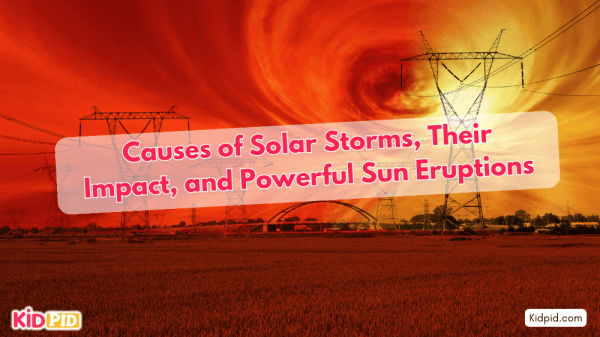
Have you ever heard of solar storms? These are big bursts of energy from the Sun that can affect Earth in surprising ways. Let’s learn what causes these storms, how they impact us, and the powerful eruptions from the Sun!
- What Are Solar Storms: Solar storms are huge bursts of energy and particles released from the Sun.
- Causes of Solar Storms: They happen due to changes in the Sun’s magnetic field.
- Types of Eruptions: Solar flares are sudden bursts of radiation. Coronal mass ejections (CMEs) are large clouds of gas and magnetic fields.
- Impact on Earth: Solar storms can disrupt satellites and communication systems. They can also affect power grids and cause blackouts.
- Safety Measures: Scientists monitor the Sun to predict solar storms. They warn people when a storm might happen to keep everyone safe.
Contents
Causes of Solar Storms, Their Impact, and Sun’s Intense Eruptions

Related MCQ’S
1. What is the Sun primarily made of?
A) Fire
B) Gas
C) Plasma
D) Water
Answer: C) Plasma
Explanation: The Sun is an ocean of plasma, a unique state of matter made of charged particles like ions and electrons.
2. What happens when the Sun’s magnetic fields get twisted?
A) The Sun stops shining
B) Solar storms occur
C) The magnetic fields disappear
D) Plasma turns into water
Answer: B) Solar storms occur
Explanation: When the Sun’s magnetic fields become twisted like a knotted pretzel, they store energy, and when they snap, solar storms like solar flares or coronal mass ejections are released.
3. What protects Earth from most solar storms?
A) The oceans
B) Earth’s magnetic field and atmosphere
C) Space shuttles
D) The Moon
Answer: B) Earth’s magnetic field and atmosphere
Explanation: Earth’s magnetic field deflects charged particles from solar storms, and the atmosphere absorbs harmful radiation, keeping us safe.
4. Why are solar superstorms a concern for modern technology?
A) They cause extreme weather
B) They can destroy satellites and power grids
C) They create too much sunlight
D) They stop Earth’s rotation
Answer: B) They can destroy satellites and power grids
Explanation: Solar superstorms carry immense energy that can disrupt modern infrastructure like satellites, power grids, and communication systems.
5. When did the last major solar storm occur?
A) 2020
B) 2012
C) 2000
D) 1999
Answer: B) 2012
Explanation: The last major solar storm, known as the “solar storm of 2012” or the “Carrington event of the 21st Century,” happened on July 23, 2012.
You may like these:
Stars and the Solar System
Stars are massive, luminous balls of gas, with our Solar System consisting of the Sun and orbiting planets, moons, asteroids, and comets.
How is a Satellite Launched?
Satellites are launched using powerful rockets that provide enough force to escape Earth’s gravity, placing them into orbit around Earth or other celestial bodies.
How does a magnet work?
Magnets generate a magnetic field, attracting or repelling other magnets and magnetic materials, driven by the motion of charged particles within atoms.
What causes the tides?
Tides are caused by the gravitational pull of the Moon and the Sun on Earth’s oceans, creating bulges that result in high and low tides.
What causes a solar eclipse?
A solar eclipse occurs when the Moon passes between Earth and the Sun, blocking the Sun’s light and casting a shadow on Earth.