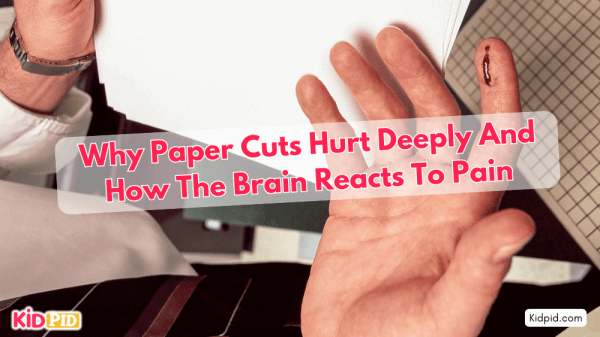
Have you ever gotten a tiny cut from a piece of paper and thought, “Ouch! That really hurts!”? Even though paper cuts are small, they can feel more painful than bigger cuts. Let’s explore why this happens and how our brain reacts to pain!
- What is a Paper Cut: A paper cut is a small cut that happens when a piece of paper slices your skin.
- Why Do They Hurt: Paper cuts hurt a lot because they often cut through sensitive skin and nerve endings.
- Nerve Endings: Our skin has tiny parts called nerve endings that help us feel sensations like pain.
Paper cuts can hit many of these nerve endings at once! - Brain’s Reaction: When we get hurt, our brain gets a signal that something is wrong.
The brain reacts quickly to tell us to be careful and to protect ourselves. - Feeling the Pain: Even though the cut is small, the brain makes it feel really painful to alert us to the injury.
- Why It Lasts: The pain from a paper cut can last longer than other cuts because it irritates the nerves for a while.
Contents
- Why Paper Cuts Hurt and How the Brain Responds.
- Related MCQ’s
- 1. Why do paper cuts hurt so much?
- 2. What makes paper edges so painful when you get a paper cut?
- 3. Why don’t paper cuts trigger the body’s natural healing system?
- 4. What should you do to help a paper cut heal faster?
- 5. What can worsen the pain of a paper cut?
- 6. How can age affect the healing of wounds?
- You may like these:
Why Paper Cuts Hurt and How the Brain Responds.
Related MCQ’s
1. Why do paper cuts hurt so much?
a) Because the paper is sharp
b) Because fingertips have more pain receptors
c) Because the paper contains chemicals
d) Because the skin is too thick
2. What makes paper edges so painful when you get a paper cut?
a) Paper edges are smooth and clean
b) Paper edges are rough and jagged like a saw
c) Paper contains sharp chemicals
d) Paper is too soft
3. Why don’t paper cuts trigger the body’s natural healing system?
a) Paper cuts are too deep to heal
b) Paper cuts are too shallow and don’t cause bleeding
c) Paper cuts happen too quickly
d) Paper cuts are very large
4. What should you do to help a paper cut heal faster?
a) Leave it open and exposed
b) Wash it with soap and water, apply ointment, and cover it with a bandage
c) Use hot water to clean it
d) Rub the cut to make it heal quicker
5. What can worsen the pain of a paper cut?
a) Washing the cut with water
b) Exposure to chemicals in the paper
c) Applying ointment
d) Keeping the wound dry
6. How can age affect the healing of wounds?
a) Wound healing speeds up with age
b) Age has no effect on healing
c) Wound healing slows down with age
d) Wound healing becomes the same at all ages
You may like these:
How a Wound Heals Itself?
A wound heals through four stages: hemostasis (clotting), inflammation (clearing debris), proliferation (tissue rebuilding), and maturation (scar formation and strengthening).
How do pain relievers work?
Pain relievers reduce pain by blocking pain signals, decreasing inflammation, or altering the brain’s perception of discomfort, often through enzymes or receptor interaction.
Why Do We Feel Pain?
Pain is a protective response to injury or harm, signaling the body to avoid further damage. Nerve receptors transmit pain signals to the brain for processing.
How Does the Nervous System Work?
The nervous system transmits electrical signals between the brain, spinal cord, and body, controlling movement, sensation, and involuntary functions via neurons and synaptic connections.