


In this worksheet, we will practice words that have double consonants, like “letter” and “happy.” Double consonants are two of the same letter next to each other in a word. Tracing, writing, and spelling these words will help you recognize and use them correctly. This will make your reading and writing even better. Let’s have fun and become great at spotting and using double consonants!
[Scroll Down for Download Link]
Contents
- Double Consonant Word Worksheets For Grade 2
- Key Facts About Double Consonant Worksheets
- Parts/Types/Examples of Double Consonant Words
- How Does This Worksheet Work?
- Benefits of Learning About Double Consonants
- Learning Objectives
- Worksheet Instructions
- Interesting Facts About Double Consonant Vocabulary
- Real-Life Applications
- FAQs
Double Consonant Word Worksheets For Grade 2
Read More: Beginning Consonants Free Printable Worksheets for Kindergarten
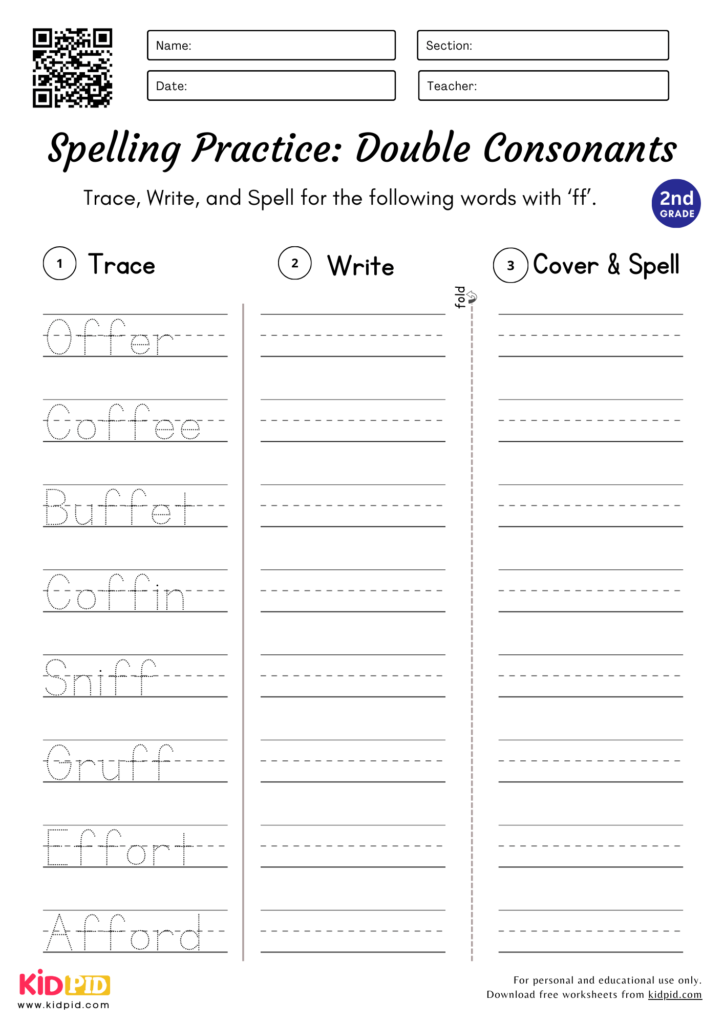
‘ff’ – Double Consonant Words
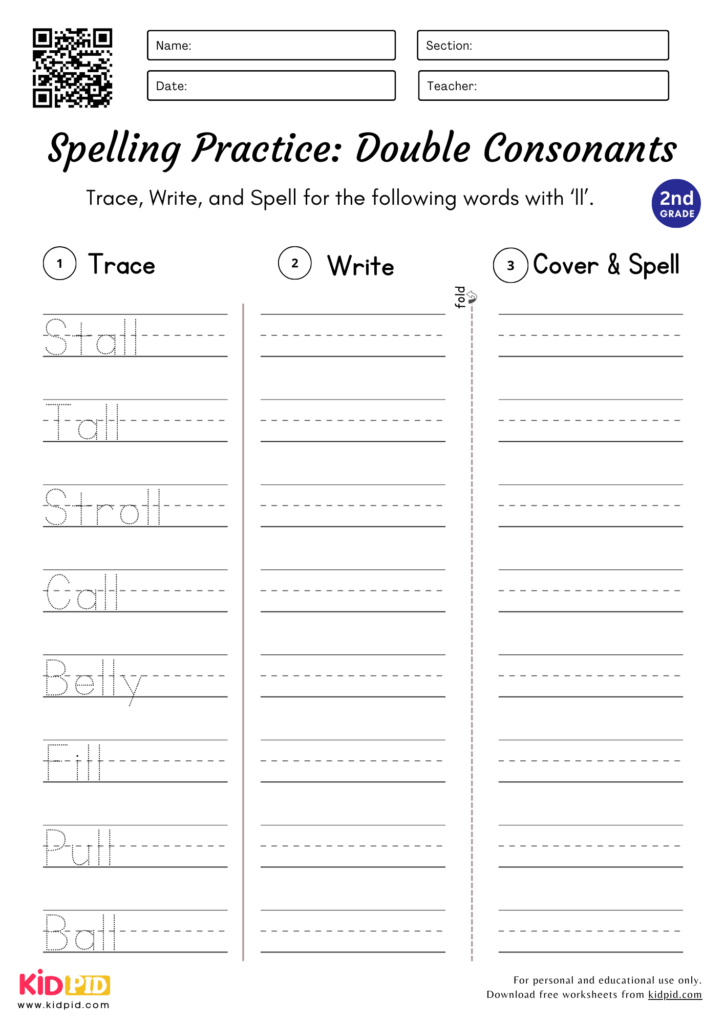
‘ll’ – Double Consonant Words
‘ss’ – Double Consonant Words

Key Facts About Double Consonant Worksheets
- Target Audience: Specifically designed for Grade 2 learners (approx. 7-8 years old) to reinforce early literacy skills.
- Focus Area: Targets phonics and spelling proficiency by focusing on word patterns containing side-by-side identical consonants (e.g., ‘ff’, ‘ll’, ‘ss’).
- Pedagogical Approach: Utilizes kinesthetic learning (tracing and writing) to anchor spelling memory.
- Standard Alignment: Supports foundational English Language Arts (ELA) standards regarding word recognition and spelling conventions.
Parts/Types/Examples of Double Consonant Words
Double consonants generally appear in the middle or at the end of words. The worksheet focuses on the most common clusters:
- ‘ff’ Words: Staff, cliff, sniff, puff.
- ‘ll’ Words: Ball, drill, small, shell.
- ‘ss’ Words: Glass, mess, grass, boss.
- Distinction: These are classified as “closed syllables,” where the vowel is typically short, helping children predict the pronunciation of new words.
How Does This Worksheet Work?
This resource employs a scaffolded learning method:
- Visual Recognition: Students identify the doubled letters within a word.
- Kinesthetic Reinforcement: Through tracing and handwriting exercises, students develop muscle memory for the spelling patterns.
- Application: Students transition from recognizing the pattern to actively writing the word, which bridges the gap between passive reading and active spelling accuracy.
Benefits of Learning About Double Consonants
- Enhanced Reading Fluency: Understanding these patterns allows children to decode multi-syllable words faster.
- Improved Spelling Accuracy: Recognizing “doubling” rules reduces common phonetic spelling errors.
- Confidence Building: Mastering specific patterns gives students the tools to tackle more complex vocabulary, leading to academic confidence.
Learning Objectives
By completing this worksheet, students will be able to:
- Identify and isolate words containing double consonants.
- Demonstrate correct letter formation through tracing and independent writing.
- Apply knowledge of ‘ff’, ‘ll’, and ‘ss’ patterns to spell simple words accurately.
- Understand the relationship between letter patterns and sound production.
Worksheet Instructions
- Preparation: Print the worksheet on high-quality paper to ensure clear tracing lines.
- Guided Practice: Have the student say the word aloud slowly to hear the “doubled” sound.
- Tracing: Encourage the student to follow the arrows or dotted lines to practice proper letter formation.
- Independent Writing: Cover the example and ask the student to write the word from memory to test retention.
- Review: Once finished, ask the student to identify another word that follows the same pattern to encourage critical thinking.
Interesting Facts About Double Consonant Vocabulary
- The “Short Vowel” Rule: In many English words, if a vowel is short, it is often followed by a double consonant (e.g., happy vs. hapy).
- Syllable Breaks: When dividing words into syllables, double consonants usually split apart (e.g., let-ter), making the word easier to read.
- Frequency: Double consonants are some of the most common features in basic English vocabulary.
Real-Life Applications
- Classroom Writing: Improved ability to write journals and short stories without needing to ask for spelling help.
- Independent Reading: Faster decoding of storybooks and school textbooks.
- Daily Communication: Better spelling in emails, notes, and homework assignments.
FAQs
Q1. At what age should a child start learning double consonants?
Answer: Typically, this skill is introduced in late Grade 1 or reinforced heavily in Grade 2, once basic CVC (consonant-vowel-consonant) words are mastered.
Q2.Why is it important to learn these specific patterns?
Answer: Mastering patterns like ‘ll’ or ‘ss’ prevents children from guessing spellings and helps them understand the logic behind English orthography.
Q3. Can this worksheet be used for remedial learning?
Answer: Yes, these worksheets are excellent for students who need extra practice with phonics or who are struggling with basic spelling consistency.
Words containing double consonants help Grade 2 students recognize important spelling patterns through meaningful practice. These engaging worksheets strengthen phonics, reading accuracy, vocabulary growth, spelling confidence, and overall language skills. Explore engaging essays, paragraphs, flashcards, quizzes, interactive resources, and worksheets designed for young learners. Follow us on YouTube & Facebook.
This educational worksheet is prepared by the Content Team to support learning success.
Reviewed By Palak
Read More:



