
Matter is everything around us that has mass and takes up space. It can be solid, liquid, or gas. From water to air to toys, everything is made of matter. These three types of matter look and behave differently, making science fun and helping us understand the world better.
[Scroll Down for Download Link]
Contents
Matter and Its Three Types


Once upon a time, there was a tiny particle named Atom. One day, Atom met three friends

Gary, who was a gas

Larry, who was a liquid

Sally, who was a solid

They invited Atom to visit their home — a science laboratory.

Curious, Atom followed them, admiring their unique shapes and forms along the way.

Atom thought, “Sally looks so strong, and Gary seems so free and flowing.”

When they entered the lab, Gary, Sally, andLarry said, “Come with us, we want to show you something!”

Inside, Atom was amazed to see many other atoms just like himself—packed tightly together to form a bottle.

All these atoms looked just like him they were all packed together with little space between them.

One atom called out, “Join us, Adam!” Atom moved closer and stood beside the other atoms, squeezing in as tightly as possible.

Atom asked, “What are we making together?”

His friend replied, “We are all atoms forming a plastic bottle.

When atoms come together like this, they create a solid — one of the states of matter.”

“Matter?” Atom asked.

“Yes,” the friend explained. “Matter is everything that has mass and takes up space.

It comes in different forms: solids like Sally, liquids like Larry, and gases like Gary.”

Matter is anything that has mass and takes up space

The friend went on, “We are packed closely in this plastic bottle, which has mass and occupies space.

The plastic bottle has mass and it is Solid

MASS? What is mass asked atom

Mass is the amount of matter inside something.

Even though this plastic bottle is lightweight, it has mass, just like a heavier glass pitcher.

The bottle has less mass and contains less matter than the pitcher. Additionally, it occupies less space, resulting in a smaller volume.

VOLUME? asked Adam

“Volume measures how much space an object fills or encloses.”

“Oh, I get it!” said Atom. “Since this bottle is light, it has less matter and takes up less volume than the glass pitcher.”

“You’re learning fast!” his friend smiled.

“Hey, where’s Larry, the liquid?”

Sally pointed, “He’s over there, doing his magic trick.”

“How does he take those shapes?” asked Atom.

“Well,” Sally explained, “Larry has no fixed shape. He needs a container, or he spills out.

Watch what happens when Larry is poured into this bottle.”

Atom watched as Larry took the shape of the bottle. “So he changes shape?”

“Yes! But he still takes up space and has mass, just like Sally and Gary.

Larry is liquid, another state of matter.” “And Gary?” asked Atom.

Sally said, “Gary is spreading everywhere, filling all the empty space around us.

He doesn’t have a fixed shape or volume. Gary is gas — part of the air we breathe.

He has mass and takes up space, too.”

Atom was amazed to see Gary filling a balloon.

“Even though I can’t see Gary, I can see the balloon expand!”

“So, let me be sure: we atoms in the bottle are solid, Larry is liquid, and Gary is gas.

We’re all matter, just different states,” Atom summarized.

“That’s right!” said the friend. “But you might wonder why we look so different? “Exactly,” Atom said.”

“Well,” the friend explained, “matter has many properties. It can be big or small, smooth or rough, colorful or clear

For example, look at this ice cube — it’s clear, cube-shaped, smooth to touch, cold, and light.”

“Now, look at this hot chocolate,” the friend continued, “It’s brown, takes the shape of its container, feels smooth and wet, tastes sweet, is warm, and heavier.”

“Thank you all,” said Atom happily, “I’m proud to be part of this group, a solid in the form of this bottle.

It’s great that Larry has a home inside us.

And Gary fills the space all around.

I’ve learned so much about how matter is different yet connected.”

In conclusion, matter is an important part of our daily life. Whether it’s solid like toys, liquid like water, or gas like air, all forms of matter have mass and volume. By learning about solids, liquids, and gases, we understand how everything around us works and why things are different. More free worksheets and books are available on Kidpid. Make it a habit to practice every day and enhance your learning. Don’t forget to follow us on Facebook, Pinterest, YouTube & Telegram. You can also ask for free printables in our Telegram group. Thanks, and keep visiting!
You may like this:
States of Matter Science Worksheets for Kids
Engaging, educational worksheets explore states of matter, allowing kids to identify solids, liquids, and gases through fun activities like matching, sorting, and coloring, thereby boosting their understanding of how matter behaves and changes.
Paragraph on ‘Fantasy vs. Science Fiction’

A clear, kid-friendly comparison of fantasy vs. science fiction: fantasy features magical realms, mythical creatures, and escapism; sci‑fi explores technology, futuristic ideas, and scientific possibilities grounded in reality.
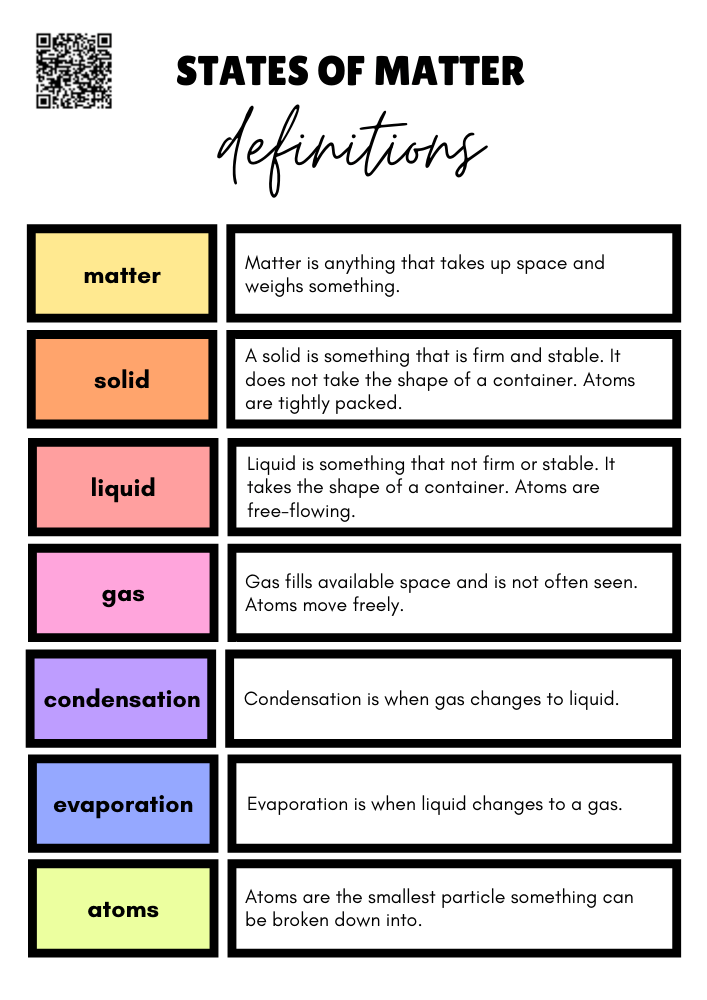
States of Matter Vocabulary Word Wall Flashcards

A colorful set of word‑wall flashcards teaching solids, liquids, and gases with clear definitions and engaging illustrations—helping kids understand states of matter through visual learning.
Hot and Cold Activity Sort Worksheets
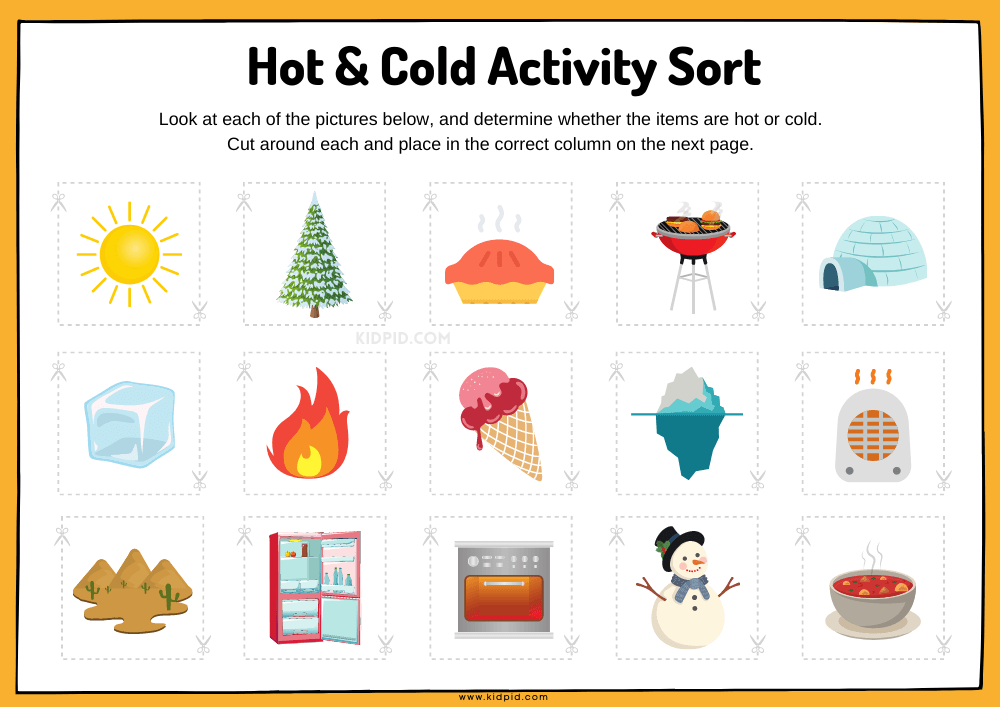
A fun, hands‑on worksheet where kindergarteners observe various items—like soup bowls, snowballs, microwaves—cut them out, and sort into “hot” or “cold” columns, building temperature awareness and fine motor skills.