Matter is everything around us that takes up space, from the air we breathe to the food we eat. It exists in four main forms: solids, liquids, gases, and plasma. Each state looks and behaves differently, helping us understand the world better by learning how things change and move around us.
[Scroll Down for Download Link]
Contents
4 States of Matter Explained!


Matter is everything that occupies space.

It includes everything around you, such as the air you breathe.

The water you drink

The food you eat

However, matter comes in different forms.

Air is a gas that is all around you.

Water is a liquid that flows easily. It flows smoothly down the throat.

The plate that holds your food is a solid, which you can physically grasp.

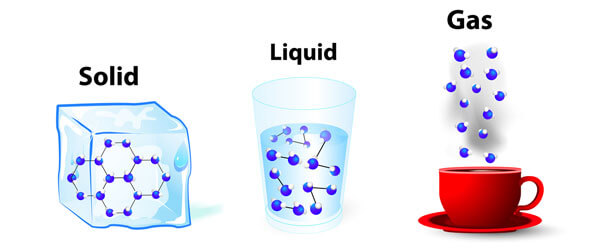
Matter exists primarily as solids, liquids, and gases. Some substances can easily change their state.

Water is a liquid

When water freezes, it turns into ice (a solid)

When it boils, it becomes water vapor (a gas)

Let’s begin with solids.

Solids have definite shapes. A book, for example, is rectangular.

while a ball is circular.

Solids consist of tiny units called particles.

They are tightly packed together, preventing them from moving freely or drifting away.

Solids can be tough, like a brick,

Or soft, like a cushion.

They can vary in weight, from heavy items like boulders.

Light ones like feathers.

They can be warm, like a slice of pizza.

or cold, like ice.

Here are some objects. Now, let’s identify some solids and circle them.

A book, a toy car, and a cup are all solids.

Next, we explore liquids.

Liquids don’t have their shape; they take the shape of whatever container they are in.

For example, water can fill a round bowl, a square pan, or a tall glass.

Liquids, like solids, are composed of tiny particles, but these particles are loosely held together, allowing them to slide past one another.

When you pour water, it flows smoothly.

It’s not like a solid, where the particles tumble and bang into each other.

Liquids are soft and not hard.

Liquids can be hot, like hot chocolate,

or cold, like lemonade.

Can you identify which of these objects are liquids?

You can see the glass of water, milk, soup, and juice.

Now, let’s move on to gases.

Gas particles are not held together. They float away and fill up space.

Gas particles are not bound together and can spread out to fill a space.

Gases can be light or heavy. For example, helium is lighter than air.

That is why helium balloons float.

Gases can be warm or cool; on a winter day, you can feel the cold air outside.

When you enter a warm room, you feel the difference.
Can you identify the different forms of matter in this picture?

In a given picture, you see ice as the solid,water as the liquid, and clouds as gas.

Another state of matter is plasma.

Plasma is a gas that has been energized and carries an electric charge.

The Sun and stars are mostly made of a type of matter called plasma.

On Earth, plasma can be observed in phenomena like lightning.

It is also used in applications such as neon signs.

Summary
- Matter is all around us. It’s everything that takes up space.
- There are different states of matter. They are solids, liquids, and gases.

- Solid particles are held together closely. They have a fixed shape.
- Liquid particles are held together loosely. They don’t have a shape.
- Gases are not held together. They float away.

- Matter can change states. Water can change to a solid (ice). It can change to a gas (water vapor).
- Plasma is a gas that has been heated and becomes charged with energy.

In conclusion, the four states of matter—solid, liquid, gas, and plasma—make up everything in our world. They can change from one form to another, like water freezing into ice or turning into steam. Knowing about these states helps us understand science better and see how nature works all around us.
You may like this:
Paragraph on ‘The Different States of Matter (Solid, Liquid, Gas)

A crisp, kid‑friendly paragraph on the different states of matter: explains solids with fixed shape, liquids adapting to containers, and gases spreading freely, highlighting how temperature or pressure changes can transform one into another.
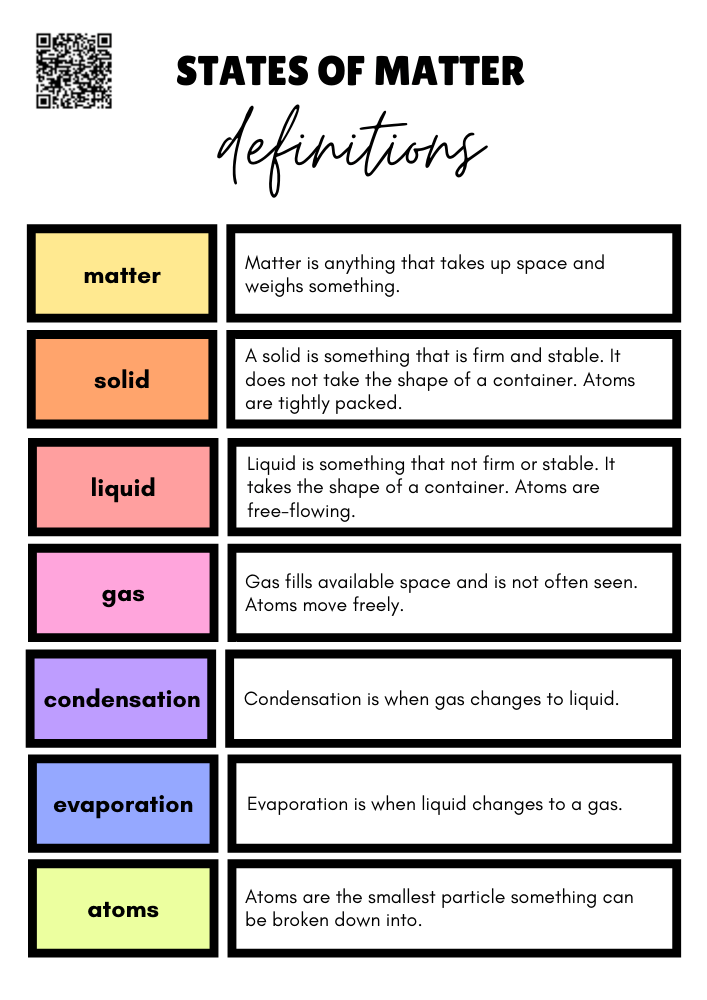
States of Matter Vocabulary Word Wall Flashcards

Bright and educational states of matter flashcards for kids: colorful cards defining solids, liquids, and gases with clear descriptions and engaging illustrations—making complex science concepts easy and fun to learn.
States of Water

A vibrant, child-friendly article on the states of water: explores water’s transformations—ice as solid, liquid drinking water, and steam as gas—using simple explanations and fun freezer and evaporation examples.
States of Matter – Solid, Liquid, Gas
A colorful, child-friendly article explaining states of matter—solid, liquid, and gas—with clear definitions, vivid examples (ice, water, air), and insights on state changes driven by heat and pressure.
States of Matter Science Worksheets for Kids
The states of matter science worksheets for kids: vibrant cut-and-paste and matching activities help children recognize solids, liquids, and gases—developing attention, reasoning, and scientific vocabulary through fun, hands-on learning.