

This engaging activity is designed to help first graders enhance their vocabulary, spelling skills, and cognitive abilities by unscrambling mixed-up letters to form the names of various birds. Perfectly tailored for curious minds, this worksheet not only reinforces language skills but also sparks an interest in ornithology. By solving these jumbled word puzzles, students will build their confidence in recognizing bird names while enjoying the challenge of decoding scrambled letters.
[Scroll Down for Download Link]
Contents
- Unscramble The Jumble Birds Words Worksheets For Grade 1
- Key Facts About Jumbled Birds Words Worksheet for Grade 1
- Parts/Types/Examples of Jumbled Birds Words Worksheet
- How Does the Worksheet Work?
- Benefits of Learning About Jumbled Bird Words
- Learning Objectives
- Worksheet Instructions
- Interesting Facts About Bird Vocabulary Words
- Real-Life Applications
- FAQs
Unscramble The Jumble Birds Words Worksheets For Grade 1
Read More: Birds can fly, but we don’t. Why?
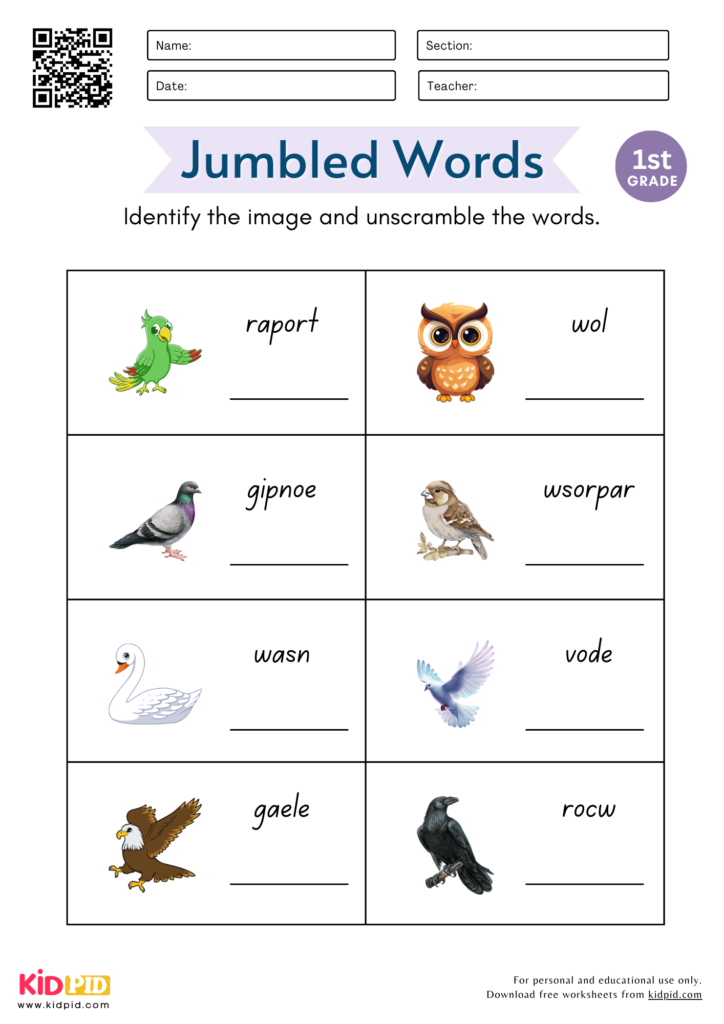
- parrot
- owl
- pigeon
- sparrow
- swan
- dove
- eagle
- crow
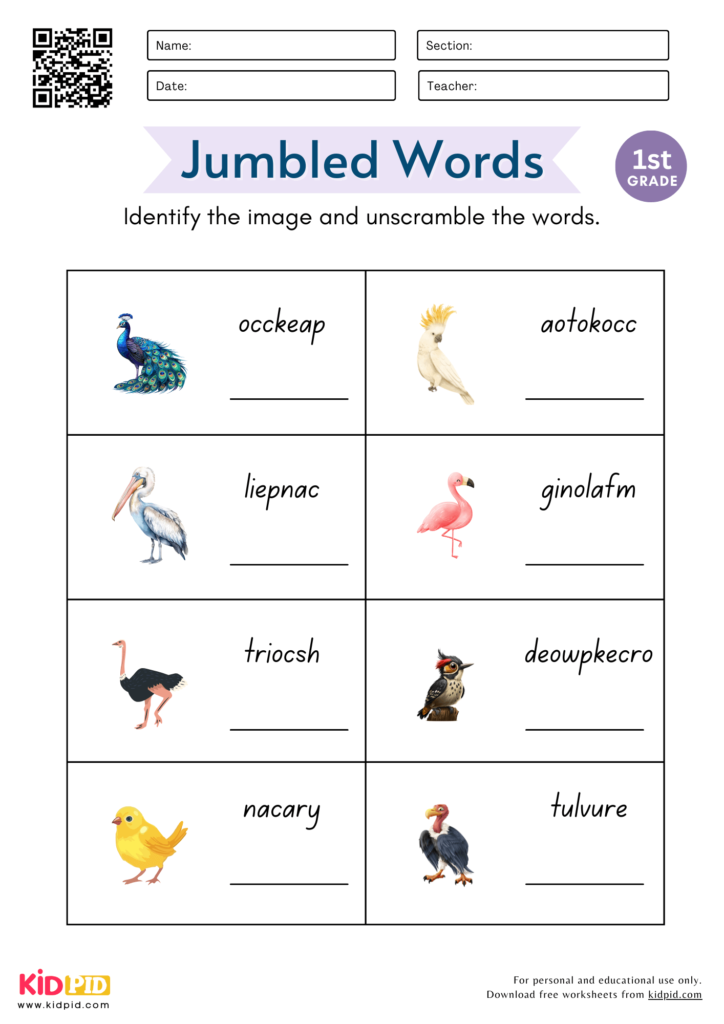
- peacock
- cockatoo
- pelican
- flamingo
- ostrich
- woodpecker
- canary
- vulture

- robin
- bluebird
- duck
- emu
- hummingbird
- kingfisher
- crane
- quail
Key Facts About Jumbled Birds Words Worksheet for Grade 1
- Educational Purpose: Designed to bridge the gap between literacy and natural science by teaching bird-related vocabulary.
- Target Audience: Specifically developed for Grade 1 students (approx. ages 6–7) to build spelling and cognitive foundation.
- Skill Focus: Enhances orthographic processing, word recognition, spelling accuracy, and pattern recognition.
- Accessibility: Created by an experienced educational content team, ensuring the material is age-appropriate and curriculum-aligned.
Parts/Types/Examples of Jumbled Birds Words Worksheet
The worksheet typically categorizes bird vocabulary into three levels of difficulty:
- Common Backyard Birds: Focuses on high-frequency words students are likely to see in their daily environment (e.g., crow, dove, owl, duck).
- Colorful & Notable Species: Introduces descriptive vocabulary often associated with birds (e.g., peacock, parrot, swan).
- Advanced Bird Vocabulary: Challenges students with longer, more complex bird names to test phonemic awareness (e.g., hummingbird, woodpecker, kingfisher).
How Does the Worksheet Work?
This worksheet functions as a cognitive puzzle. Students are provided with a list of “jumbled” letters—a random arrangement of characters that spell a specific bird name.
- Analysis: The student examines the jumbled letters.
- Visualization: They mentally rearrange the letters to identify the bird.
- Encoding: They write the correctly spelled word in the provided space, physically cementing the correct spelling pattern in their memory through the act of writing.
Benefits of Learning About Jumbled Bird Words
- Improved Spelling Retention: Unlike rote memorization, unscrambling forces the brain to analyze the sequence of letters, leading to better long-term retention.
- Cognitive Development: Promotes “lateral thinking,” where students must manipulate parts of a whole to solve a problem.
- Scientific Interest: By focusing on bird names, students are naturally introduced to biology and ornithology, fostering an interest in the natural world.
- Vocabulary Expansion: Directly grows the student’s lexicon, helping them express themselves more clearly in both writing and speaking.
Learning Objectives
- Correctly identify and spell a variety of common and unique bird species.
- Demonstrate mastery of letter sequence and phonetic patterns.
- Develop concentration and critical thinking skills.
- Gain confidence in solving word-based logic puzzles.
Worksheet Instructions
- Review the Jumbled Set: Start by looking at all the letters provided for each bird.
- Sound it Out: Say the letters aloud to help recognize potential sound combinations (blends or digraphs).
- Look for Patterns: Identify common bird-name suffixes or prefixes (e.g., “bird” at the end of bluebird).
- Write and Verify: Fill in the correct word, then double-check the spelling against the original list.
Interesting Facts About Bird Vocabulary Words
- Phonetic Diversity: Bird names range from simple, one-syllable words like crow to complex, multi-syllabic ones like hummingbird, making them perfect for diverse learning levels.
- Descriptive Naming: Many bird names are literal descriptions of the bird’s appearance or behavior (e.g., woodpecker pecks wood; bluebird is blue).
- Linguistic History: Many bird names have ancient roots, helping students understand the history of the English language.
Real-Life Applications
- Nature Walks: Students can identify birds they see in the park or backyard, reinforcing the vocabulary they learned.
- Creative Writing: These words serve as building blocks for young learners when they begin writing stories about nature or animals.
- General Literacy: The spelling strategies used here (recognizing patterns) are transferable to every other subject in the Grade 1 curriculum.
FAQs
Q1. At what age is this worksheet most effective?
Answer: This is designed for Grade 1 (ages 6–7), but it is excellent for any early reader who is practicing phonics and spelling.
Q2. How can I help my child if they get stuck?
Answer: Instead of answering, try asking them, “What sounds do you hear in this bird’s name?” or “Can you find a vowel that might go in the middle?”
Q3. Can these worksheets be used for classroom group work?
Answer: Yes! These worksheets are great for “pair-and-share” activities, where students work together to unscramble the words.
Q4. Where can I find more worksheets like this?
Answer: You can explore the Kidpid library for more English grammar and vocabulary printables designed for primary education.
Jumbled Bird Words Worksheets help Grade 1 students unscramble bird names while building vocabulary and spelling skills. These fun activities improve word recognition, reading confidence, logical thinking, and language development. Explore our educational collection featuring worksheets, essays, paragraphs, flashcards, quizzes, and interactive resources. Connect with us on YouTube & Facebook.
This worksheet was created by the Content Team to support academic progress.
Reviewed By Riten
Read More:



