

One effective method to enhance their vocabulary and spelling skills is through engaging activities like the Jumbled Stationery Words Worksheet for Grade 1. This worksheet is specifically designed to help first graders become familiar with common stationery items by unscrambling mixed-up letters to form correct words.
[Scroll Down for Download Link]
Contents
- Unscramble The Jumble Stationery Words Worksheets For Grade 1
- Key Facts About the Jumbled Stationery Words Worksheet
- Parts, Types, and Examples of Stationery Words
- How Does This Worksheet Work?
- Benefits of Learning About Jumbled Stationery Words
- Learning Objectives
- Worksheet Instructions
- Interesting Facts About Stationery Vocabulary Words
- Real-Life Applications
- FAQs
Unscramble The Jumble Stationery Words Worksheets For Grade 1
Read More: Make Compound Words Printable Worksheets for Grade 1
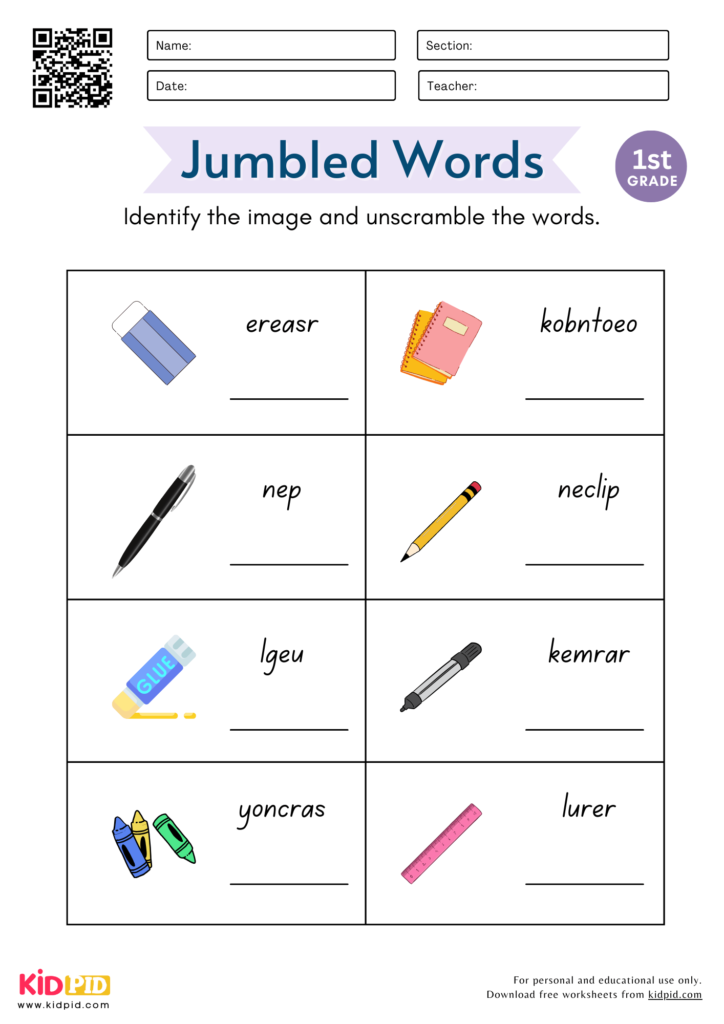
- eraser
- notebook
- pen
- pencil
- glue
- marker
- crayons
- ruler

- sharpener
- scissors
- clipboard
- paperclip
- hole punch
- tape
- book
- stamp
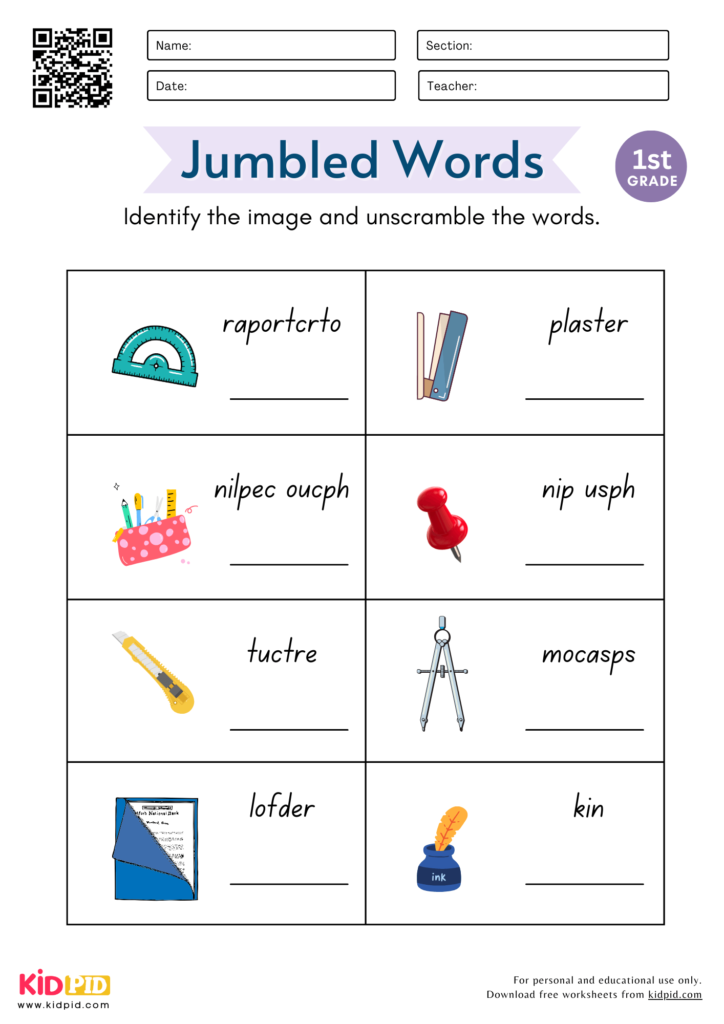
- protractor
- stapler
- pencil pouch
- push pin
- cutter
- compass
- folder
- ink
Key Facts About the Jumbled Stationery Words Worksheet
- Target Audience: Specifically designed for Grade 1 students (ages 6–7).
- Educational Focus: Improving spelling accuracy, vocabulary acquisition, and pattern recognition.
- Topic: Common stationery and school supplies.
- Pedagogical Approach: Uses gamified learning (unscrambling) to make spelling practice less intimidating and more interactive.
- Expert Review: Developed and curated by experienced educators and curriculum specialists to ensure alignment with primary learning standards.
Parts, Types, and Examples of Stationery Words
To master these worksheets, students work with categorized vocabulary. Here are the types of stationery items covered:
- Writing & Correction Tools: Pen, Pencil, Marker, Eraser.
- Paper & Organizing Supplies: Notebook, Book, Folder, Clipboard.
- Adhesives & Cutting Tools: Glue, Scissors, Tape, Cutter.
- Art & Measurement Tools: Crayons, Ruler, Protractor, Compass.
- Office/School Essentials: Sharpener, Stapler, Paperclip, Hole punch, Push pin, Ink, Stamp, Pencil pouch.
How Does This Worksheet Work?
This worksheet functions on the principle of cognitive reconstruction. Students are presented with scrambled letters (e.g., “ELIPCN”) and must rearrange them to form the correct word (“PENCIL”). This process forces the brain to:
- Analyze the individual letter components.
- Recall the visual spelling of the word.
- Synthesize the letters into the correct sequence. It transforms passive reading into an active problem-solving task.
Benefits of Learning About Jumbled Stationery Words
- Boosts Spelling Confidence: Repeatedly unscrambling words helps solidify the mental image of correct spelling.
- Enhances Cognitive Flexibility: Challenging the brain to reorder sequences builds essential critical thinking skills.
- Vocabulary Expansion: Introducing students to tools like “protractor” or “stapler” expands their lexicon beyond basic school supplies.
- Engagement: Gamification removes the “drill and kill” monotony often associated with rote spelling practice.
Learning Objectives
- Accurately identify and spell at least 15+ common stationery vocabulary words.
- Demonstrate improved visual memory for letter patterns.
- Develop foundational organizational skills by categorizing objects found in their daily school environment.
Worksheet Instructions
- Preparation: Download and print the worksheet. Ensure the student has a sharpened pencil and an eraser ready.
- Guided Practice: Start with a few examples together. Say the scrambled word aloud to help the student hear the phonetic components.
- Independent Task: Allow the student to attempt the jumbles. Encourage them to cross out letters as they use them to keep track of their progress.
- Review: Once finished, check the spelling against the correct word list. Use any missed words as a focus for the next session.
Interesting Facts About Stationery Vocabulary Words
- Etymology: Many school supplies have fascinating histories! For example, the word “pencil” comes from the Latin word penicillus, meaning “little tail.”
- Global Standard: Stationery items are universal, making them an excellent “bridge” topic for ESL students to learn common English nouns.
- Tool Evolution: Comparing modern items like a “mechanical pencil” to historical tools like a “quill” can spark great classroom discussions about how technology changes our learning environment.
Real-Life Applications
- Classroom Readiness: Students who recognize these words are better prepared to follow instructions like, “Get your ruler from your pencil pouch.”
- Writing Fluency: A strong grasp of common object names allows students to write descriptive sentences about their school day with greater ease and fewer spelling errors.
- Independence: Knowing the names of these tools empowers children to ask for specific items they need, fostering autonomy in the classroom.
FAQs
Q1. At what age should a child start these worksheets?
Answer: These are specifically curated for Grade 1 (ages 6–7), but they are excellent for any child starting to read and write independently.
Q2. Can I use this for homeschooling?
Answer: Absolutely! These worksheets are a staple resource for parents and educators focusing on supplementary literacy activities.
Q3. How often should my child complete these?
Answer: Consistency is key. Practicing one sheet twice a week is generally more effective than doing five sheets in one sitting.
Q4. Where can I find more resources like this?
Answer: Explore the Kidpid library for more English grammar, spelling, and vocabulary worksheets tailored to primary school standards.
The Jumbled Stationary Words Worksheet for Grade 1 is an engaging and educational tool that enhances young students’ spelling and cognitive skills. By solving jumbled words, children not only improve their vocabulary but also develop critical thinking abilities, making early learning both fun and effective. Visit our website for worksheets, essays, flashcards, quizzes, paragraphs, and interactive resource plus interactive educational resources for kids. Visit our website, YouTube & Facebook.
The worksheet is developed by the Content Team to enhance learning assistance.
Reviewed By Parul Rana
Read More:



