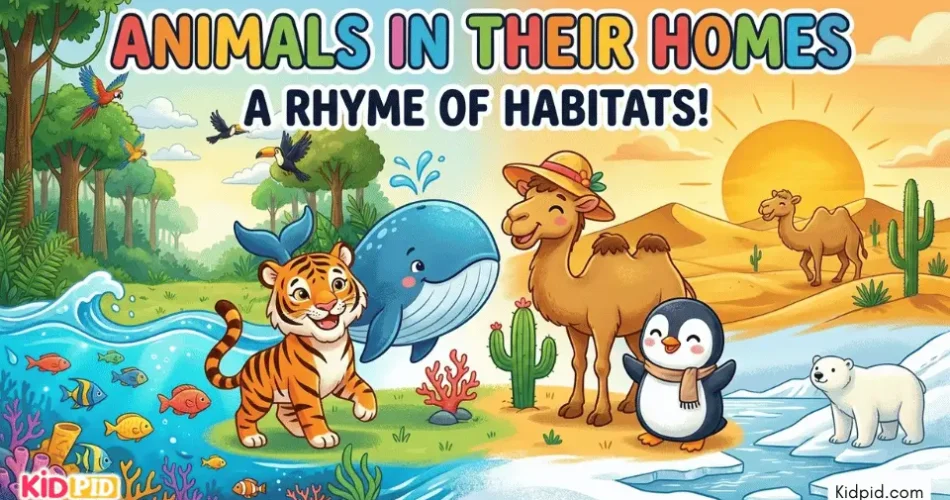
Animal Habitats Rhyme for Kids is a fun and educational poem that introduces children to the fascinating places where animals live. From lush forests and deep oceans to hot deserts and icy polar regions, each habitat provides unique conditions that help animals survive and thrive. This engaging rhyme helps preschoolers, kindergarteners, and elementary students learn about animal habitats, ecosystems, wildlife, nature, and environmental science through simple words and memorable rhythms. By exploring different habitats, children can develop a better understanding of biodiversity, animal adaptation, and the importance of protecting our natural world.
Contents
- Animals in Their Homes – Habitats Rhyme for Kids
- What Are Animal Habitats?
- Learning Benefits of This Animal Habitats Rhyme
- Fun Facts About Animal Habitats
- Why Protecting Habitats Is Important
- FAQs
- Q1. What is an animal habitat?
- Q2. What are the main types of animal habitats?
- Q3. Why is it important for children to learn about animal habitats?
- Q4. Which animals live in forest habitats?
- Q5. What animals can be found in ocean habitats?
- Q6. How do animals adapt to their habitats?
- Q7. What skills can children develop from animal habitat rhymes?
- Q8. How can we help protect animal habitats?
Animals in Their Homes – Habitats Rhyme for Kids
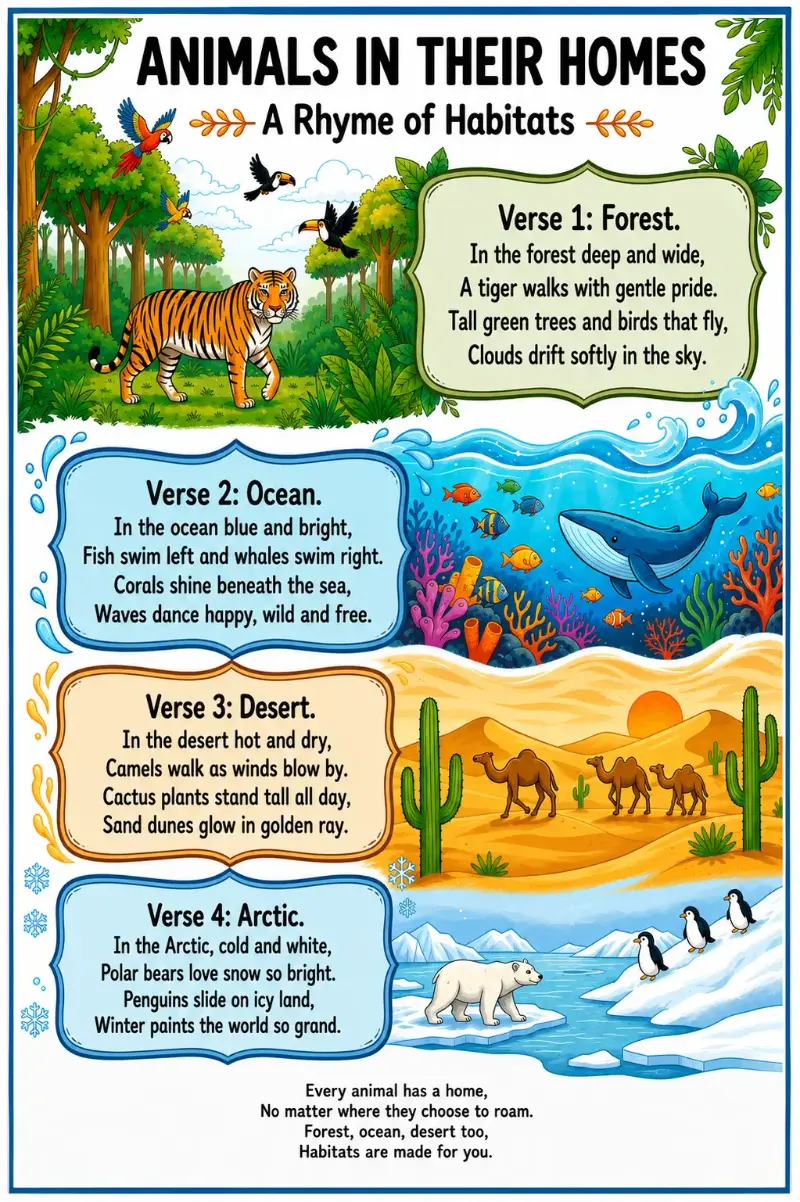
Help children discover different animal habitats while building vocabulary, environmental awareness, and reading confidence through a fun educational rhyme.
Explore the amazing world of animal habitats through this educational rhyme for kids. Children learn where animals live, from forests and oceans to deserts and the Arctic. The colorful illustrations make science and geography concepts easy to understand and remember.
What Are Animal Habitats?
An animal habitat is the natural place where an animal lives, finds food, gets shelter, and raises its young. Different animals need different habitats because each environment provides specific conditions necessary for survival.
Types of Animal Habitats :
Forest Habitat
- Home to tigers, monkeys, deer, birds, and insects.
- Provides trees, plants, food, and shelter.
Ocean Habitat
- Home to fish, whales, dolphins, sharks, and sea turtles.
- Covers most of Earth’s surface and supports diverse marine life.
Desert Habitat
- Home to camels, lizards, snakes, and scorpions.
- Receives very little rainfall and experiences extreme temperatures.
Polar Habitat
- Home to polar bears, seals, Arctic foxes, and penguins.
- Characterized by snow, ice, and extremely cold weather.
Learning Benefits of This Animal Habitats Rhyme
- Builds understanding of different ecosystems.
- Improves science and environmental knowledge.
- Enhances vocabulary related to animals and nature.
- Strengthens listening, memory, and reading skills.
- Encourages curiosity about wildlife and conservation.
- Supports classroom and homeschooling activities.
Fun Facts About Animal Habitats
- Rainforests contain more animal species than any other habitat.
- Oceans cover about 70% of the Earth’s surface.
- Camels can survive for days without water in desert habitats.
- Polar bears have thick fur and fat layers to stay warm in freezing temperatures.
- Coral reefs are often called the “rainforests of the sea” because of their rich biodiversity.
Why Protecting Habitats Is Important
Animal habitats provide everything wildlife needs to survive. Pollution, deforestation, climate change, and habitat destruction can threaten many species. Teaching children about habitats helps them develop respect for nature and encourages responsible environmental behavior from an early age.
FAQs
Q1. What is an animal habitat?
Answer: An animal habitat is the natural environment where an animal lives, finds food, water, shelter, and space to survive and reproduce.
Q2. What are the main types of animal habitats?
Answer: The main types of animal habitats include forests, oceans, deserts, grasslands, wetlands, and polar regions. Each habitat supports different kinds of plants and animals.
Q3. Why is it important for children to learn about animal habitats?
Answer: Learning about animal habitats helps children understand nature, biodiversity, ecosystems, and how animals adapt to different environments. It also encourages environmental awareness and conservation.
Q4. Which animals live in forest habitats?
Answer: Many animals live in forests, including tigers, deer, monkeys, bears, birds, and insects. Forests provide food, shelter, and protection for wildlife.
Q5. What animals can be found in ocean habitats?
Answer: Ocean habitats are home to fish, whales, dolphins, sharks, sea turtles, octopuses, and many other marine animals.
Q6. How do animals adapt to their habitats?
Answer: Animals develop special features and behaviors that help them survive in their environment. For example, camels store fat to survive in deserts, while polar bears have thick fur to stay warm in cold climates.
Q7. What skills can children develop from animal habitat rhymes?
Answer: Animal habitat rhymes help improve reading fluency, listening skills, vocabulary, memory, comprehension, and early science knowledge.
Q8. How can we help protect animal habitats?
Answer: We can protect animal habitats by reducing pollution, conserving natural resources, planting trees, recycling, and supporting wildlife conservation efforts.
Animal habitats are special places that provide food, water, shelter, and safety for living creatures. Through this fun and educational rhyme, children can discover how animals adapt to forests, oceans, deserts, and polar regions. Understanding habitats helps young learners appreciate biodiversity, develop environmental awareness, and recognize the importance of protecting wildlife. Keep exploring the amazing world of animals and nature to build a lifelong love for science, conservation, and learning. Explore our website for fresh paragraphs, essays, worksheets, flashcards, quizzes, and much more. Join us on YouTube & Facebook for daily educational videos and fun-filled activities for children.