


Learning how to form compound words is an essential skill for young readers and writers. Compound words are created when two individual words are joined together to create a new word with a unique meaning. For first graders, mastering this concept not only enhances their vocabulary but also boosts their ability to understand and construct more complex sentences.
[Scroll Down for Download Link]
Contents
- Learn Compound Word Worksheets For Grade 1
- Key Facts About Complete the Compound Words Worksheet for Grade 1
- Parts/Types/Examples of Complete the Compound Words Worksheet for Grade 1
- How Does the Complete the Compound Words Worksheet for Grade 1 Work?
- Benefits of Learning About Completing the Compound Words Worksheet for Grade 1
- Learning Objectives
- Worksheet Instructions
- Interesting Facts About Compound Word Vocabulary Words
- Real-Life Applications
- FAQs
- Q1. What are compound words?
- Q2. Why are compound words important for Grade 1 students?
- Q3. What is an example of a compound word?
- Q4. How can children learn compound words easily?
- Q5. Are compound words used in everyday language?
- Q6. How do compound word worksheets improve literacy skills?
- Q7. Can compound words help with writing skills?
- Q8. What age group is this worksheet suitable for?
- You may like these:
Learn Compound Word Worksheets For Grade 1
Read More: Compound Words: Learn to Read (Book)

- Notebook
- Schoolbus
- Grasshopper
- Playmate
- Flashlight

- Backbone
- Playhouse
- Stepfather
- Jetport
- Firefly

- Southeast
- Bookshelf
- Honeymoon
- Waterpark
- Baseball

- Starfish
- Handbag
- Cupcake
- Playtime
- Sunbath
Key Facts About Complete the Compound Words Worksheet for Grade 1
The Complete the Compound Words Worksheet for Grade 1 helps young learners understand how two smaller words can combine to create a new word with a different meaning. This worksheet strengthens vocabulary, spelling, reading comprehension, and word-building skills through engaging activities. Students identify missing word parts and complete compound words such as sunflower, toothbrush, and raincoat. Designed for first-grade learners, it supports early literacy development while encouraging critical thinking and language recognition.
Key Facts:
- Suitable for Grade 1 students.
- Focuses on compound word formation.
- Improves vocabulary and spelling skills.
- Enhances reading and language comprehension.
- Uses interactive fill-in-the-blank activities.
- Supports independent and classroom learning.
Parts/Types/Examples of Complete the Compound Words Worksheet for Grade 1
Compound word worksheets can include different activity formats that help children practice word-building skills.
Parts of the Worksheet:
- Word fragments or halves
- Picture clues
- Fill-in-the-blank sections
- Matching exercises
- Vocabulary review activities
Types of Compound Words:
- Closed Compound Words – Written as one word (e.g., football, cupcake).
- Hyphenated Compound Words – Joined with a hyphen (e.g., mother-in-law).
- Open Compound Words – Written as separate words (e.g., ice cream).
Examples:
- Sun + flower = Sunflower
- Tooth + brush = Toothbrush
- Rain + coat = Raincoat
- Basket + ball = Basketball
- Snow + man = Snowman
How Does the Complete the Compound Words Worksheet for Grade 1 Work?
This worksheet presents students with incomplete compound words or separate word parts. Children must identify the correct missing word and combine the two words to form a meaningful compound word.
- Read the given word part carefully.
- Look at the picture or clue provided.
- Identify the missing word.
- Combine both words to create a compound word.
- Write the completed word in the space provided.
- Review the word’s meaning and pronunciation.
This hands-on practice helps children recognize patterns in language and improve word recognition skills.
Benefits of Learning About Completing the Compound Words Worksheet for Grade 1
Learning compound words provides a strong foundation for reading and vocabulary development.
Benefits Include:
- Expands vocabulary knowledge.
- Improves spelling accuracy.
- Strengthens reading fluency.
- Enhances word recognition skills.
- Develops critical thinking and problem-solving abilities.
- Encourages understanding of word meanings.
- Supports early writing development.
- Builds confidence in language learning.
Regular practice with compound words helps children become more effective readers and writers.
Learning Objectives
By completing this worksheet, students will be able to:
- Identify common compound words.
- Combine two simple words to form a new word.
- Understand the meaning of compound words.
- Improve vocabulary and spelling skills.
- Strengthen reading comprehension.
- Develop word analysis and decoding abilities.
- Apply compound words in speaking and writing activities.
Worksheet Instructions
Follow these simple steps to complete the worksheet:
- Read each word or word fragment carefully.
- Observe any picture clues provided.
- Think about which word completes the compound word.
- Write the missing word in the blank space.
- Read the completed compound word aloud.
- Check your answers after finishing the worksheet.
- Practice using the compound words in sentences.
Take your time and have fun learning new vocabulary words.
Interesting Facts About Compound Word Vocabulary Words
Compound words are fascinating because they show how language can create new meanings by combining simple words.
Interesting Facts:
- English contains thousands of compound words.
- Many everyday words are compound words, such as bedroom and playground.
- Compound words can be nouns, verbs, or adjectives.
- New compound words are created regularly as language evolves.
- Understanding compound words helps students guess the meanings of unfamiliar words.
- Many compound words are easier to remember because they combine familiar words.
These facts make compound words an exciting part of early language learning.
Real-Life Applications
Compound words appear everywhere in daily life and communication.
Real-Life Uses:
- Reading storybooks and school textbooks.
- Understanding signs and labels such as bathroom and playground.
- Writing sentences and creative stories.
- Improving classroom communication skills.
- Building a stronger vocabulary for future academic success.
- Recognizing words in newspapers, advertisements, and digital content.
Learning compound words helps children become more confident readers and effective communicators.
FAQs
Q1. What are compound words?
Answer: Compound words are words formed by combining two smaller words to create a new word with a unique meaning.
Q2. Why are compound words important for Grade 1 students?
Answer: They help improve vocabulary, spelling, reading comprehension, and word-building skills.
Q3. What is an example of a compound word?
Answer: A common example is the sunflower, which combines sun and flower.
Q4. How can children learn compound words easily?
Answer: Children can practice through worksheets, reading books, word games, and picture-matching activities.
Q5. Are compound words used in everyday language?
Answer: Yes. Many everyday words, such as toothbrush, notebook, and raincoat, are compound words.
Q6. How do compound word worksheets improve literacy skills?
Answer: They help students recognize word patterns, understand meanings, improve spelling, and strengthen reading fluency.
Q7. Can compound words help with writing skills?
Answer: Yes. A larger vocabulary enables children to write clearer and more descriptive sentences.
Q8. What age group is this worksheet suitable for?
Answer: This worksheet is primarily designed for Grade 1 students, but it can also benefit kindergarten and Grade 2 learners who are developing vocabulary skills.

Complete the Compound Words Worksheets to help Grade 1 students build vocabulary by filling in missing word parts. These fun activities improve spelling, reading, word recognition, language skills, and learning confidence. Explore more free worksheets, paragraphs, flashcards, quizzes, and interactive resources on Kidpid. Practice daily to improve your skills. Follow us on Facebook, Pinterest, YouTube, and Telegram. Join our Telegram group for free printables. Thanks for visiting, and keep learning!
The Content Team created this worksheet to improve learning outcomes.
Reviewed By Sansriti Pandey
You may like these:
Compound Words Matching Puzzles Worksheets for Kindergarten

Compound Words Matching Puzzles Worksheets help kindergarten kids learn new words by joining two smaller words, like “sun” and “flower” to make “sunflower.” These fun puzzles improve vocabulary and thinking skills.
Compound Words Flashcards
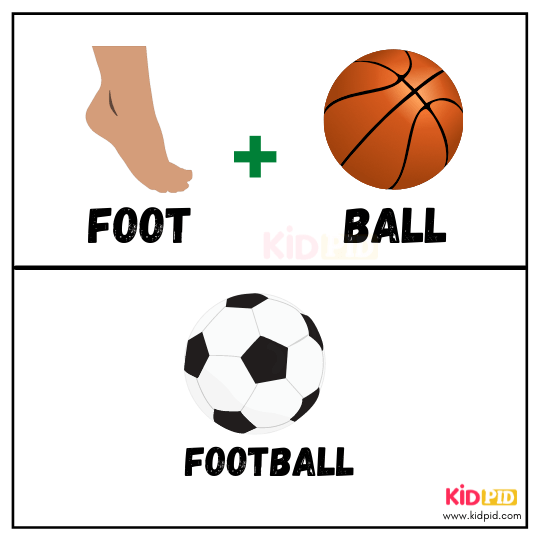
Compound Words Flashcards help kids learn by combining two words to make a new one, like “rain” + “bow” = “rainbow.” They make learning fun, improving vocabulary and reading skills easily.
Compound Words Printable Worksheets for Grade 1
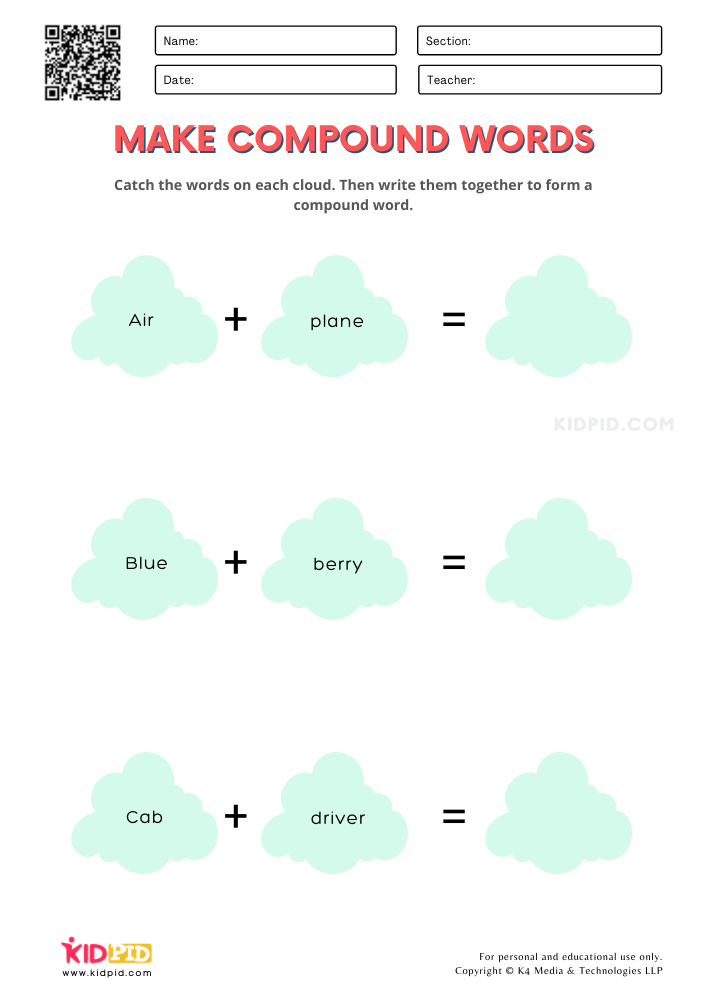
Grade 1 students practice forming compound words with these simple and engaging worksheets, enhancing their vocabulary, spelling, and language skills in a fun way.
Identify Compound Words Printable Worksheets
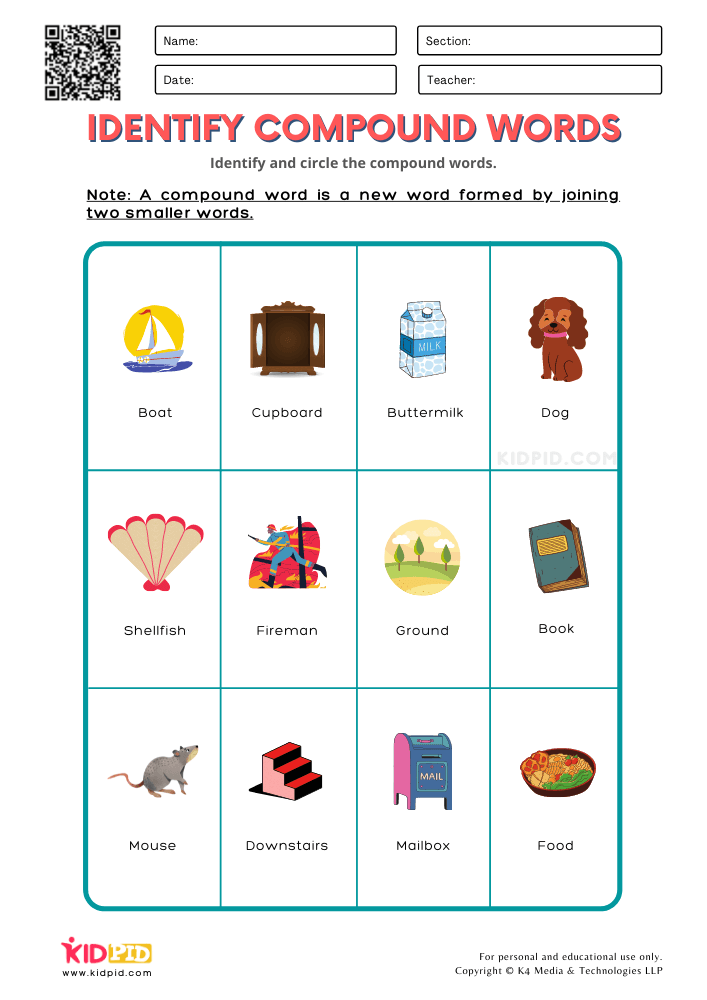
These worksheets help Grade 1 students identify and understand compound words through interactive exercises, strengthening their language skills and word recognition abilities.
Compound Words Printable Worksheets for Grade 1
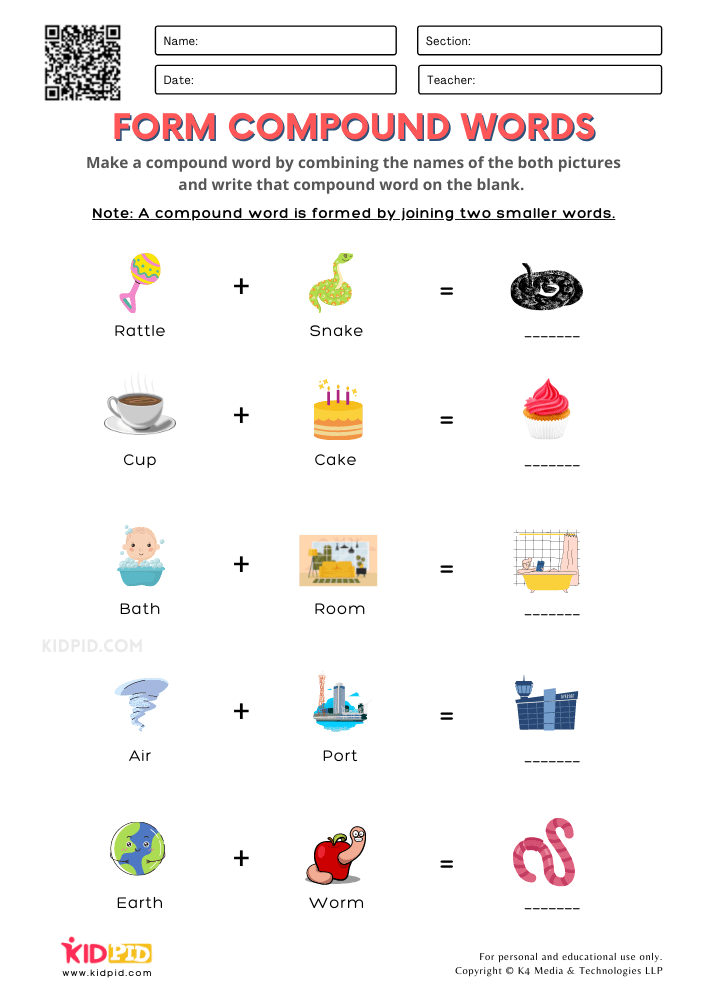
These worksheets help Grade 1 students learn compound words through fun and interactive activities. Engaging exercises improve vocabulary, spelling, and word recognition skills effectively.



