

This “Fractions, Decimals and Percentages Word Problem Maths Worksheet” is designed to challenge Grade 6 students’ ability to apply their knowledge of these mathematical concepts to real-world scenarios. Through a series of engaging word problems, students will practice interpreting information, setting up equations, and finding solutions that combine fractions, decimals, and percentages.
Read More: Coordinate Grid Maths Worksheet for Grade 4
Contents
- Fractions, Decimals, and Percentages Word Problem Maths Worksheet for Grade 6 – 1
- Fractions, Decimals and Percentages Word Problem Maths Worksheet for Grade 6 – 2
- Fractions, Decimals, and Percentages Word Problem Maths Worksheet for Grade 6 – 3
- Key Facts About Word Problem Maths Worksheet
- Parts, Types, and Examples of Word Problems
- How Does the Worksheet Work?
- Benefits of Learning Fractions, Decimals, and Percentages
- Learning Objectives
- Worksheet Instructions
- Interesting Facts About Fractions, Decimals, and Percentages
- Vocabulary Words
- Real-Life Applications
- FAQs
- Q1. Why should Grade 6 students learn fractions, decimals, and percentages together?
- Q2. How do word problems improve mathematical understanding?
- Q3. Are percentages and fractions related?
- Q4. What skills does this worksheet develop?
- Q5. Can these concepts be used outside the classroom?
- Q6. How often should students practice these problems?
Fractions, Decimals, and Percentages Word Problem Maths Worksheet for Grade 6 – 1
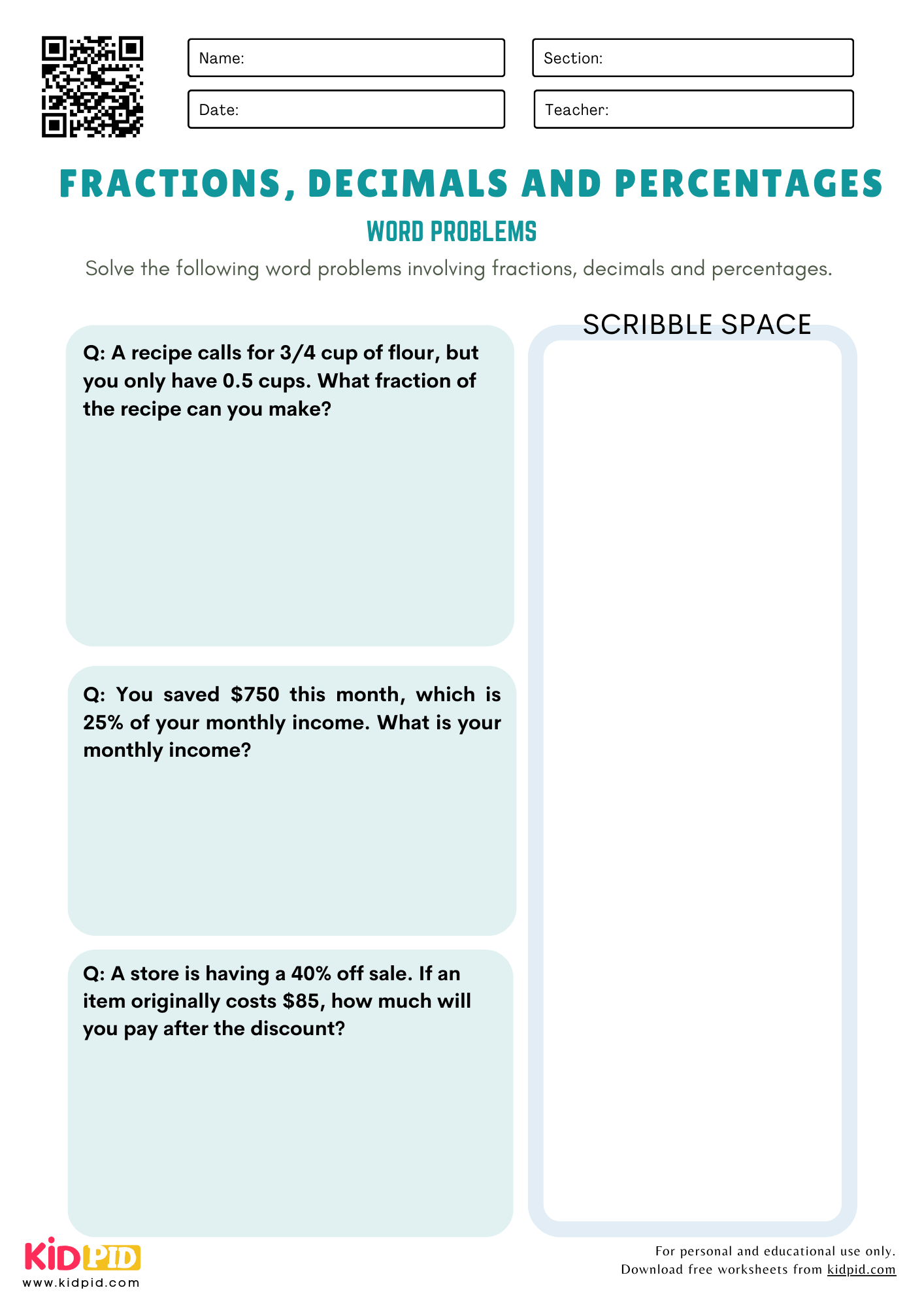
- 0.5 cups / (3/4 cups) = 2/3 of the recipe.
- $750 is 25% of the monthly income, so the monthly income = $750 / 0.25 = $3,000
- Original price – 40% of $85 = $85 – ($85 x 0.4) = $51.
Fractions, Decimals and Percentages Word Problem Maths Worksheet for Grade 6 – 2

- 2.75 liters / 5 liters = 0.55 or 55% of the container will be filled.
- Fraction sold = 25/40 = 5/8.
Decimal sold = 5/8 = 0.625.
Percentage sold = 0.625 x 100 = 62.5%. - 20% off $60 = $60 – ($60 x 0.2) = $48.
You will pay $48 for the jacket.
Fractions, Decimals, and Percentages Word Problem Maths Worksheet for Grade 6 – 3
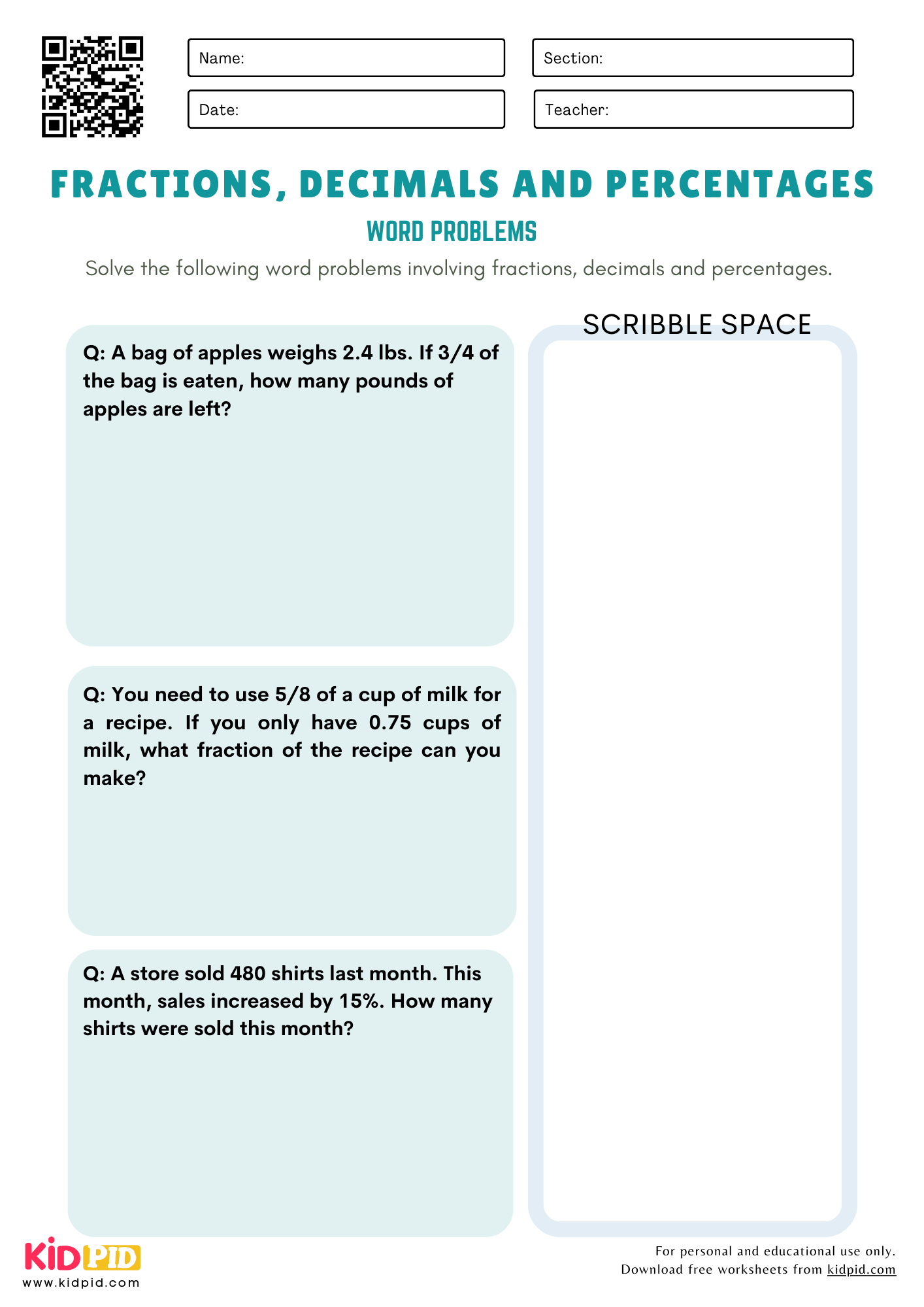
- 2.4 lbs x (1 – 3/4) = 2.4 lbs x 1/4 = 0.6 lbs of apples left.
- 0.75 cups / 5/8 cups = 0.75 / 0.625 = 1.2, so you can make the full recipe.
- 480 shirts x 1.15 = 552 shirts sold this month.
Key Facts About Word Problem Maths Worksheet
- Designed for Grade 6 students to strengthen number sense and problem-solving skills.
- Focuses on converting and comparing fractions, decimals, and percentages.
- Uses real-world word problems to make mathematical concepts practical and meaningful.
- Helps students understand the relationship between fractions, decimals, and percentages.
- Supports curriculum standards related to numerical reasoning and data interpretation.
- Encourages critical thinking, logical reasoning, and mathematical communication.
Parts, Types, and Examples of Word Problems
Parts of the Worksheet
- Word problem scenarios
- Numerical data and clues
- Space for calculations
- Answer sections
- Conversion and comparison exercises
Types of Questions
- Fraction to percentage conversions
- Decimal to fraction conversions
- Percentage increase and decrease problems
- Shopping and discount calculations
- Data interpretation questions
Examples
- What percentage of a class of 40 students is 10 students?
- Convert 0.75 into a fraction and a percentage.
- A store offers a 20% discount on a ₹500 item. What is the final price?
How Does the Worksheet Work?
The worksheet presents students with everyday situations involving fractions, decimals, and percentages.
Learners read each word problem, identify relevant information, perform calculations, and write their answers.
By solving multiple scenarios, students practice converting between forms and applying mathematical concepts
to real-life contexts. This approach builds confidence while improving analytical and computational skills.
Benefits of Learning Fractions, Decimals, and Percentages
- Improves problem-solving and logical reasoning skills.
- Strengthens understanding of numerical relationships.
- Enhances mental math and calculation accuracy.
- Prepares students for advanced mathematics topics.
- Develops confidence in handling real-world numerical data.
- Supports financial literacy and decision-making skills.
Learning Objectives
By completing this worksheet, students will be able to:
- Convert fractions, decimals, and percentages accurately.
- Solve multi-step mathematical word problems.
- Compare numerical values represented in different forms.
- Apply mathematical concepts to practical situations.
- Interpret and analyze quantitative information.
- Improve mathematical reasoning and communication.
Worksheet Instructions
- Read each word problem carefully.
- Identify whether fractions, decimals, or percentages are involved.
- Highlight important numbers and keywords.
- Perform the necessary calculations.
- Show your work whenever possible.
- Check conversions and answers for accuracy.
- Review completed questions before submission.
Interesting Facts About Fractions, Decimals, and Percentages
- Percent means “per hundred” and is represented by the symbol %.
- Fractions have been used for thousands of years in trade and measurement.
- Decimals simplify calculations involving parts of a whole.
- Every percentage can be expressed as a fraction and a decimal.
- Financial institutions, businesses, and scientists frequently use percentages and decimals.
- Fractions, decimals, and percentages represent the same value in different forms.
Vocabulary Words
- Fraction
- Numerator
- Denominator
- Decimal
- Percentage
- Equivalent
- Conversion
- Ratio
- Discount
- Increase
- Decrease
- Value
- Compare
- Whole
- Part
Real-Life Applications
- Calculating shopping discounts and sales tax.
- Understanding bank interest rates.
- Interpreting sports statistics and scores.
- Reading nutrition labels and ingredient percentages.
- Analyzing survey and research data.
- Managing personal budgets and expenses.
- Measuring ingredients in cooking and baking.
FAQs
Q1. Why should Grade 6 students learn fractions, decimals, and percentages together?
Answer: These concepts represent the same values in different forms and are commonly used in everyday life and higher-level mathematics.
Q2. How do word problems improve mathematical understanding?
Answer: Word problems help students apply mathematical concepts in realistic situations, improving comprehension and problem-solving abilities.
Answer: Yes. Every percentage can be written as a fraction with a denominator of 100 and converted into a decimal.
Q4. What skills does this worksheet develop?
Answer: It develops calculation skills, critical thinking, logical reasoning, data interpretation, and numerical fluency.
Q5. Can these concepts be used outside the classroom?
Answer: Absolutely. They are essential for shopping, budgeting, banking, statistics, measurements, and many everyday decisions.
Q6. How often should students practice these problems?
Answer: Regular practice, even a few problems each week, helps improve accuracy, speed, and confidence in mathematical problem-solving.
Every completed worksheet gives Grade 6 learners valuable practice using fractions, decimals, and percentages in realistic word problems. Consistent problem-solving develops numerical confidence, analytical thinking, mathematical accuracy, and everyday decision-making skills. Our website is filled with worksheets, essays, paragraphs, flashcards, quizzes, and interactive resources, as well as engaging learning resources for every child. Follow us on YouTube & Facebook.
This educational worksheet is prepared by the Content Team to promote classroom success.
Reviewed By Komal Singh