Kids are like an empty vase waiting to be filled with beautiful flowers of knowledge. At the initial stage of learning, kids not only learn from books but also from their surroundings and the activities they do on a regular basis. As adults, it is our duty to provide a healthy environment for them to learn and provide activities to do on a daily basis so that they don’t lose interest.
Most of the students find maths difficult and confusing. It is important to go slowly but steadily. Consistency is important, no matter if it is taking more time or less, but make sure the current topic is crystal clear before you move to another, because the base of the building should be strong. Start from the easy sums and slowly move to harder and in no time, kids will solve the sums at the snap of their fingers. Here are some worksheets with easy sums for kids so that they can get the topic easily.
Contents
- Decimal Adding Practice Worksheets
- Key Facts About Adding Decimals Math Worksheets
- Parts/Types/Examples of Adding Decimals Worksheets
- How Does Adding Decimals Work?
- Benefits of Learning About Adding Decimals
- Learning Objectives
- Worksheet Instructions
- Interesting Facts About Decimals
- Vocabulary Words
- Real-Life Applications
- FAQs
Decimal Adding Practice Worksheets
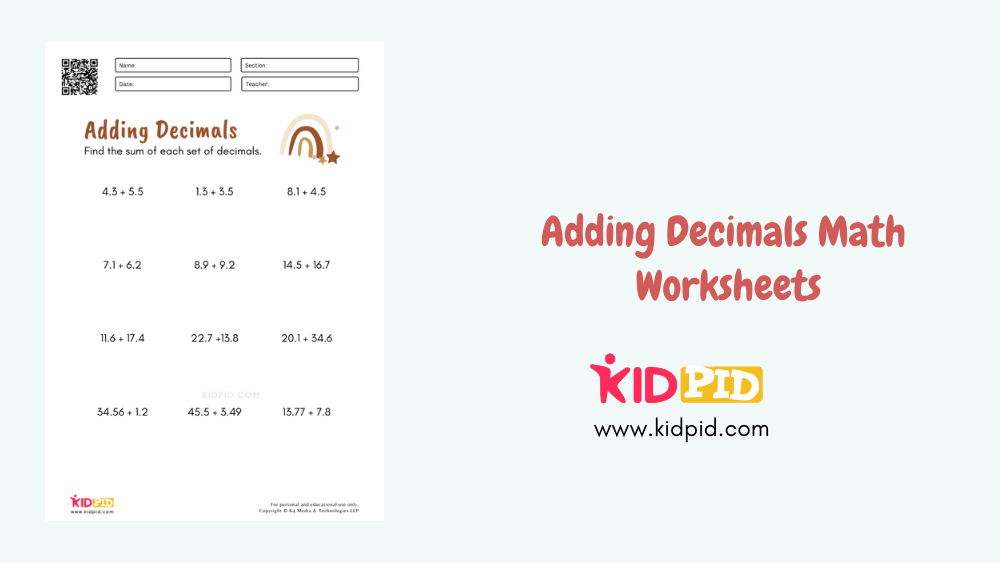
 The first thing taught in mathematics is numbers. There are numbers between the whole and fractional numbers, which are written after a small dot called a decimal. In these worksheets, easy sets of decimal numbers to add are provided. This may seem complicated to children, but it is very simple. Just write the numbers in a vertical row with the decimals lined up and add the numbers. Whatever answer you get, put the decimal just below the decimals lined up.
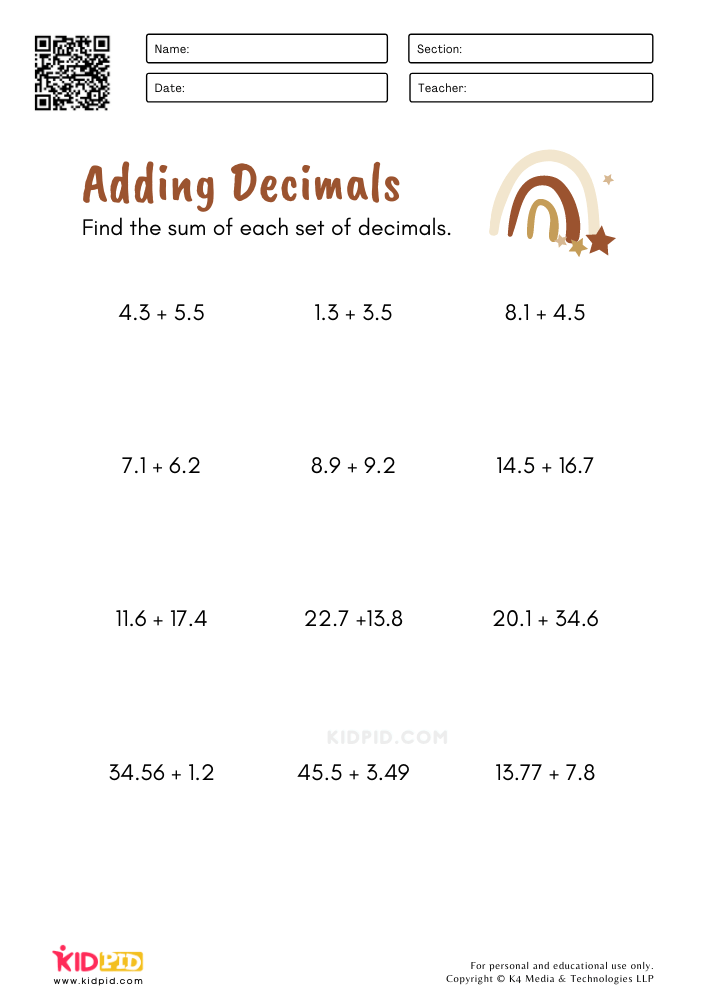
Here is the second worksheet, and hopefully, adding decimals has become easy till now. In this worksheet, the same procedure will be followed to solve, but the numbers are different for more practice. Ask your kids to make a rough note and do the calculation on it. By doing this, the sum will become easier, and there will be no confusion.
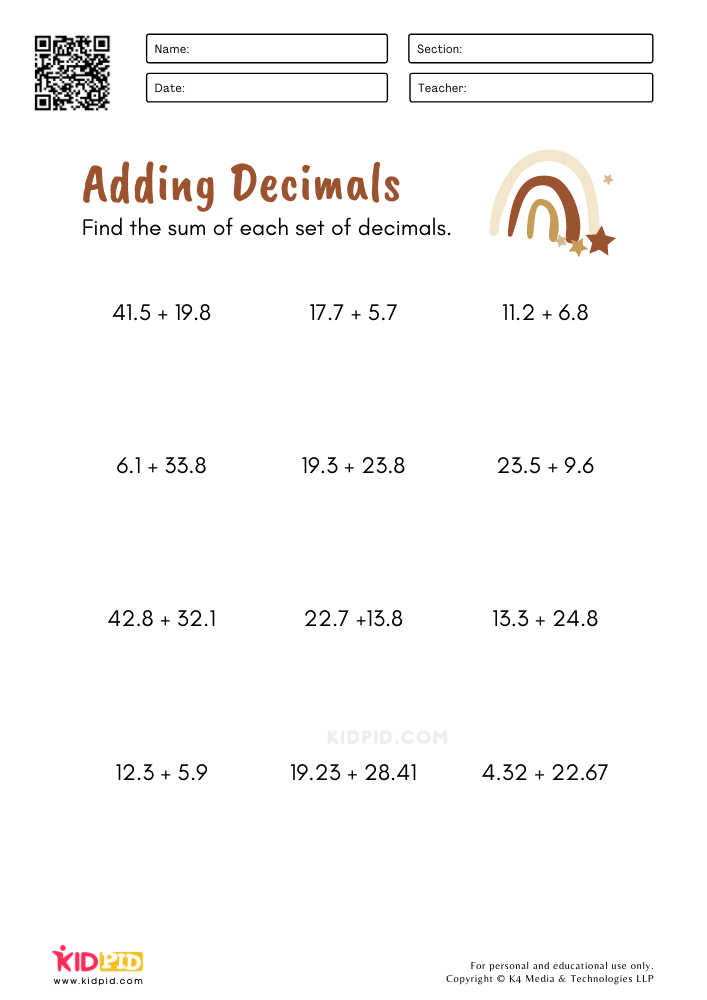
Kids may find some solutions difficult and time-consuming, and this may make them lose interest. Ask them to move on to another question rather than getting stuck on the same question, and come back to them later. By doing this, they won’t lose interest and will also get an idea to solve the previous question that they left by solving others.
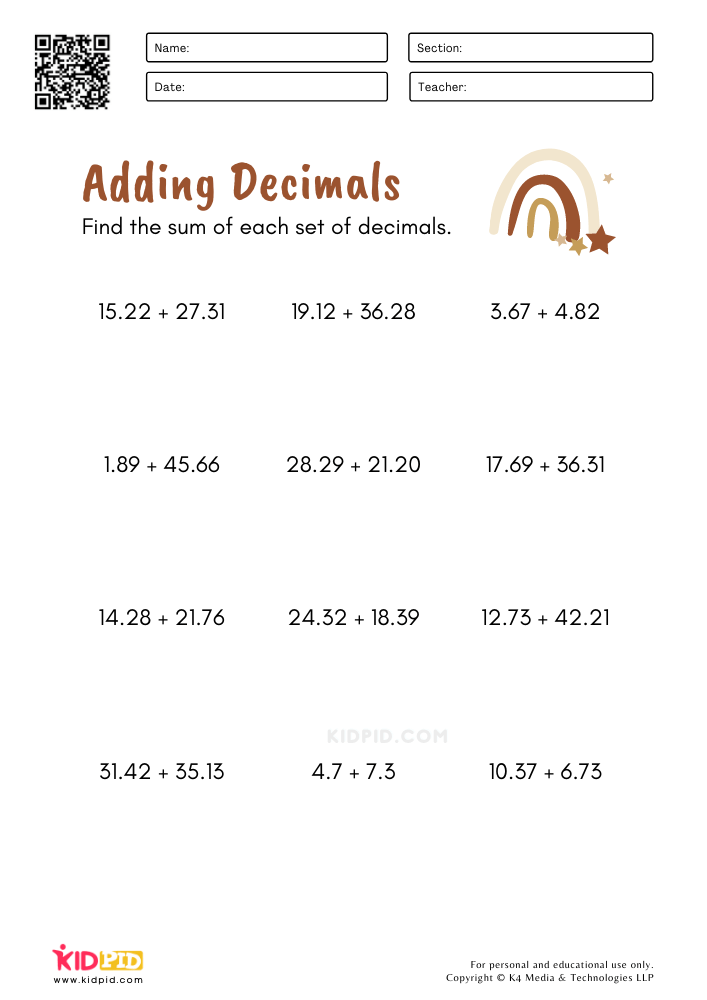
Always ask your kids to recite the questions and solutions along with solving, because kids usually find it fun, and it will help them to stay focused. Basic mathematics is used in our daily life, and a complete knowledge of decimal numbers is gonna help a lot in basic calculations and many mathematical topics, like fractions, which they gonna study in higher classes.
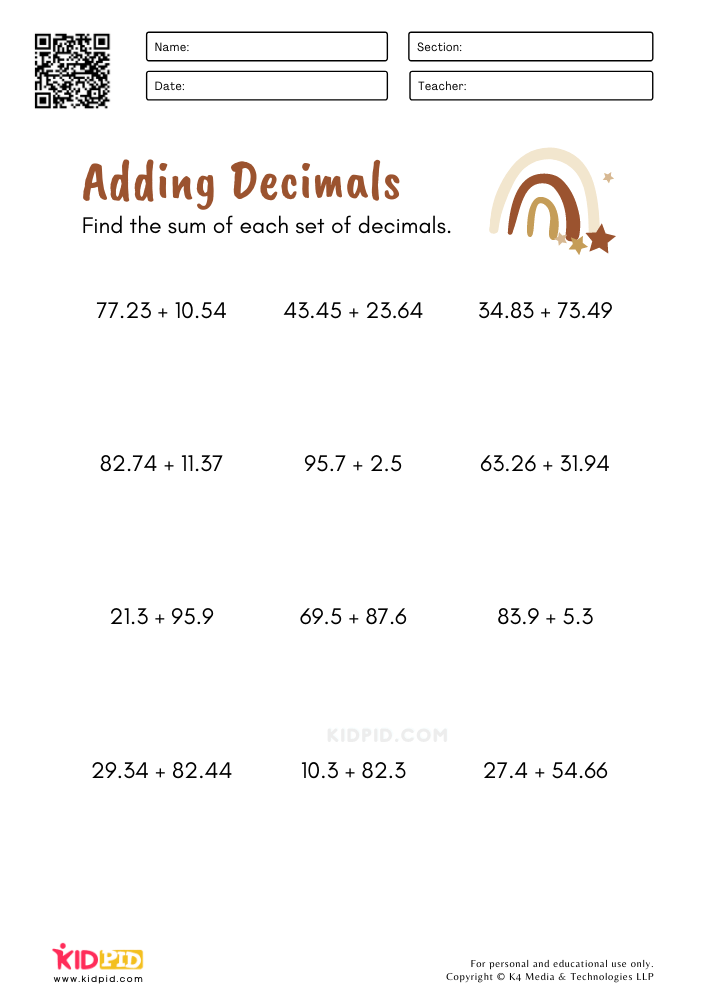
Break the work into parts so that kids don’t feel much pressure and get bored, and give some of the worksheets as homework so that they can do some of the sums on their own. By doing this, you will get to know their weakness which can be improved. This will also make them responsible for their studies.
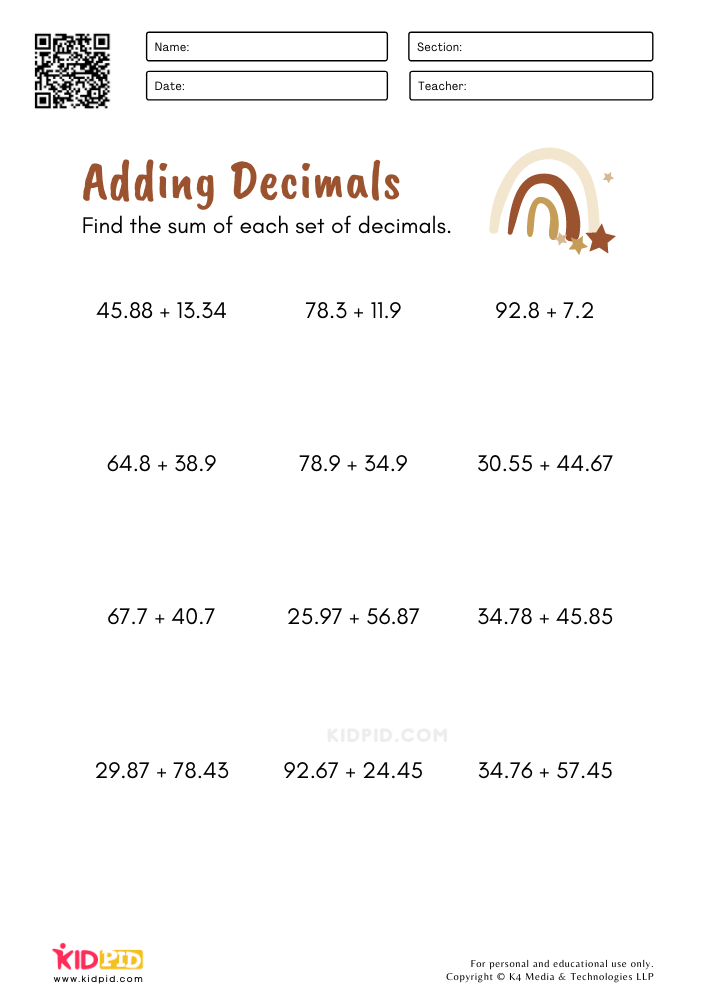
Decimals are important in dealing with fractional questions. Kids often find mathematics a little confusing because of the calculations. Ask them not to panic and solve each question with a calm mind, and always make a rough note for the calculations. This will definitely help them to clear their confusion related to calculations.
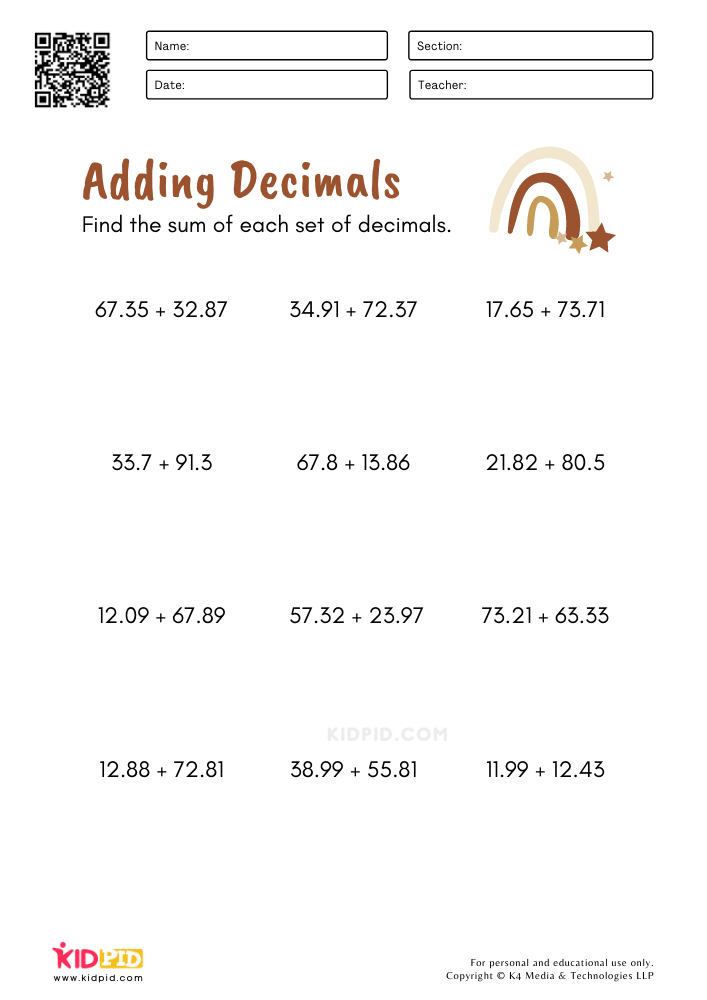
Let your kids solve the worksheet, and let them know that studies are fun too. Never let them feel bored with studies. Divide their work into different parts that have to be done at different times according to a schedule. By doing this, they will not only feel less work pressure but also learn discipline. Don’t be harsh to your kids if they don’t want to or don’t understand anything; instead, help them to clear their doubts.
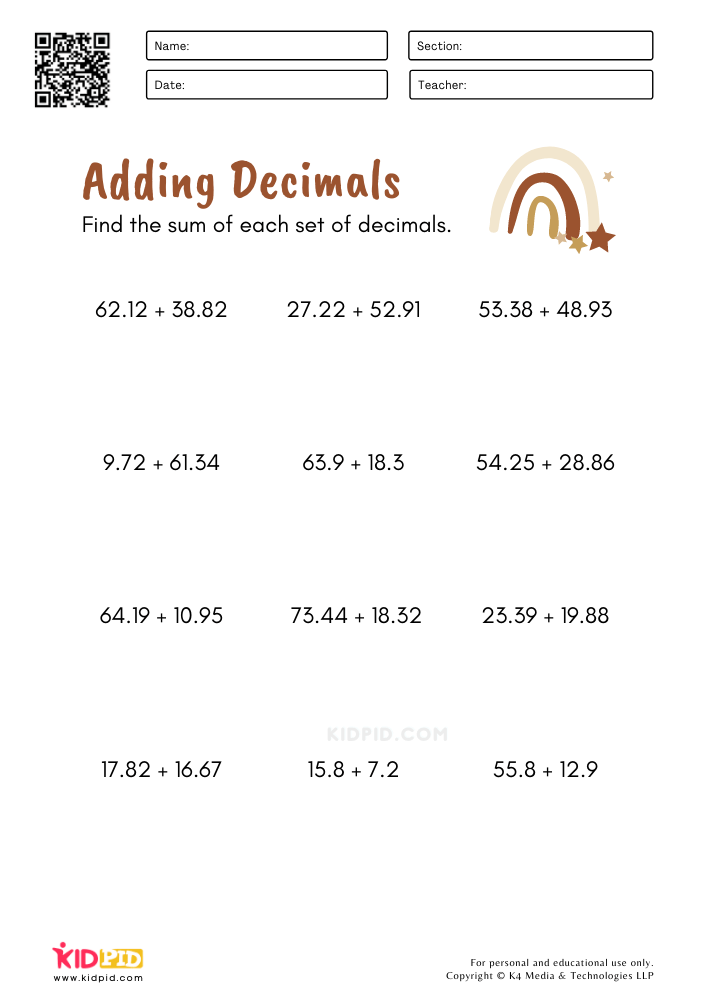
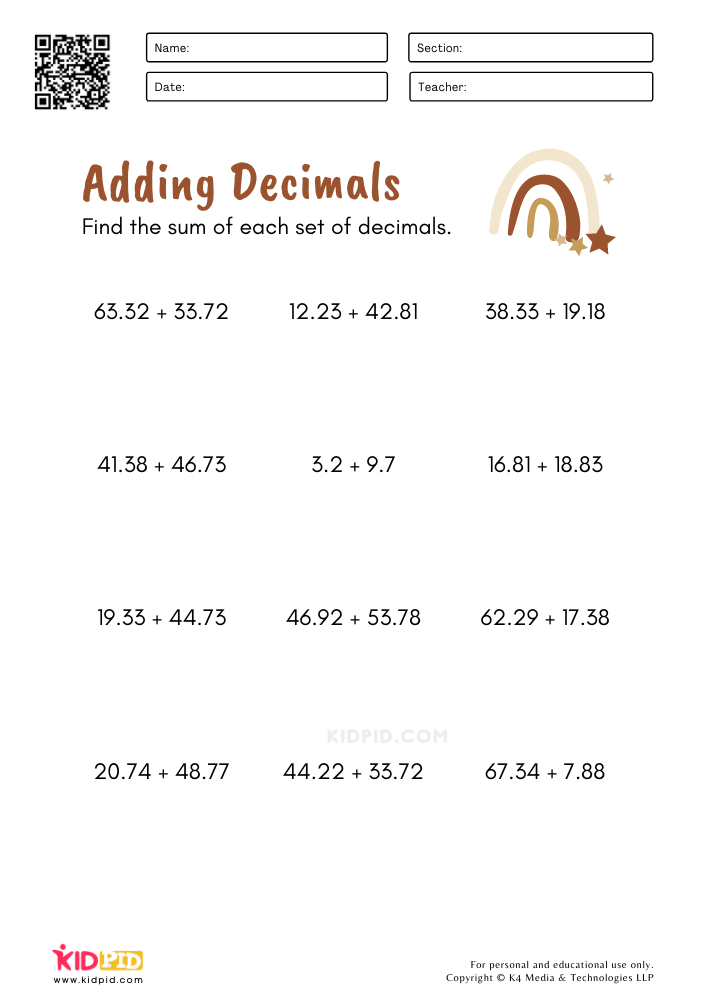
Kids are like a sponge that absorbs everything that comes their way, so it is our duty to surround them with good things so that they develop a good character. Education can not be gained only by books; our environment and nature teach us a lot. Let your kids observe their surroundings and learn from everything.
Give them worksheets to solve and practice, by which they can understand the logic very easily and in no time.
Key Facts About Adding Decimals Math Worksheets
- Target Audience: Primarily designed for upper elementary students (Grade 4, Grade 5, and Grade 6) who are transitioning from basic whole-number arithmetic to fractional and decimal values.
- Core Mathematical Skill: Visualizing and manipulating decimal place values (tenths, hundredths, thousandths) using vertical addition strategies.
- Format & Utility: Free, printable PDF worksheets structured sequentially from simple equations to more advanced multi-digit problems.
- Pedagogical Goal: To build mathematical fluency and consistency by bridging abstract decimal concepts with structured, repetitive practice.
Parts/Types/Examples of Adding Decimals Worksheets
To accommodate different stages of a child’s learning curve, Kidpid’s adding decimals worksheets are organized progressively:
- Like Decimal Places Addition (No Regrouping): Problems where both numbers have the same number of decimal digits (e.g., Tenths only).
- Example: 4.2 + 3.5 = 7.7
- Unlike Decimal Places Addition: Problems where students must use zero placeholders to correctly align columns.
- Example: 12.4 + 5.18 → (Rewrite as 12.40 + 5.18 = 17.58)
- Decimal Addition with Regrouping (Carrying): Advanced equations requiring students to carry over values to the next largest place-value column.
- Example: 6.78 + 2.45 = 9.23
How Does Adding Decimals Work?
Adding decimals follows the same underlying logic as adding whole numbers, with one critical structural exception: the alignment of the decimal point. Here is the systematic breakdown of how the process works:
- Line Up Vertically: Write the addends vertically so that the decimal points are perfectly stacked on top of one another. This ensures that tenths align with tenths, hundredths with hundredths, and so on.
- Fill Empty Spaces: If one number has fewer decimal digits than the other, insert a “0” at the end as a placeholder to keep the columns uniform.
- Add Right to Left: Begin adding from the far-right column, carrying or regrouping into the next column to the left when a sum exceeds 9.
- Drop the Decimal: Drop the decimal point straight down into the same position in the final answer line.
Benefits of Learning About Adding Decimals
Mastering decimal addition via structured worksheets offers vital cognitive and academic benefits:
- Strengthens Place Value Comprehension: Prevents the common misconception that decimals behave like whole numbers (e.g., understanding that 0.7 is larger than 0.15).
- Reduces Mathematical Anxiety: Breaking down equations into bite-sized worksheet practices builds confidence and mathematical consistency.
- Prepares for Advanced Mathematics: Acts as a direct prerequisite for percentages, ratios, fraction conversions, and introductory algebraic concepts taught in higher grades.
- Improves Mental Math Capacity: Teaches kids how to break apart numbers logically, facilitating faster real-world mental calculations.
Learning Objectives
By thoroughly completing these adding decimals worksheets, students will be able to:
- Identify and locate the tenths, hundredths, and thousandths places relative to a decimal point.
- Accurately align vertical numbers of varying length by matching their decimal points.
- Apply regrouping strategies correctly across the decimal boundary into whole numbers.
- Verify answers utilizing scratch paper calculations or estimation strategies to identify simple computational errors.
Worksheet Instructions
To ensure an optimal and stress-free learning session, guide your young learners with these step-by-step instructions:
- Prepare Your Workspace: Print out the worksheet and grab a sharp pencil, an eraser, and a piece of scratch paper for rough work.
- Rewrite the Problem Vertically: If a problem is presented horizontally, copy it onto your scratch paper vertically. Crucial Rule: Line up the dots, not the numbers!
- Use Zeros as Shields: If a column looks empty, fill it with a zero placeholder to prevent alignment mistakes.
- Take It Slow: Start adding from the column furthest to the right. Take your time when carrying numbers over.
- Drop the Anchor: Place your decimal point in the answer row directly underneath the other decimal points before writing your final whole-number total.
- Keep Moving: If a sum feels too difficult, don’t panic! Leave it, move on to the next problem, and come back to it with a fresh eye at the end.
Interesting Facts About Decimals
- The Origin Story: The word “decimal” comes from the Latin word decimus, which means “tenth.” Our entire numbering system is a “Base-10” system because humans naturally started counting on their ten fingers!
- Ancient Innovations: While ancient civilizations used fractions, the systematic use of decimal fractions and the decimal point as we know it today was popularized by mathematicians like Simon Stevin and John Napier in the late 16th and early 17th centuries.
- The Stealthy Zero: Adding zeros to the very end of a decimal number changes absolutely nothing about its actual value! For example, 0.5, 0.50, and 0.500 are all completely identical chunks of a whole.
Vocabulary Words
Educators and parents can use these terms to reinforce academic vocabulary during math practice:
- Decimal Point: The period or dot used to separate the whole number part from the fractional part of a number.
- Addend: Any number that is being added to another number to form a sum.
- Sum: The total value resulting from the addition of two or more numbers.
- Placeholder Zero: A zero written at the end of a decimal value to maintain consistent column width without altering the number’s actual worth.
- Regrouping: The process of making groups of tens when adding or subtracting two-digit numbers (also known as “carrying”).
Real-Life Applications
Decimals aren’t just numbers on a page—they are used daily in the real world:
- Handling Money: Calculating costs at a store relies entirely on decimal addition. Adding $4.50 for a snack and $1.75 for a drink requires perfect decimal alignment.
- Sports Metrics: Track and field, swimming, and racing rely on decimals to measure precise times. Adding split times (e.g., 12.45 seconds + 11.82 seconds) dictates who wins a gold medal.
- Baking and Cooking: Measuring ingredients accurately often requires decimals, especially when adapting metric recipes (e.g., combining 1.5 liters of water with 0.25 liters of syrup).
- Scientific Measurements: Measuring temperature, heights, or chemical solutions in labs requires totaling fractional amounts with decimals.
FAQs
Q1: At what age or grade level should children start learning to add decimals?
Answer: Students typically begin exploring decimal place values and introductory addition in the 4th Grade (ages 9–10), with full mastery of multi-digit decimal operations targeted in the 5th and 6th Grades (ages 10–12).
Q2: What is the most common mistake kids make when adding decimals?
Answer: The most frequent mistake is aligning the numbers by their right-hand edge rather than aligning them by the decimal point. For instance, mistakenly lining up 4.5 + 1.23 as if it were 45 + 123. Utilizing grid paper or drawing vertical alignment lines can easily fix this.
Q3: Why do we add zero placeholders to the end of decimals?
Answer: Adding zero placeholders does not change the mathematical value of a number, but it helps kids visually structure the math columns. It keeps columns uniform, ensuring students don’t accidentally add a digit from the tenths place to a digit in the hundredths place.
Q4: How can I make learning decimal addition fun for a child who hates math?
Answer: Turn worksheets into a real-world game using money! Use plastic coins or play money to match the numbers on Kidpid’s worksheets. Let your child pretend to be a shopkeeper totaling up a grocery bill. Coupling abstract worksheet numbers with tangible rewards dramatically boosts engagement.
A solid understanding of decimal addition begins with meaningful practice. These worksheets encourage careful calculations, develop numerical confidence, and make solving decimal problems more accurate, efficient, and enjoyable. Keep visiting our website and explore more paragraphs, essays, worksheets, flashcards, Quizzes, and many other interactive resources. Don’t forget to follow us on YouTube & Facebook.
The Content Team developed this worksheet to promote student growth.
Reviewed By Kartik
Read More: