
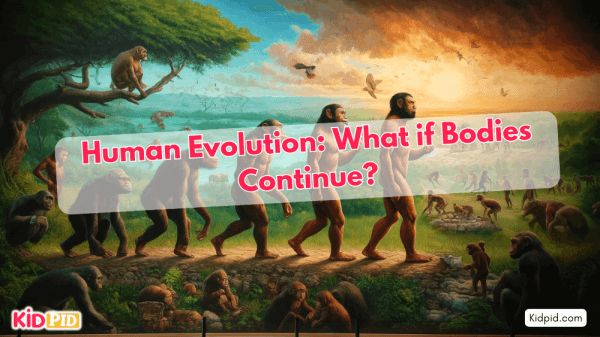
Have you ever wondered what humans will look like in the future? A million years from now, our bodies might have changed a lot! Let’s explore some fun ideas about how humans could evolve and what new traits we might develop to adapt to the world around us.
- Theory of Evolution: In 1859, Charles Darwin said humans evolve over time to adapt to their environment.
- Human Traits: Our brains are complex, we can walk on two legs, and we can use tools to survive.
- Bajao People: Some people, like the Bajao in Southeast Asia, have evolved to hold their breath underwater for up to 15 minutes because of their large spleens.
- Lactose Digestion: Thousands of years ago, humans couldn’t drink milk, but some can now digest it because of evolution.
- Possible Future Evolution: If people stay healthy, humans might evolve to be more fit. If the environment gets polluted, we might have stronger immune systems. As the world gets hotter, humans might evolve thinner skin or larger ears to help cool down. Our brains may get smaller, but more efficient, and we could become taller.
- Phone Use: With all the time we spend on phones, we might develop stronger fingers and better hand-eye coordination.
- Where Humans Came From: Humans’ earliest ancestors lived in Africa about 7 million years ago.
- Evolving Continues: Evolution is always happening, and how we look in the future depends on many things today.
Contents
- How Might Our Bodies Evolve? Humans A Million Years Into The Future.
- Related MCQ’s
- 1. Who published the theory of evolution in 1859?
- 2. What is the reason why humans have complex brains, walk on two legs, and use tools?
- 3. What is the Bajao people of Southeast Asia known for?
- 4. What does the ability to digest lactose suggest about human evolution?
- 5. What might happen if the environment becomes more polluted?
- 6. How might humans evolve to better cope with global warming?
- 7. What could be a possible result of humans’ habit of using phones a lot?
- 8. Where did the earliest known human ancestors live?
- You may like these:
How Might Our Bodies Evolve? Humans A Million Years Into The Future.
Related MCQ’s
1. Who published the theory of evolution in 1859?
A) Albert Einstein
B) Charles Darwin
C) Isaac Newton
D) Nikola Tesla
2. What is the reason why humans have complex brains, walk on two legs, and use tools?
A) We learned it from animals
B) These traits helped humans to survive and thrive
C) We evolved from apes
D) We were born with these traits
3. What is the Bajao people of Southeast Asia known for?
A) They can stay underwater for almost 15 minutes
B) They can walk on two legs without falling
C) They have large brains
D) They live in trees
4. What does the ability to digest lactose suggest about human evolution?
A) Humans can no longer digest milk
B) Humans have not evolved in recent centuries
C) Evolution is a continuous process
D) Humans used to have larger brains
5. What might happen if the environment becomes more polluted?
A) Humans might evolve to have better eyesight
B) Humans might develop stronger immune systems
C) Humans will become shorter
D) Humans will become immune to disease
6. How might humans evolve to better cope with global warming?
A) Humans may develop smaller brains
B) Humans might develop thicker skin
C) Humans might develop thinner skin or larger ears
D) Humans may become shorter
7. What could be a possible result of humans’ habit of using phones a lot?
A) Larger brains
B) Stronger finger muscles and improved hand-eye coordination
C) More complex thoughts
D) Larger bodies
8. Where did the earliest known human ancestors live?
A) Europe
B) Africa
C) Asia
D) Australia
You may like these:
Charles Darwin – The Theory of Evolution
Learn about Charles Darwin’s groundbreaking theory of evolution, explaining how species evolve through natural selection, shaping the diversity of life on Earth.
Why do our bodies age?
Our bodies age because cells slow down, and damage builds up over time. This affects how we look and feel as we grow older.
The Science of Skin – Interesting Facts about Skin
Skin is the body’s largest organ. It protects us, helps control temperature, and has three layers. Skin also heals quickly when damaged.