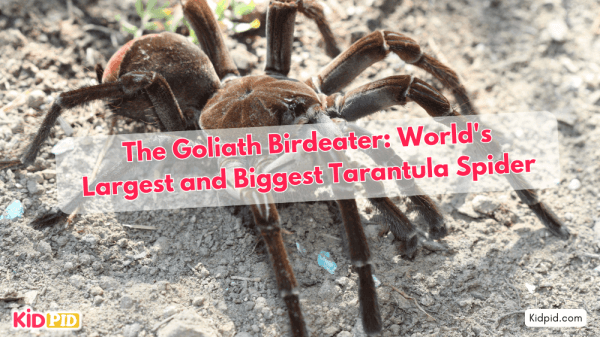
Meet the Goliath Birdeater, the biggest spider in the world! This giant tarantula might look scary, but it’s a fascinating creature. Let’s learn more about what makes the Goliath Birdeater so special!
- Size: The Goliath Birdeater can have a leg span up to 12 inches and weigh around 6 ounces, about as much as a small kitten
- Habitat: These spiders live in the rainforests of South America. They like to stay hidden in burrows or under leaves.
- Diet: Despite its name, the Goliath Birdeater mostly eats insects. Sometimes, it can catch small rodents or frogs.
- Appearance: They have hairy bodies and long legs. Their coloring helps them blend into their surroundings.
- Behavior: Goliath Birdeaters are not aggressive towards humans. They use their fangs to defend themselves when threatened.
Contents
- The Goliath Birdeater: The World’s Biggest and Heaviest Tarantula Spider
- Related MCQ’S
- 1. What is the Goliath Bird Eater known for?
- 2. What is the primary diet of the Goliath Bird Eater?
- 3. How does the Goliath Bird Eater defend itself?
- 4. How long can the Goliath Bird Eater live?
- 5. What do the Goliath Bird Eaters use their urticating hairs for?
- 6. What is a unique feature of the Goliath Bird Eater’s eggs?
- You may like these:
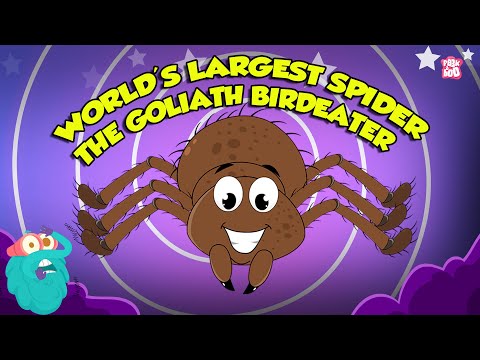
The Goliath Birdeater: The World’s Biggest and Heaviest Tarantula Spider
Related MCQ’S
1. What is the Goliath Bird Eater known for?
a) Being the smallest spider in the world
b) Having a venom strong enough to harm humans
c) Being the largest spider in the world
d) Being a bird-eating monster
Answer: c) Being the largest spider in the world
Explanation: The Goliath Bird Eater, also known as the T. blondi, is famous for being the largest spider in the world with a leg span of 12 inches.
2. What is the primary diet of the Goliath Bird Eater?
a) Only birds
b) Insects and small vertebrates
c) Plants and leaves
d) Only large animals
Answer: b) Insects and small vertebrates
Explanation: Despite its name, the Goliath Bird Eater usually prefers insects and sometimes small vertebrates, not birds.
3. How does the Goliath Bird Eater defend itself?
a) By using its venom to attack
b) By making a hissing sound with its legs
c) By biting with its fangs
d) By running away
Answer: b) By making a hissing sound with its legs
Explanation: The Goliath Bird Eater makes a high-pitched hissing sound called stridulation by rubbing its front legs together to warn predators.
4. How long can the Goliath Bird Eater live?
a) Up to 2 years
b) Up to 10 years
c) Up to 20 years
d) Up to 50 years
Answer: c) Up to 20 years
Explanation: Female Goliath Birdeater live 15–20 years, while males live only 3–6 years.
5. What do the Goliath Bird Eaters use their urticating hairs for?
a) To capture prey
b) To help them climb trees
c) To defend themselves from predators
d) To scare away humans
Answer: c) To defend themselves from predators
Explanation: The Goliath Bird Eater can flick its tiny hook-shaped urticating hairs to irritate predators or threats, such as humans.
6. What is a unique feature of the Goliath Bird Eater’s eggs?
a) They are small and easy to find
b) They are stored in a giant sack
c) They are only laid once every 5 years
d) They are poisonous
Answer: b) They are stored in a giant sack
Explanation: Female Goliath Bird Eaters lay between 50 and 150 eggs in a sack that can measure over an inch in diameter.
You may like these:
What’s the biggest spider?
The Goliath birdeater is the world’s largest spider, with a leg span of up to 12 inches and a weight of around 6 ounces.
Spider Crafts for Kids
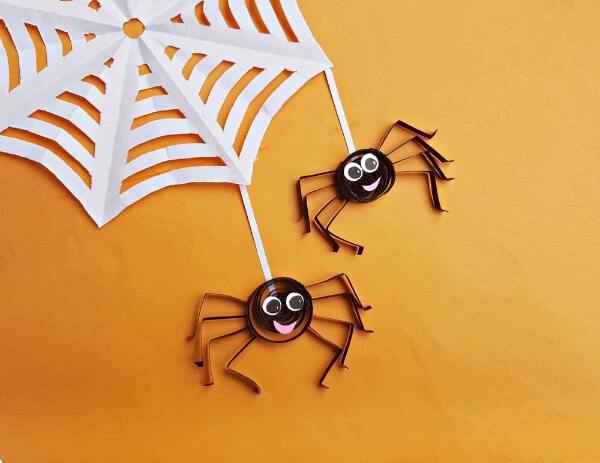

Fun, easy spider-themed crafts for kids, including paper plate spiders, pipe cleaner creations, and spooky decorations to celebrate Halloween or explore nature’s creatures.
20 MILLION Year-Old Spider and the Science of Spider Silk
A 20-million-year-old fossilized spider reveals insights into ancient arachnids, offering clues to the evolution of spider silk’s strength and versatility.
How does a spider make a web?
Spiders produce silk from specialized glands, spinning intricate webs by releasing liquid silk that solidifies, creating sticky, strong structures for trapping prey.