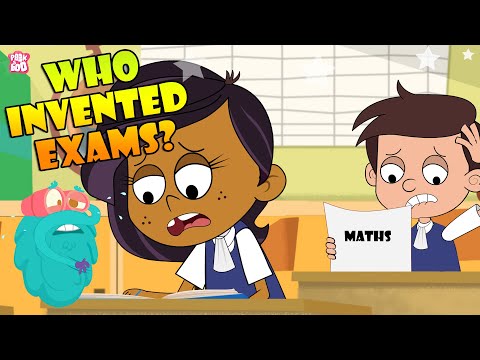
Have you ever wondered who invented exams? Exams are a way to test what you’ve learned in school. Let’s explore how they began and why they were created!
- Exams are tests that check how much you’ve learned about a subject.
- Exams started in ancient China over 2,000 years ago. They were first used to find the best people for government jobs.
- Exams were made to measure knowledge, test skills, and make fair decisions about who was most qualified.
- The idea of exams spread to other countries and became a way to test learning in schools.
- Exams help students, teachers, and parents know what has been learned and what needs more practice.
- Fun Fact: Ancient exams in China could take days to finish, and only the best answers were chosen!
Contents
- Who Invented Exams? The Story Behind The Origin of Tests.
- Related MCQ’S
- 1. What does the word “examination” mean?
- 2. Where and when did the concept of formal examinations first start?
- 3. What was the purpose of the imperial examinations in ancient China?
- 4. Which dynasty introduced written examinations to allow candidates from humble backgrounds?
- 5. Who is credited with inventing modern-day academic exams?
- 6. When did the British introduce examinations in India?
- 7. What should students focus on besides academic grades?
- 8. Who is the youngest graduate in the world?
- You may like these:
Who Invented Exams? The Story Behind The Origin of Tests.
Related MCQ’S
1. What does the word “examination” mean?
a) To deeply observe or study something
b) To play and relax
c) To invent new things
d) To write a story
Answer: a) To deeply observe or study something
Explanation: The word “examination” refers to observing, inspecting, or studying something carefully. It can also mean a formal test of knowledge.
2. Where and when did the concept of formal examinations first start?
a) Ancient Greece in 1000 BC
b) Ancient China in 605 AD
c) Ancient India in 1806
d) England in 1853
Answer: b) Ancient China in 605 AD
Explanation: Formal examinations began in Ancient China during the Sui dynasty to select candidates for government positions.
3. What was the purpose of the imperial examinations in ancient China?
a) To build stronger armies
b) To select candidates for government positions based on merit
c) To teach children how to write
d) To choose the next emperor
Answer: b) To select candidates for government positions based on merit
Explanation: The imperial examinations were designed to ensure that candidates were chosen based on merit, not birth order.
4. Which dynasty introduced written examinations to allow candidates from humble backgrounds?
a) Sui Dynasty
b) Tang Dynasty
c) Ming Dynasty
d) Qing Dynasty
Answer: b) Tang Dynasty
Explanation: The Tang dynasty, under Empress Wu Zetian, reformed the system to include candidates from humble backgrounds.
5. Who is credited with inventing modern-day academic exams?
a) Henry Fishel
b) Emperor Yang of Sui
c) Empress Wu Zetian
d) Michael Kearney
Answer: a) Henry Fishel
Explanation: Henry Fishel, either a businessman or professor, is credited with inventing modern academic exams in the late 19th century.
6. When did the British introduce examinations in India?
a) 1600
b) 1705
c) 1806
d) 1853
Answer: d) 1853
Explanation: The East India Company introduced competitive examinations in India in 1853 to select civil servants.
7. What should students focus on besides academic grades?
a) Watching TV
b) Identifying their talents and passions
c) Avoiding exams altogether
d) Sleeping all day
Answer: b) Identifying their talents and passions
Explanation: Students are encouraged to discover their natural talents and passions, as there is much more to life than just academic grades.
8. Who is the youngest graduate in the world?
a) Albert Einstein
b) Isaac Newton
c) Michael Kearney
d) Henry Fishel
Answer: c) Michael Kearney
Explanation: Michael Kearney earned a bachelor’s degree in anthropology at the age of 10 in 1994, making him the youngest graduate in the world.
You may like these:
Ancient China
Ancient China flourished with rich traditions, innovations like paper and silk, and iconic structures like the Great Wall. It’s known for its dynasties and cultural heritage.
How long is the Great Wall of China?
The Great Wall of China stretches approximately 13,171 miles (21,196 kilometers), built over centuries to protect against invasions and unify Chinese territories.
Ancient Egypt
Ancient Egypt is renowned for its pyramids, pharaohs, and hieroglyphics. Its civilization thrived along the Nile River, pioneering advancements in architecture, writing, and religion.