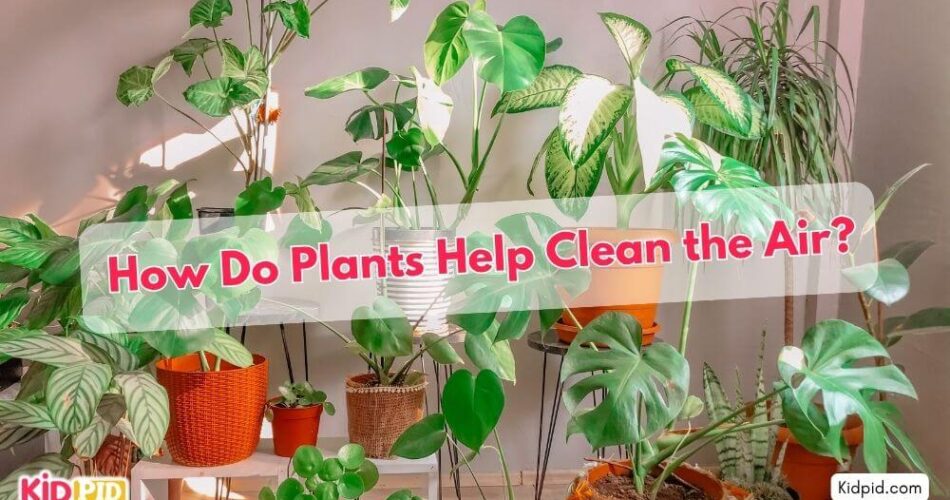
Plants help clean the air by absorbing pollutants and carbon dioxide through their leaves in photosynthesis. They then release oxygen, improving air quality. Some plants can also absorb harmful toxins from the air, such as formaldehyde and benzene, making the air healthier to breathe.

Contents
- MCQs
- 1. What do plants release into the air that helps humans and animals breathe?
- 2. Which part of the plant is most involved in the process of cleaning the air?
- 3. How do plants help reduce pollutants in indoor environments?
- 4. What is one-way plants can help reduce the effects of climate change?
- 5. Which process do plants use to convert carbon dioxide and water into glucose and oxygen?
- Fill in The Blanks
- True / False
- 1. Plants help clean the air by releasing carbon dioxide into the atmosphere (True / False)
- 2. Plants can help reduce the amount of greenhouse gases in the air (True / False)
- 3. Plants do not affect the levels of pollutants in the air (True / False)
- 4. Plants can only clean the air in indoor environments (True / False)
MCQs
1. What do plants release into the air that helps humans and animals breathe?
A) Carbon dioxide
B) Oxygen
C) Nitrogen
D) Hydrogen
Answer: B) Oxygen
Explanation: Through photosynthesis, plants convert carbon dioxide and water into glucose and oxygen. The oxygen is released into the air, which is vital for animal and human respiration.
2. Which part of the plant is most involved in the process of cleaning the air?
A) Roots
B) Flowers
C) Leaves
D) Stems
Answer: C) Leaves
Explanation: Leaves are the primary site of photosynthesis, where carbon dioxide is absorbed, and oxygen is released, thus playing a crucial role in cleaning the air.
3. How do plants help reduce pollutants in indoor environments?
A) By generating heat
B) By absorbing toxins through their leaves
C) By making noise
D) By reflecting sunlight
Answer: B) By absorbing toxins through their leaves
Explanation: Certain plants can absorb harmful toxins and volatile organic compounds (VOCs) through their leaves, thereby purifying indoor air.
4. What is one-way plants can help reduce the effects of climate change?
A) By increasing humidity
B) By shading buildings
C) By absorbing excess carbon dioxide
D) By producing waste
Answer: C) By absorbing excess carbon dioxide
Explanation: By absorbing excess carbon dioxide, plants help reduce the greenhouse effect, thus reducing the impacts of climate change.
5. Which process do plants use to convert carbon dioxide and water into glucose and oxygen?
A) Respiration
B) Photosynthesis
C) Transpiration
D) Fermentation
Answer: B) Photosynthesis
Explanation: Photosynthesis is the process by which plants use sunlight to synthesize nutrients from carbon dioxide and water, releasing oxygen as a byproduct.
Fill in The Blanks
Choose from these words: carbon dioxide, and transpiration.
1. Plants help clean the air by taking in __________ during photosynthesis and releasing oxygen.
Answer: carbon dioxide
2. Plants release moisture into the air through a process called __________.
Answer: transpiration
True / False
1. Plants help clean the air by releasing carbon dioxide into the atmosphere (True / False)
False: Plants absorb carbon dioxide and release oxygen into the atmosphere through photosynthesis.
2. Plants can help reduce the amount of greenhouse gases in the air (True / False)
True: Plants help reduce the amount of carbon dioxide in the air, which is a greenhouse gas that contributes to global warming.
3. Plants do not affect the levels of pollutants in the air (True / False)
False: Plants can help remove pollutants from the air, such as formaldehyde and benzene, through a process called phytoremediation.
4. Plants can only clean the air in indoor environments (True / False)
False: Plants can clean the air both indoors and outdoors by absorbing carbon dioxide and releasing oxygen.
Read More: