Young minds are highly curious and perceptive – kids are keen on learning about things around them. An important aspect of early learning is teaching children how to express themselves.
A robust vocabulary is a key to being able to verbalize and communicate with people. But the value of a broad vocabulary is beyond just that – it has been directly related to better performance in school, vast knowledge of words allows children to read and learn more information, and helps them pick up reading faster.
But mindlessly learning words from a list is no fun, is it?
Well, we have the perfect alternative! These worksheets are a fun and interactive way for children to learn new words and expand their word library. The task here is simple – match the correct word to the picture depicted. This provides children with the opportunity to learn new words and their meanings through visual representation, making it easier for them to recall the words in the future.
Contents
- Match Picture to Word Worksheets
- Key Facts About Match Picture to Word Worksheets for Grade 1
- Parts, Types, and Examples of First Grade Matching Worksheets
- How Does a Match Picture to Word Worksheet Work?
- Benefits of Learning with Picture-Word Matching
- Learning Objectives
- Worksheet Instructions for Teachers and Parents
- Interesting Facts About Visual Vocabulary Tools
- Featured Vocabulary Words
- Real-Life Applications
- FAQs
- Read More:
Match Picture to Word Worksheets

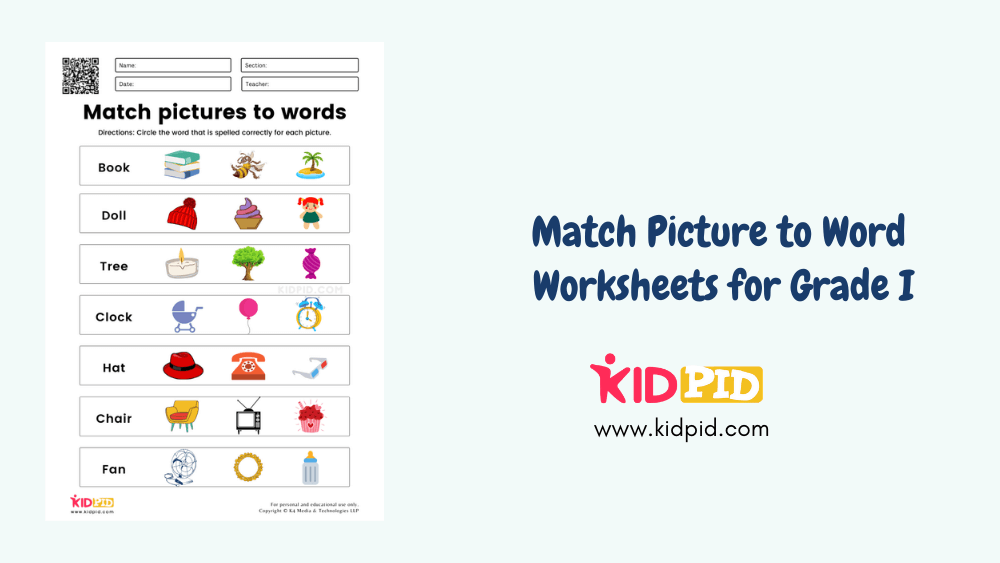
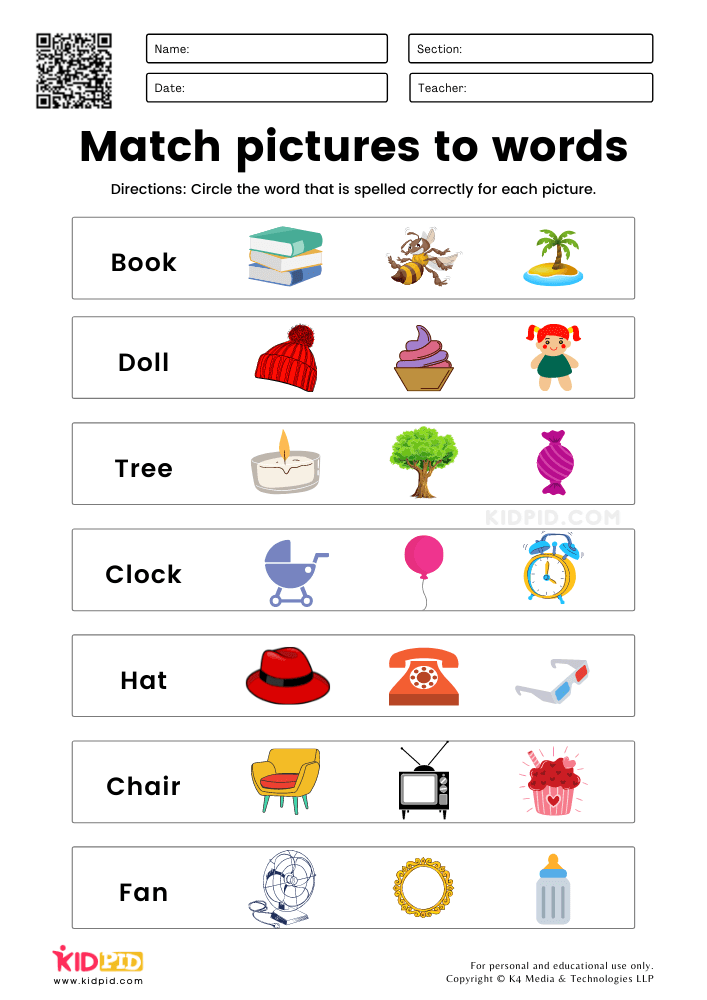
This is the first worksheet depicting common and familiar images. Match the word to the correct image.
This is the second worksheet. While matching the words to the images, sound the words out loud to understand the pronunciation of the word.
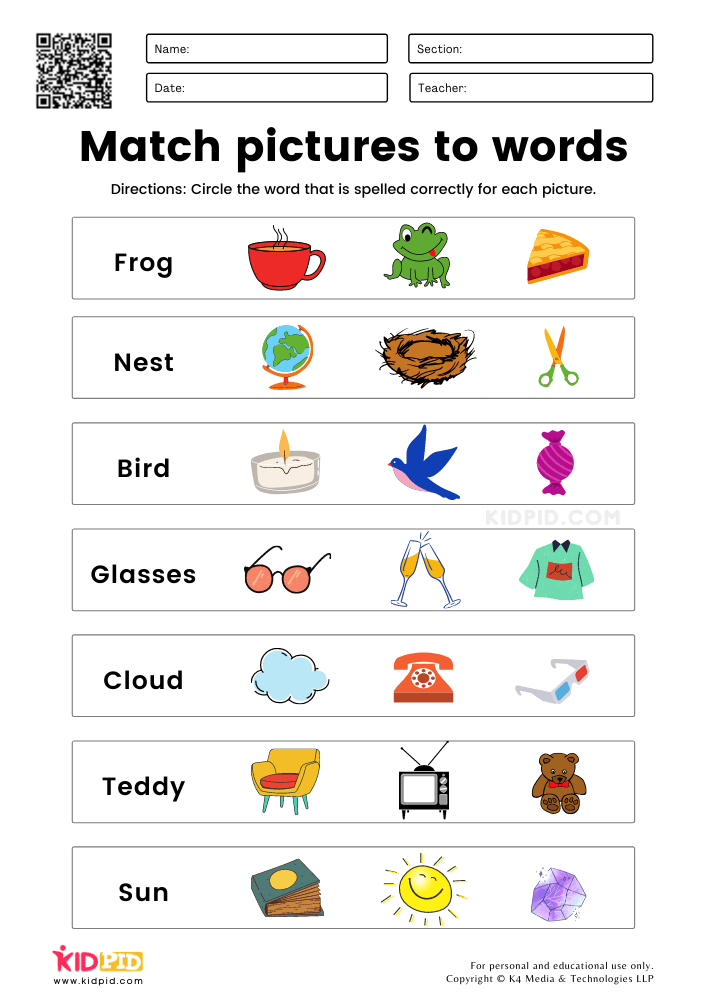
Bright and colourful pictures help engage children and keep them motivated in any activity.
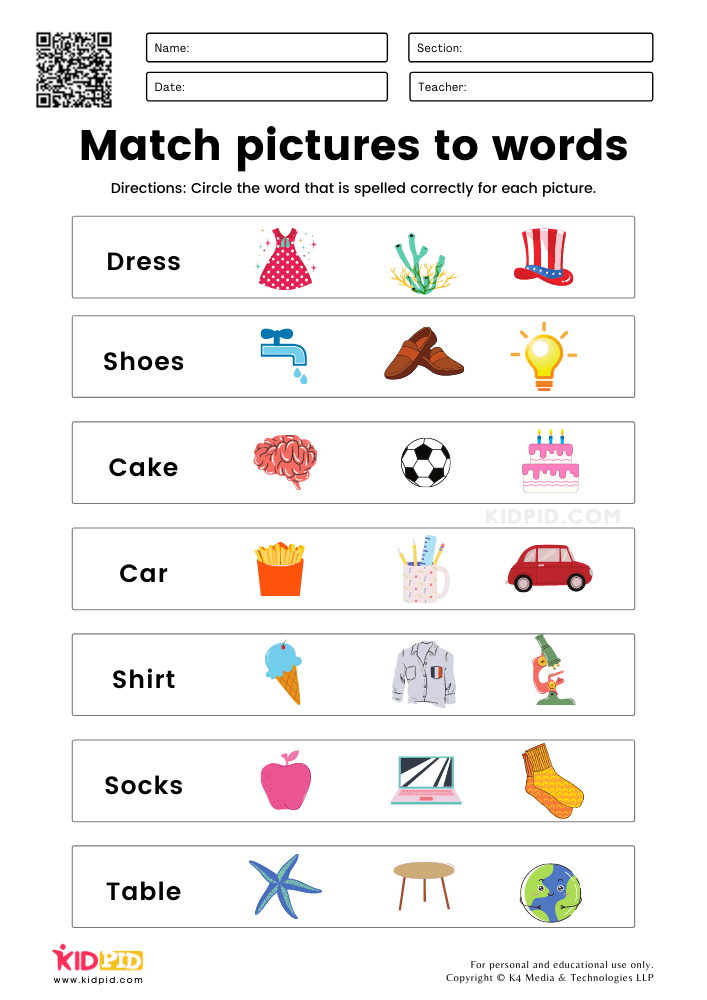
While most kids have seen these pictures multiple times, either on the wall of the classroom or in their books, they may not necessarily know the word for them. So, this is a great way for them to learn new words.
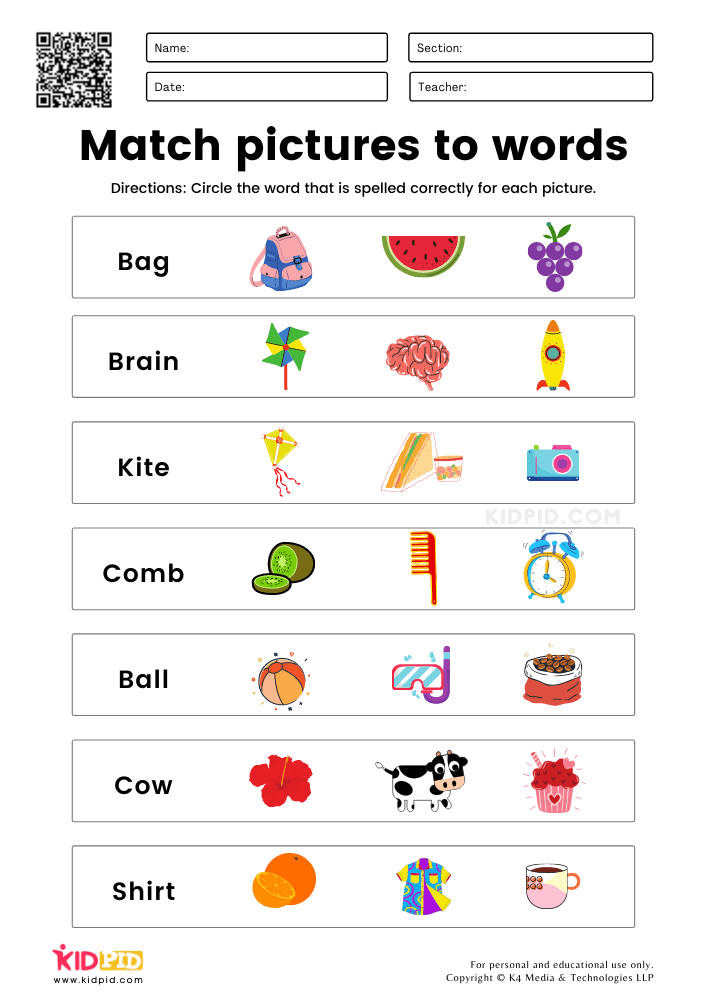
Matching words is a fun and unique alternative to learning than simply memorizing words and their meanings. Visual representation is a great way to understand new things and greatly helps children improve their memory.
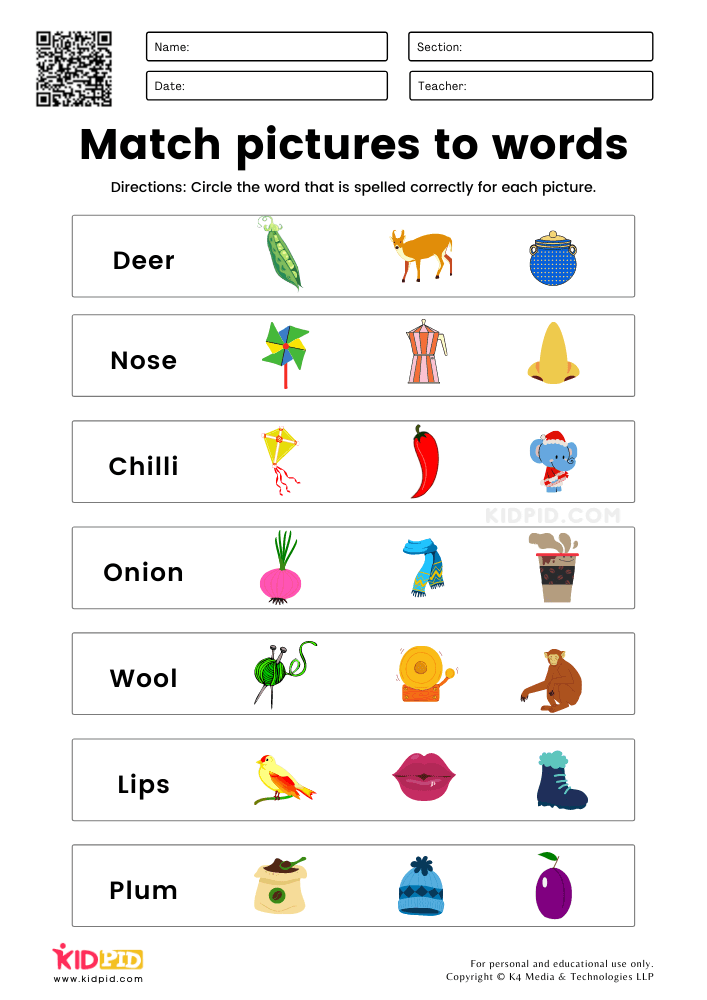
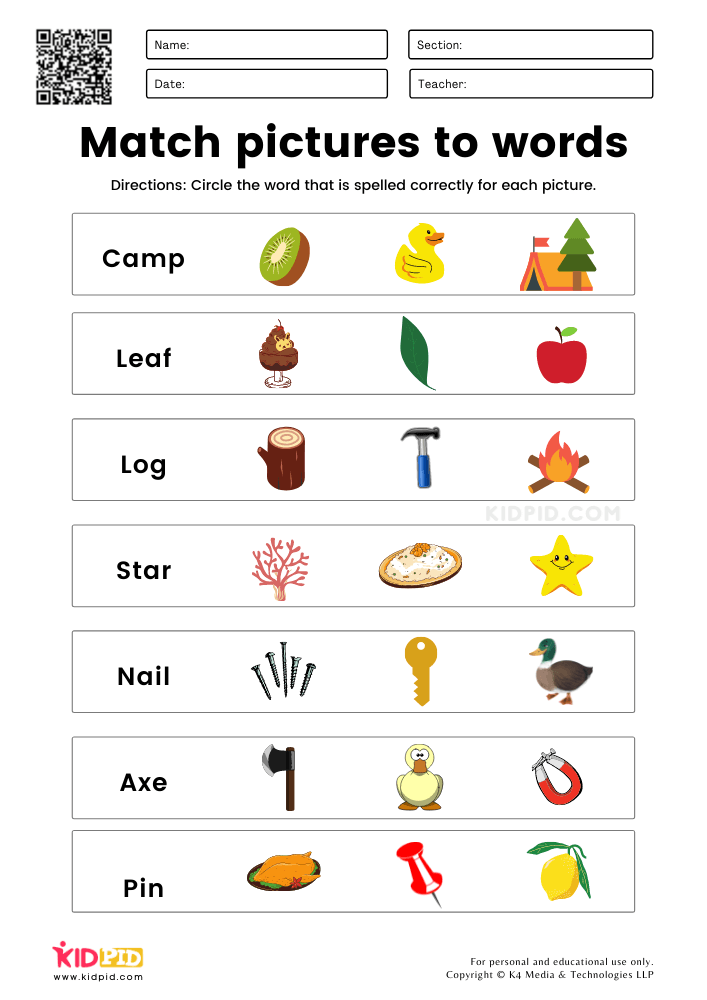
This is the sixth worksheet of the set. A great way to motivate children is to set a time limit for finishing a task – it pushes them to concentrate and work harder.
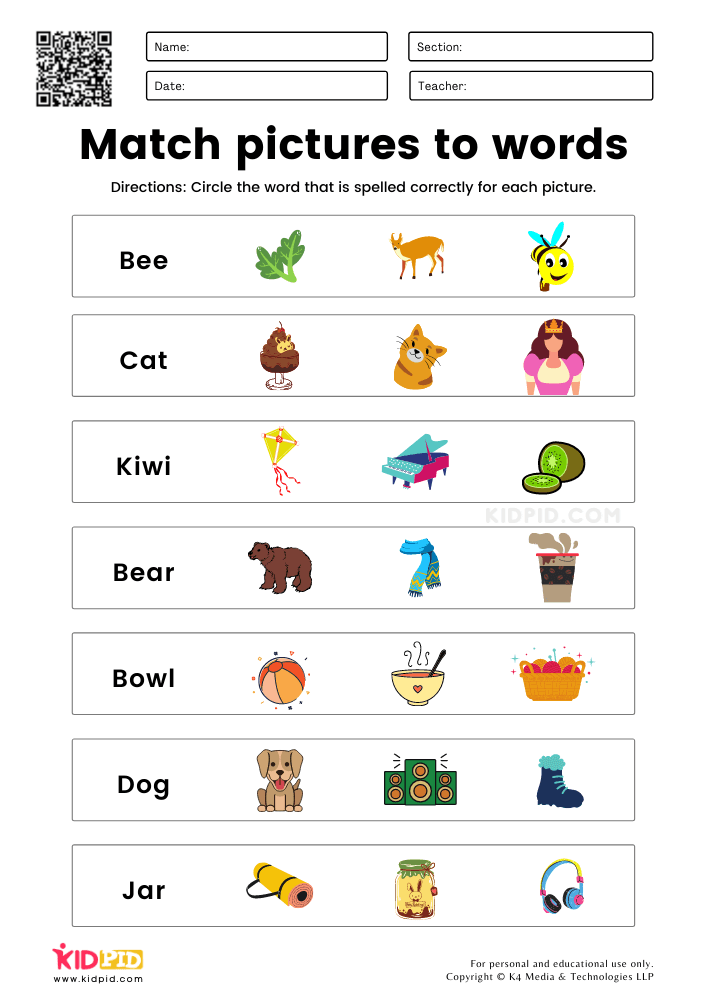
As children at this point already know the alphabet and how to write, they can also practice how to write each word along the way as they match it to the images.
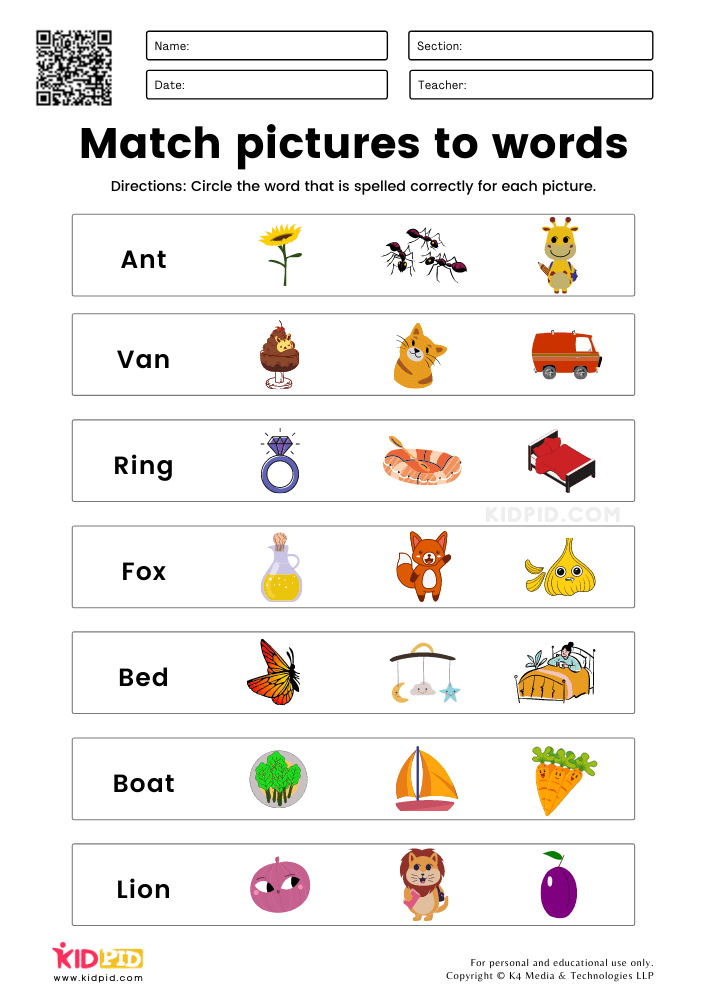
Familiar words are used in this exercise as reliability helps children better associate with what they’re learning and feel comfortable.
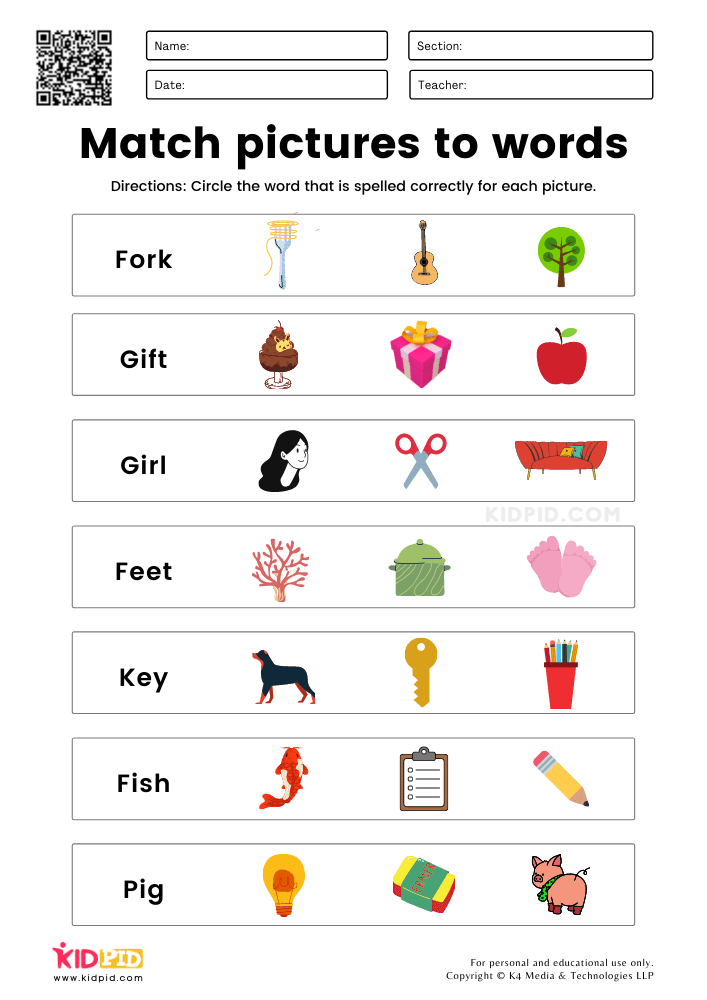
Children are quick to get distracted by fun and colourful images. So make sure they are focused on the task at hand.
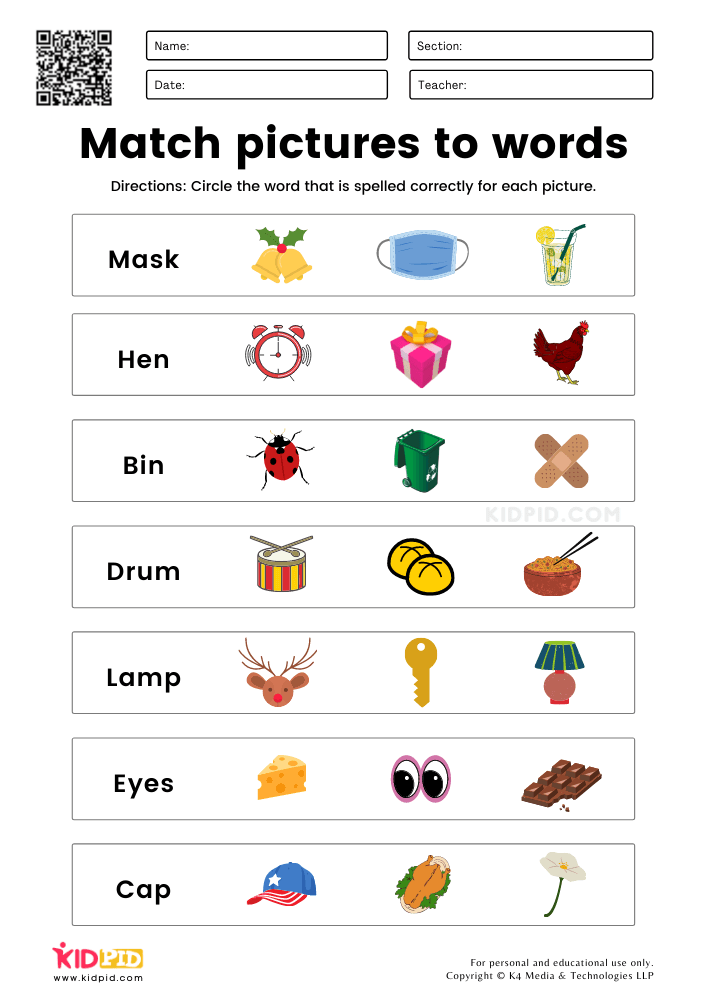
Give your child or student a few worksheets to solve every week – with or without a time limit. Regular practice will help them learn and grow.
Key Facts About Match Picture to Word Worksheets for Grade 1
- Target Developmental Stage: Ideal for early readers (typically ages 6 to 7) transitioning from letter recognition to full word decoding.
- Core Learning Mechanism: Relies on Dual Coding Theory, combining visual imagery with printed text to double the brain’s pathways for memory retrieval.
- Skill Integration: Simultaneously builds phonics skills, sight word recognition, contextual vocabulary, and fine motor control (drawing lines).
- Curriculum Alignment: Directly supports Common Core State Standards (CCSS) for English Language Arts (ELA), specifically in foundational reading skills and vocabulary acquisition.
Parts, Types, and Examples of First Grade Matching Worksheets
Early childhood educators categorize these interactive tools into several structural styles to prevent cognitive fatigue and keep learning engaging:
1. Thematic Vocabulary Clusters
Instead of random words, worksheets are grouped by familiar themes.
Examples: Animals (cat, dog, bird), Household Items (bed, chair, cup), and Nature (sun, tree, flower).
2. Phonetic Phonics Matches
These sheets focus on specific phonetic structures to test decoding skills rather than memory alone.
Examples: Short vowel CVC words (c-a-t, p-i-g), blend words (f-l-a-g), or silent ‘e’ words (b-a-k-e).
3. Sight Word Reinforcement
Focuses on high-frequency words that are difficult to illustrate abstractly but can be paired with definitive action or object imagery.
Examples: Color words (red, blue) paired with colored shapes, or directional words (up, down) paired with arrows.
How Does a Match Picture to Word Worksheet Work?
The mechanics of these worksheets leverage a child’s natural visual-spatial processing to build literacy through a three-step cognitive loop:
- Visual Decoding: The student looks at the illustration on the page (e.g., a picture of a sun) and identifies the concept in their mind.
- Phonetic Scanning: The student looks at the column of words and sounds out the letters phonetically (s-u-n) or recognizes the word shape as a known sight word.
- Neuromuscular Connection: By drawing a physical line from the anchor point of the image to the corresponding text box, the student creates a permanent cognitive link between the physical world object and its abstract written symbol.
Benefits of Learning with Picture-Word Matching
Introducing these exercises into a daily learning routine offers profound literacy advantages:
- Eliminates Reading Frustration: Providing a visual clue prevents early readers from guessing wildly or feeling defeated when encountering a challenging word.
- Enhances Long-Term Memory Retention: Studies show that children remember vocabulary significantly better when words are anchored to vibrant, clear illustrations.
- Builds Independent Learning Habits: The self-explanatory nature of matching exercises allows Grade 1 students to complete tasks successfully without constant adult intervention, boosting academic confidence.
- Strengthens Contextual Context: It bridges the gap between mechanical decoding (sounding out letters) and semantic comprehension (actually understanding what the word means).
Learning Objectives
By completing this curated set of printables, Grade 1 students will achieve the following milestones:
- Cognitive: Correctly associate printed words with their real-world objects with at least 85% accuracy.
- Phonics: Apply grade-level phonics and word analysis skills to successfully decode phonetically regular monosyllabic words.
- Motor Skills: Demonstrate precise hand-eye coordination and fine motor precision by tracing direct lines between targets.
- Language: Expand their expressive and receptive vocabulary banks with common, everyday nouns and verbs.
Worksheet Instructions for Teachers and Parents
To get the most out of these educational printables, follow these simple directions:
- Prepare: Print the worksheets in high-quality color to ensure the images are clear and engaging. Provide the child with a pencil or a colorful crayon.
- Review: Before drawing lines, ask the child to point to each picture and say what object they see out loud.
- Decode: Encourage the child to look at the first word, sound it out slowly using their phonics rules, and read the full word.
- Connect: Instruct them to draw a clean, direct line from the picture to the matching text.
- Bonus Practice: Once completed, have the child practice writing the words on a separate lined sheet of paper to reinforce spelling.
Interesting Facts About Visual Vocabulary Tools
- Ancient Roots: The concept of using pictures to teach words dates back to 1658 with the publication of Orbis Sensualium Pictus (The World in Pictures), widely considered the first illustrated textbook for children.
- Brain Priority: The human brain processes visual images roughly 60,000 times faster than text, which is why children learn to recognize pictures long before they can read letters.
- Left vs. Right: Matching exercises stimulate both hemispheres of the brain simultaneously—the right hemisphere processes the image while the left processes the phonetic text.
Featured Vocabulary Words
This primary worksheet set includes essential foundational vocabulary, including, but not limited to:
- Nouns: Apple, Ball, Cat, Dog, Elephant, Fish, Hat, Sun, Tree, Tent.
- Action Words (Verbs): Run, Jump, Swim, Sit.
- Descriptive Elements: Big, Small, Red, Hot.
Real-Life Applications
The skills learned on these pages extend far beyond the classroom:
- Navigating the Environment: Helps children read grocery store signs, label icons in public spaces, and safety markers.
- Digital Literacy: Prepares children to navigate educational software, where text commands are frequently paired with visual app icons.
- Interactive Reading: Empowers children to confidently tackle picture books, using illustrations to naturally verify words they are uncertain of while reading at home.
FAQs
Q1. What age group are these worksheets best suited for?
Answer: While specifically mapped to Grade 1 reading standards (ages 6-7), these printables serve as an excellent enrichment tool for advanced Kindergarteners or a comforting remedial review for struggling Grade 2 readers.
Q2. Can these worksheets help children learn English as a Second Language (ESL)?
Answer: Absolutely. Because the illustrations provide instant context without needing a translation, picture-to-word matching is one of the most effective, stress-free ways for ESL students to acquire native vocabulary.
Q3. How many matching worksheets should my child do a week?
Answer: Consistency is better than overload. Completing 2 to 3 pages per week ensures steady progression without causing academic burnout.
Q4. My child is guessing based purely on the first letter of the word. How do I stop this?
Answer: Cover the pictures briefly with a blank card. Have them phonetically sound out the whole word first, and only let them reveal the illustrations once they have attempted to read the entire word out loud.
Connecting pictures with words strengthens reading comprehension and vocabulary naturally. These Grade 1 worksheets encourage visual learning, improve word recognition, and help children develop stronger language skills with confidence. Unlock more learning opportunities with our collection of worksheets, essays, flashcards, paragraphs, quizzes, and interactive resources. Follow us on YouTube & Facebook for fresh content daily.
The Content Team designed this worksheet to improve learning success.
Reviewed By Madhulika
Read More: