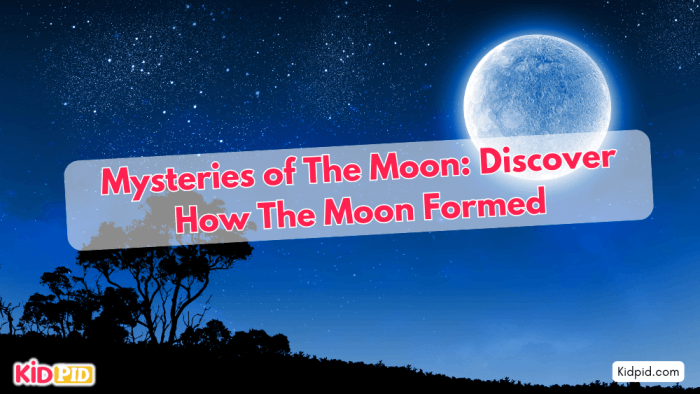
In this fun and exciting exploration, we will learn all about the Moon and how it was formed. The Moon has fascinated people for centuries, and now we’ll uncover the secrets behind it!
- The Moon is Earth’s closest neighbor in space and has always sparked curiosity.
- Scientists believe the Moon was formed about 4.5 billion years ago after a big collision between Earth and a Mars-sized object.
- This impact caused debris to float around Earth, eventually coming together to form the Moon.
- The Moon’s surface is covered in craters made by space objects hitting it.
- The Moon has no atmosphere, so it doesn’t have wind or weather like Earth.
- The Moon controls tides on Earth because of its gravitational pull.
- It takes about 27 days for the Moon to orbit Earth.
- The Moon’s phases (like full moon and new moon) happen because of how it orbits Earth and the sunlight it reflects.
- The Moon has been explored by astronauts, and even though we know a lot, it still holds many secrets!
Contents
- Mysteries of the Moon: Discover How the Moon Formed.
- Related MCQ’s
- 1. What is the Moon’s light actually?
- 2. What is the most widely accepted theory about the Moon’s formation?
- 3. Which phase of the Moon occurs when it is nearly invisible from Earth?
- 4. What causes the phases of the Moon?
- 5. What happens during a total lunar eclipse?
- 6. What would happen if the Moon suddenly disappeared?
- 7. What is the most important role of the Moon?
- 8. What would happen if the Moon exploded?
- 9. What would happen if the Moon fell to Earth?
- 10. How far is the Moon moving away from Earth each year?
- You may like these:
Mysteries of the Moon: Discover How the Moon Formed.
Related MCQ’s
1. What is the Moon’s light actually?
A) The Moon’s own light
B) The Sun’s light reflected off the Moon
C) Light from Earth
D) A combination of all lights
2. What is the most widely accepted theory about the Moon’s formation?
A) Capture Theory
B) Aggression Theory
C) Fission Theory
D) Giant Impact Theory
3. Which phase of the Moon occurs when it is nearly invisible from Earth?
A) Full Moon
B) New Moon
C) First Quarter
D) Waxing Crescent
4. What causes the phases of the Moon?
A) The Moon’s size changes
B) The Moon’s position in relation to Earth and the Sun
C) The Sun’s movement
D) Earth’s rotation
5. What happens during a total lunar eclipse?
A) The Moon gets brighter
B) The Moon turns red
C) The Moon becomes invisible
D) The Moon moves closer to Earth
6. What would happen if the Moon suddenly disappeared?
A) The Earth would rotate slower
B) There would be no tides
C) Days on Earth would become longer
D) All animals would disappear
7. What is the most important role of the Moon?
A) It provides light at night
B) It causes the seasons
C) It keeps Earth stable and rotates
D) It affects Earth’s atmosphere
8. What would happen if the Moon exploded?
A) It would become brighter
B) The Earth’s temperature would decrease
C) The Earth’s rotation would speed up
D) Earth’s climate would become more stable
9. What would happen if the Moon fell to Earth?
A) The Moon would grow in size
B) Earth would experience massive earthquakes and volcanic eruptions
C) The tides would stop completely
D) The Earth would spin slower
10. How far is the Moon moving away from Earth each year?
A) 1.5 inches
B) 4 centimeters
C) 1 foot
D) 10 miles
You may like these:
What is the Moon made of?
The Moon is composed mainly of rock and metal, with a crust, mantle, and core. Its surface features include craters, mountains, and maria.
Why can we see the Moon during the day?
We can see the Moon during the day due to its brightness and the reflection of sunlight, making it visible even against the blue sky.
Stars and the Solar System
Stars are massive, glowing balls of gas that generate energy. The Solar System includes the Sun, planets, moons, and other celestial objects that orbit the Sun.