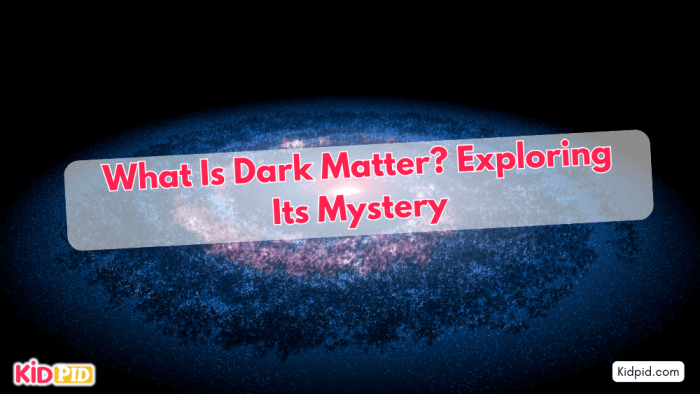
Dark matter is a special kind of matter that we cannot see. It doesn’t give off light, so it’s invisible to our eyes and telescopes. Even though we can’t see it, scientists know dark matter exists because it has gravity and pulls on things around it. It helps explain how galaxies stay together and move in space.
- What is Dark Matter: Dark matter is a type of matter that doesn’t shine or reflect light, so we can’t see it. It is invisible but has mass and gravity, which affect stars and galaxies.
- Why is it Important: Dark matter makes up a large part of the universe. Without it, galaxies wouldn’t hold together properly, and space would be very different.
- How Do We Know It Exists: Scientists see how stars and galaxies move, and dark matter’s gravity helps explain their movements.
- Mystery of Dark Matter: Even though scientists know it exists, we still don’t know exactly what dark matter is made of. It remains one of space’s biggest mysteries!
Contents
- What Is Dark Matter? Unraveling The Enigma Of Dark Matter.
- Related MCQ’s
- 1. What is the greatest mystery of the universe?
- 2. What makes up less than five percent of the universe?
- 3. Why can’t we see dark matter?
- 4. Who discovered that galaxies have more mass than we can see?
- 5. What force helps us detect dark matter?
- 6. What percentage of the universe is made up of dark matter?
- 7. What can bend light and help us detect dark matter?
- You may like these:
What Is Dark Matter? Unraveling The Enigma Of Dark Matter.

Related MCQ’s
1. What is the greatest mystery of the universe?
A) Dark Energy
B) Dark Matter
C) Gravity
D) Atoms
Answer: B) Dark Matter
Explanation: Dark Matter is the greatest mystery because it is invisible, and we don’t know much about it.
2. What makes up less than five percent of the universe?
A) Dark Energy
B) Normal Matter
C) Atoms
D) Light
Answer: B) Normal Matter
Explanation: Normal matter, the building blocks of everything, makes up less than five percent of the universe. The rest is dark matter and dark energy.
3. Why can’t we see dark matter?
A) It is too small to see.
B) It does not reflect light.
C) It is too far away.
D) It is invisible because of gravity.
Answer: B) It does not reflect light.
Explanation: Dark matter doesn’t reflect light like normal matter does, which is why it’s invisible.
4. Who discovered that galaxies have more mass than we can see?
A) Albert Einstein
B) Dr. Binocs
C) Fritz Zwicky
D) Isaac Newton
Answer: C) Fritz Zwicky
Explanation: Fritz Zwicky discovered in 1933 that galaxies have more mass than visible objects show, leading to the concept of dark matter.
5. What force helps us detect dark matter?
A) Magnetism
B) Gravity
C) Light
D) Friction
Answer: B) Gravity
Explanation: Gravity helps us detect dark matter because objects are held together by an unseen gravitational force, indicating the presence of dark matter.
6. What percentage of the universe is made up of dark matter?
A) 5%
B) 27%
C) 68%
D) 50%
Answer: B) 27%
Explanation: Dark matter makes up about 27% of the universe.
7. What can bend light and help us detect dark matter?
A) Black Holes
B) Galaxies
C) Areas with high concentrations of dark matter
D) Stars
Answer: C) Areas with high concentrations of dark matter
Explanation: Areas with high concentrations of dark matter bend light around them, allowing us to detect its presence.
You may like these:
Concept of Gravity
Gravity is a force that attracts objects toward each other. It keeps everything grounded on Earth, causes objects to fall, and keeps planets in orbit around the Sun.
What is Big Bang Theory?
The Big Bang Theory explains how the universe began. Around 13.8 billion years ago, the universe started as a small, hot, dense point, expanding ever since.
How to build a dark matter detector
To build a dark matter detector, use sensitive instruments like a particle detector, shield it from noise, and search for signs of dark matter particles in space.
Space Crafts For Kids


Get creative with fun space crafts! Make rockets, planets, and stars using simple materials. These crafts bring the wonders of space exploration into your home.