“Green Revolution” is a key topic on which students may be asked to write a paragraph in school exams. The Green Revolution began in the 1960s to improve farming and fight hunger by using better seeds, fertilizers, and techniques. Please check the various versions (in 100 words, 150 words, 200 words, and 300 words) provided below for the paragraph.
Contents
- Paragraph on ‘Green Revolution’ in 100 Words
- Paragraph on ‘Green Revolution’ in 150 words
- Paragraph on ‘Green Revolution’ in 200 words
- Paragraph on ‘Green Revolution’ in 300 words
- MCQ’s on ‘Green Revolution’
- 1. When did the Green Revolution begin?
- 2. Who is known as the main scientist behind the Green Revolution?
- 3. What was one of the main crops improved during the Green Revolution?
- 4. How did farmers grow more food during the Green Revolution?
- 5. Which country greatly benefited from the Green Revolution?
- 6. What problem was reduced by the Green Revolution?
- 7. What harm did using too many fertilizers and pesticides cause?
- 8. What do farmers today try to do to protect nature?
- 9. What method helps keep the soil healthy?
- 10. What is one main lesson from the Green Revolution?
- You may like these:
Paragraph on ‘Green Revolution’ in 100 Words


The Green Revolution was a time when farming improved to grow more food. It started in the 1960s to help fight hunger. Scientists found better seeds, taught farmers how to use fertilizers, and shared new ways of farming. These changes helped farmers grow more crops like wheat and rice. This was very helpful in countries like India, where many people needed food. The Green Revolution made sure fewer people went hungry. It also showed how science could help farming. But it also brought challenges, like using too many chemicals, which hurt the soil and water.
Paragraph on ‘Green Revolution’ in 150 words

The Green Revolution changed farming forever. It began in the 1960s when scientists wanted to find ways to grow more food. They made better seeds for crops like wheat and rice. These seeds grew faster and gave more food. Farmers also started using machines, fertilizers, and pesticides. This helped grow food in less time. The Green Revolution helped countries like India grow enough food for their people. Before, many people didn’t have enough to eat, but this change helped reduce hunger. However, using too many fertilizers and sprays can harm the soil and water. Today, farmers try to find better ways to grow food without hurting the earth.
Paragraph on ‘Green Revolution’ in 200 words
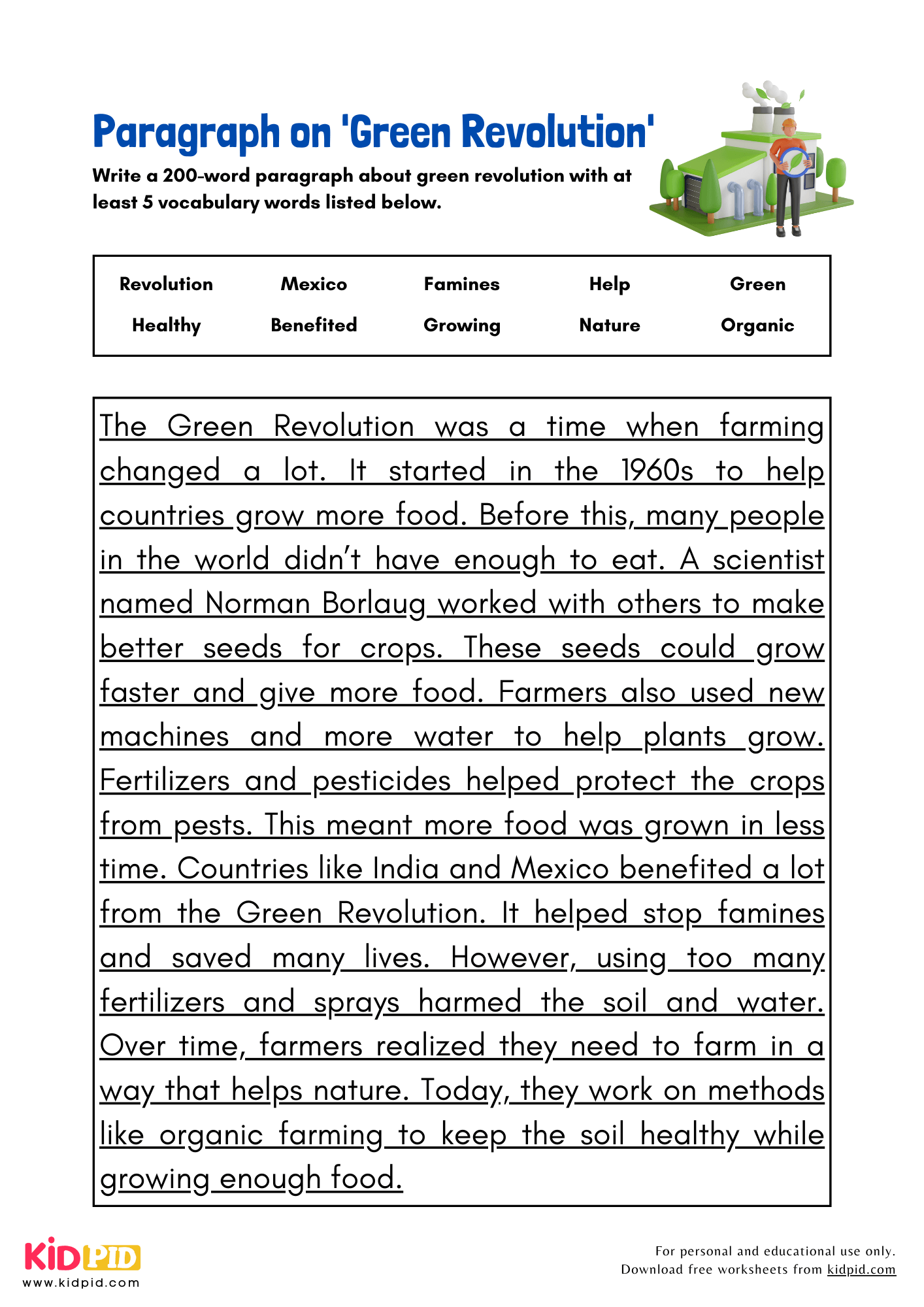
The Green Revolution was a time when farming changed a lot. It started in the 1960s to help countries grow more food. Before this, many people in the world didn’t have enough to eat. A scientist named Norman Borlaug worked with others to make better seeds for crops. These seeds could grow faster and give more food. Farmers also used new machines and more water to help plants grow. Fertilizers and pesticides helped protect the crops from pests. This meant more food was grown in less time. Countries like India and Mexico benefited a lot from the Green Revolution. It helped stop famines and saved many lives. However, using too many fertilizers and sprays harmed the soil and water. Over time, farmers realized they needed to farm in a way that helped nature. Today, they work on methods like organic farming to keep the soil healthy while growing enough food.
Paragraph on ‘Green Revolution’ in 300 words
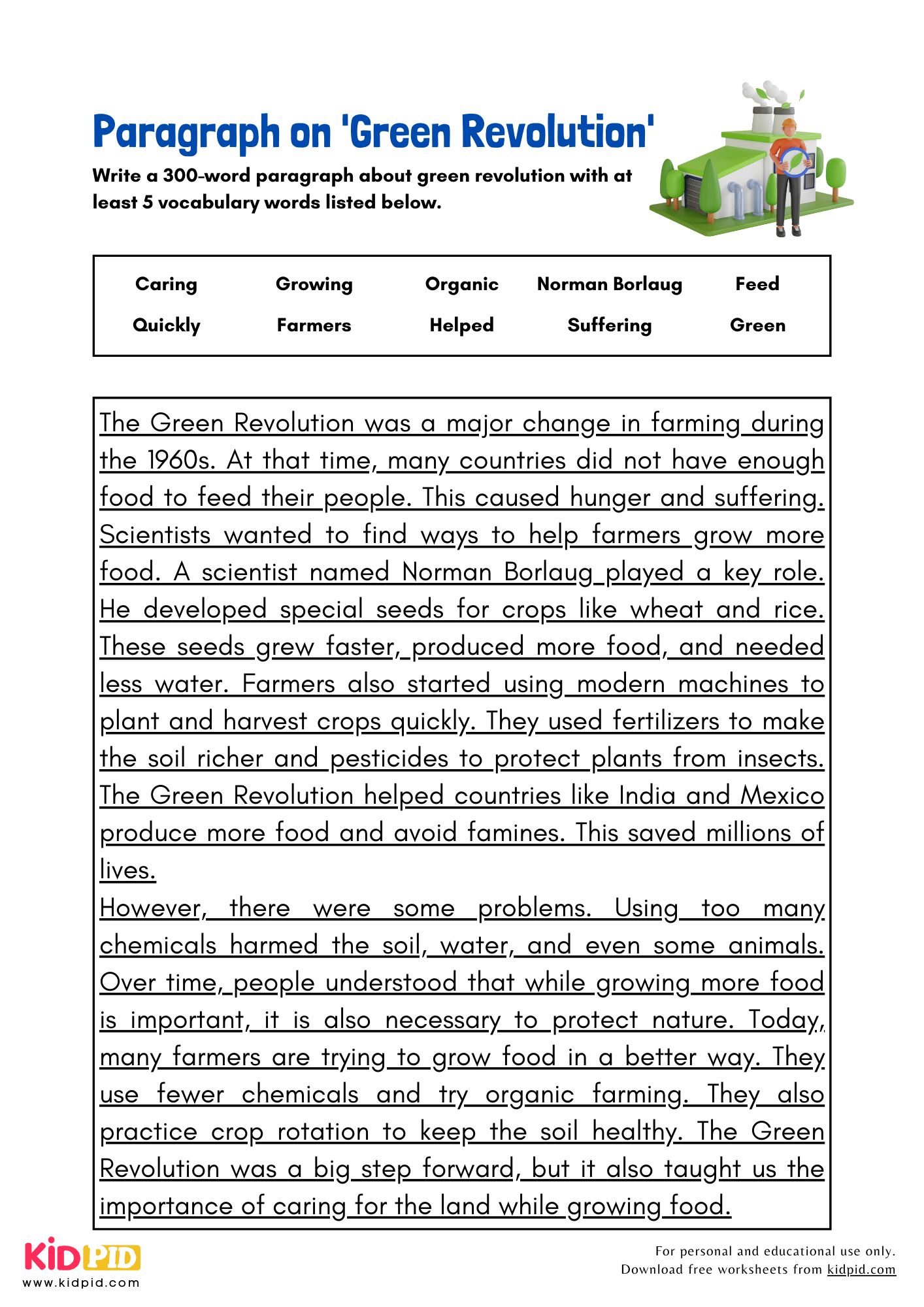
The Green Revolution was a major change in farming during the 1960s. At that time, many countries did not have enough food to feed their people. This caused hunger and suffering. Scientists wanted to find ways to help farmers grow more food. A scientist named Norman Borlaug played a key role. He developed special seeds for crops like wheat and rice. These seeds grew faster, produced more food, and needed less water. Farmers also started using modern machines to plant and harvest crops quickly. They used fertilizers to make the soil richer and pesticides to protect plants from insects. The Green Revolution helped countries like India and Mexico produce more food and avoid famines. This saved millions of lives.
However, there were some problems. Using too many chemicals harmed the soil, water, and even some animals. Over time, people understood that while growing more food is important, it is also necessary to protect nature. Today, many farmers are trying to grow food in a better way. They use fewer chemicals and try organic farming. They also practice crop rotation to keep the soil healthy. The Green Revolution was a big step forward, but it also taught us the importance of caring for the land while growing food.
MCQ’s on ‘Green Revolution’
1. When did the Green Revolution begin?
A) 1940s
B) 1950s
C) 1960s
D) 1970s
Answer: C) 1960s
Explanation: The Green Revolution started in the 1960s to solve the problem of food shortages.
2. Who is known as the main scientist behind the Green Revolution?
A) Albert Einstein
B) Isaac Newton
C) Norman Borlaug
D) Thomas Edison
Answer: C) Norman Borlaug
Explanation: Norman Borlaug developed special seeds that helped grow more food.
3. What was one of the main crops improved during the Green Revolution?
A) Cotton
B) Wheat
C) Banana
D) Potato
Answer: B) Wheat
Explanation: Wheat and rice were key crops improved during the Green Revolution.
4. How did farmers grow more food during the Green Revolution?
A) By planting more trees
B) By using better seeds, fertilizers, and machines
C) By farming less land
D) By growing only fruits
Answer: B) By using better seeds, fertilizers, and machines
Explanation: Farmers used new seeds, machines, and fertilizers to grow food faster.
5. Which country greatly benefited from the Green Revolution?
A) India
B) Australia
C) Canada
D) Japan
Answer: A) India
Explanation: India was one of the countries that grew more food and reduced hunger.
6. What problem was reduced by the Green Revolution?
A) Pollution
B) Hunger
C) Traffic
D) Deforestation
Answer: B) Hunger
Explanation: The Green Revolution helped reduce hunger by increasing food production.
7. What harm did using too many fertilizers and pesticides cause?
A) It made people rich
B) It harmed the soil and water
C) It made plants grow taller
D) It helped protect the animals
Answer: B) It harmed the soil and water
Explanation: Too many chemicals cause damage to the soil and water.
8. What do farmers today try to do to protect nature?
A) Use more fertilizers
B) Cut down trees
C) Use fewer chemicals and try organic farming
D) Burn the crops
Answer: C) Use fewer chemicals and try organic farming
Explanation: Farmers now try to grow food using fewer chemicals to protect nature.
9. What method helps keep the soil healthy?
A) Cutting down forests
B) Using only pesticides
C) Crop rotation
D) Planting only one type of crop
Answer: C) Crop rotation
Explanation: Crop rotation helps keep the soil healthy by changing the type of crops grown.
10. What is one main lesson from the Green Revolution?
A) Only grow one type of crop
B) Grow more food but protect the land
C) Stop using machines
D) Use more water
Answer: B) Grow more food but protect the land
Explanation: The Green Revolution showed that while growing food is important, protecting the land is also necessary.


We hope you found the paragraphs on the topic “Green Revolution” written by our team of experienced teachers helpful. Keep visiting our website and explore more paragraphs, essays, worksheets, flashcards, Quizzes and many other interactive resources. Don’t forget to follow us on YouTube & Facebook.
You may like these:
Industrial Revolution
The Industrial Revolution marked a transformative era of technological advancements, urbanization, and mechanization, revolutionizing industries, transportation, and society from the late 18th century onwards.
Crop Production and Management
Crop production and management encompass practices like soil preparation, sowing, irrigation, and harvesting, ensuring efficient, sustainable agricultural yield to meet growing food demands.
A Seed Tells A Farmers Story
A single seed narrates the journey of cultivation, highlighting farmers’ efforts, challenges, and the interconnectedness of tradition, innovation, and nature in agriculture.
Where Did Agriculture Begin? How It Started?
Agriculture began in the Fertile Crescent around 10,000 years ago, evolving from hunting-gathering to farming, driven by domestication of plants and animals.