“The Moon” is a significant topic that students may be asked to write a paragraph about in school exams. The Moon, Earth’s closest neighbor, orbits our planet and plays an important role in space exploration and Earth’s environment. Please check the various versions (in 50 words, 100 words, 150 words, 200 words, and 300 words) provided below for the paragraph.
Contents
- Paragraph on ‘The Moon’ in 50 Words for Classes 1 & 2
- Paragraph on ‘The Moon’ in 100 Words for Classes 3 & 4
- Paragraph on ‘The Moon’ in 150 Words for Class 5
- Paragraph on ‘The Moon’ in 200 Words for Classes 6 & 7
- Paragraph on ‘The Moon’ in 300 Wordsfor Classes 8 to 10
- MCQ’s on ‘The Moon’
- 1. What is the Moon made of?
- 2. How far is the Moon from Earth?
- 3. Why does the Moon shine at night?
- 4. What causes the craters on the Moon’s surface?
- 5. How long does it take the Moon to orbit Earth?
- 6. Why do we only see one side of the Moon from Earth?
- 7. What is the effect of the Moon’s gravity on Earth?
- 8. What did astronauts Neil Armstrong and Buzz Aldrin do on the Moon?
- 9. What shape does the Moon appear as when we see the whole thing lit up?
- 10. What does the Moon help with on Earth?
- Importance of the Moon
- Additional Facts About the Moon
- You may like these:
Read This Article in Other Languages
- चाँद पर अनुच्छेद (Hindi / हिंदी)
- Párrafo sobre la luna (Spanish / Español)
- Paragraphe sur la lune (French / Français)
- Absatz über den Mond (German / Deutsch)
- فقرة عن القمر (Arabic / العربية)
- চাঁদ সম্পর্কে অনুচ্ছেদ (Bengali / বাংলা)
- சந்திரன் பற்றி பத்தி (Tamil / தமிழ்)
- చంద్రుడిపై పేరా (Telugu / తెలుగు)
- ചന്ദ്രനെക്കുറിച്ചുള്ള പാരഗ്രാഫ് (Malayalam / മലയാളം)
- چاند پر پیراگراف (Urdu / اردو)
- Parágrafo sobre a lua (Portuguese / Português)
Translation Disclaimer: These links use Google Translate, an automated translation service. Translations may vary in accuracy and are provided for convenience only.
Paragraph on ‘The Moon’ in 50 Words for Classes 1 & 2
The Moon is a bright, round object in the sky. It shines at night and changes shape every month. People have visited the Moon in rockets. The Moon has mountains and craters. It looks beautiful and helps us know time through months.
Paragraph on ‘The Moon’ in 100 Words for Classes 3 & 4


The Moon is Earth’s closest neighbor in space. It is a big, round rock that orbits around Earth. The Moon is not a light source. It shines because it reflects the Sun’s light. The Moon has many craters, which are holes caused by space rocks hitting it. The Moon has no air, so there is no sound or wind. It is much smaller than Earth and has only a little gravity. The Moon moves around Earth in about 28 days. People have visited the Moon, and it is an exciting part of space exploration.
Paragraph on ‘The Moon’ in 150 Words for Class 5

The Moon is a large, round object that orbits Earth. It is made of rock and has no air or weather. The Moon is about 238,855 miles away from Earth. It does not make its own light, but it shines brightly at night because it reflects the Sun’s light. The Moon has many craters that were made by space rocks crashing into it. It has very weak gravity, which means things on the Moon weigh less than on Earth. The Moon orbits Earth once every 28 days. We can only see one side of the Moon from Earth because it spins slowly. The Moon has been a subject of interest for humans for thousands of years. In 1969, astronauts landed on the Moon and explored its surface. The Moon plays an important role in our night sky and affects the tides on Earth.
Paragraph on ‘The Moon’ in 200 Words for Classes 6 & 7
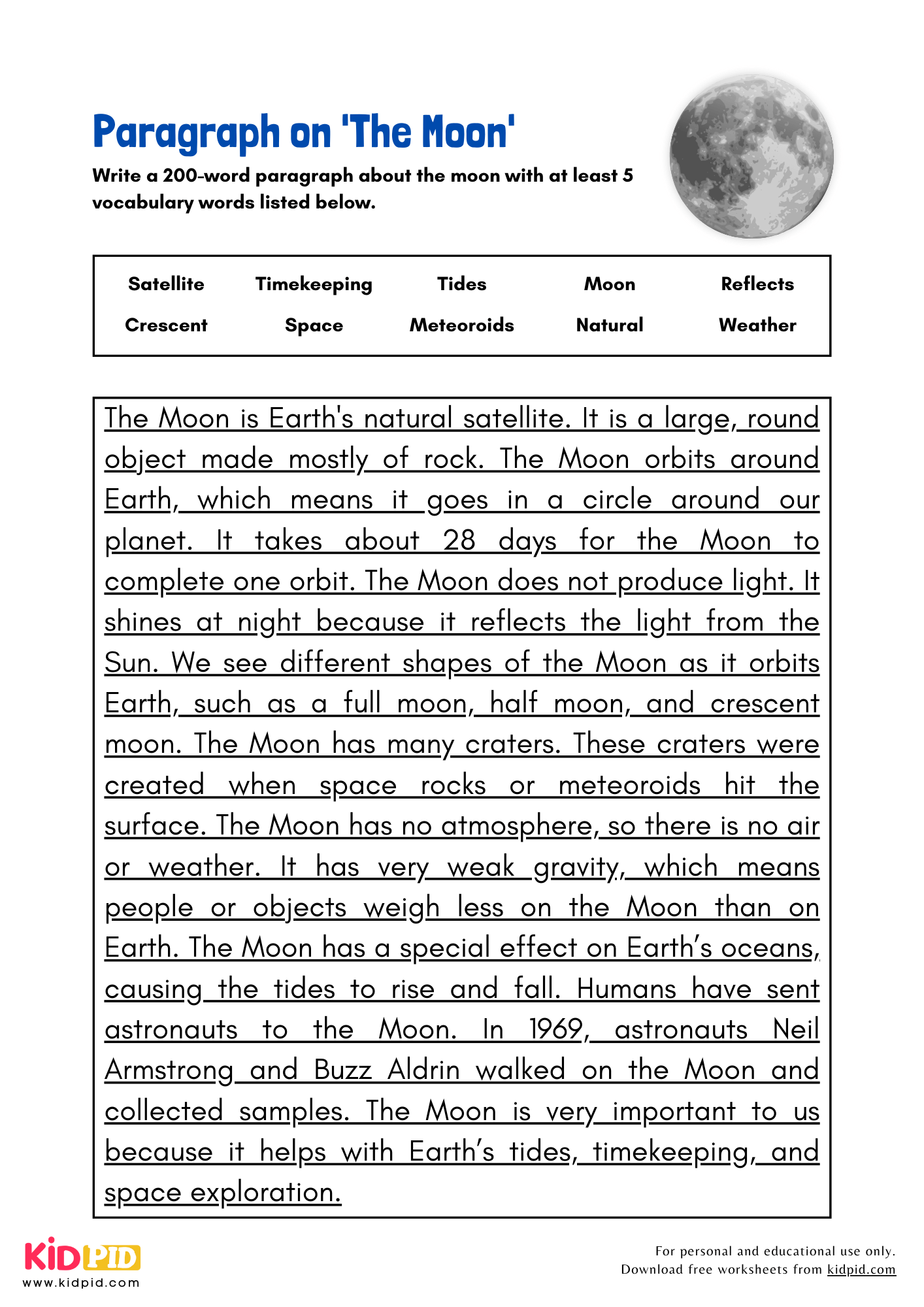
The Moon is Earth’s natural satellite. It is a large, round object made mostly of rock. The Moon orbits around Earth, which means it goes in a circle around our planet. It takes about 28 days for the Moon to complete one orbit. The Moon does not produce light. It shines at night because it reflects the light from the Sun. We see different shapes of the Moon as it orbits Earth, such as a full moon, half moon, and crescent moon. The Moon has many craters. These craters were created when space rocks or meteoroids hit the surface. The Moon has no atmosphere, so there is no air or weather. It has very weak gravity, which means people or objects weigh less on the Moon than on Earth. The Moon has a special effect on Earth’s oceans, causing the tides to rise and fall. Humans have sent astronauts to the Moon. In 1969, astronauts Neil Armstrong and Buzz Aldrin walked on the Moon and collected samples. The Moon is very important to us because it helps with Earth’s tides, timekeeping, and space exploration.
Paragraph on ‘The Moon’ in 300 Wordsfor Classes 8 to 10
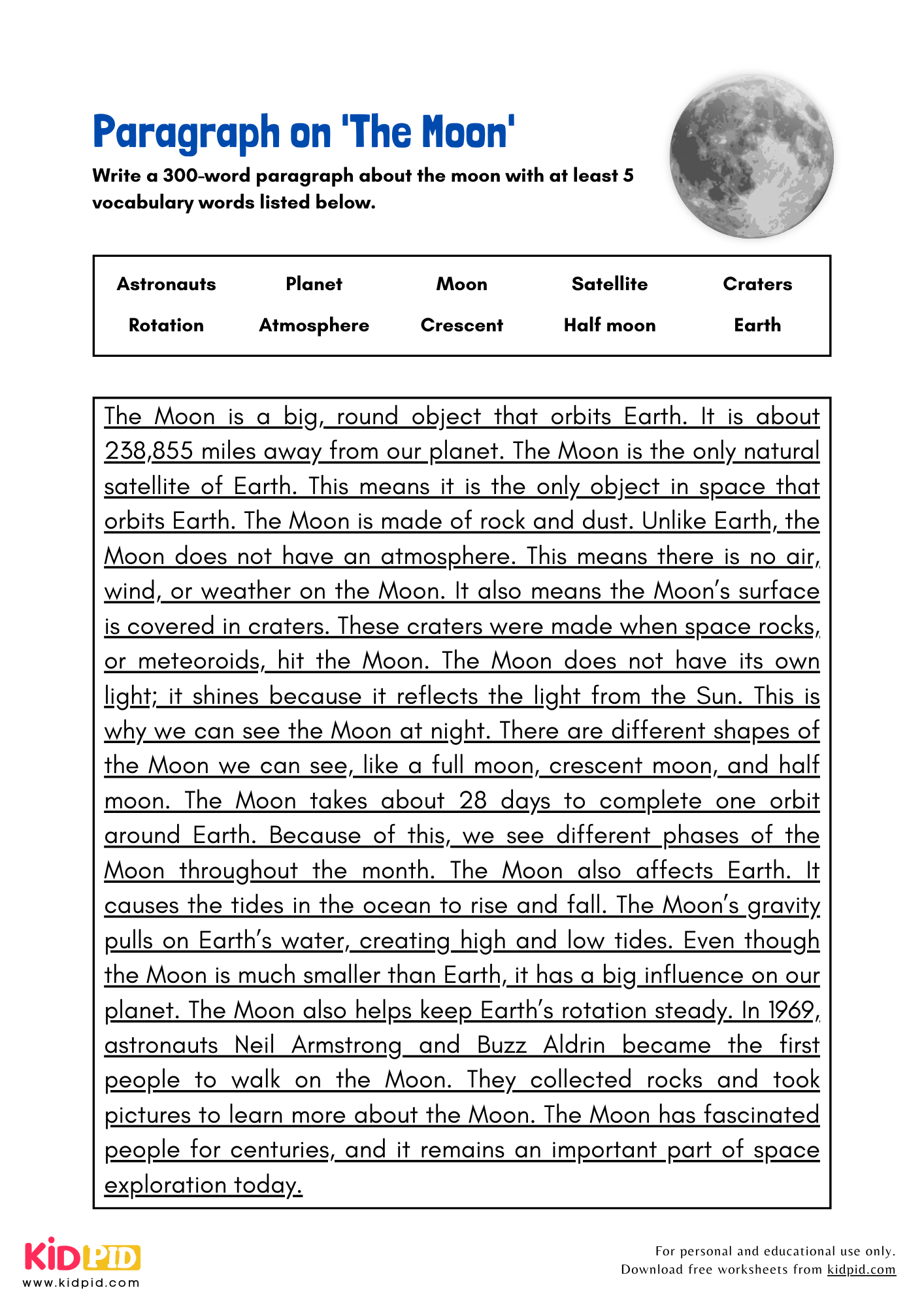
The Moon is a big, round object that orbits Earth. It is about 238,855 miles away from our planet. The Moon is the only natural satellite of Earth. This means it is the only object in space that orbits Earth. The Moon is made of rock and dust. Unlike Earth, the Moon does not have an atmosphere. This means there is no air, wind, or weather on the Moon. It also means the Moon’s surface is covered in craters. These craters were made when space rocks, or meteoroids, hit the Moon. The Moon does not have its own light; it shines because it reflects the light from the Sun. This is why we can see the Moon at night. There are different shapes of the Moon we can see, like a full moon, crescent moon, and half moon. The Moon takes about 28 days to complete one orbit around Earth. Because of this, we see different phases of the Moon throughout the month. The Moon also affects Earth. It causes the tides in the ocean to rise and fall. The Moon’s gravity pulls on Earth’s water, creating high and low tides. Even though the Moon is much smaller than Earth, it has a big influence on our planet. The Moon also helps keep Earth’s rotation steady. In 1969, astronauts Neil Armstrong and Buzz Aldrin became the first people to walk on the Moon. They collected rocks and took pictures to learn more about the Moon. The Moon has fascinated people for centuries, and it remains an important part of space exploration today.
MCQ’s on ‘The Moon’
1. What is the Moon made of?
a) Water
b) Ice
c) Rock
d) Gas
Answer: c) Rock
Explanation: The Moon is made mostly of rock and dust.
2. How far is the Moon from Earth?
a) 100 miles
b) 238,855 miles
c) 500,000 miles
d) 1,000 miles
Answer: b) 238,855 miles
Explanation: The Moon is about 238,855 miles away from Earth.
3. Why does the Moon shine at night?
a) It makes its own light
b) It reflects the Sun’s light
c) It catches fire
d) It is glowing
Answer: b) It reflects the Sun’s light
Explanation: The Moon shines because it reflects light from the Sun.
4. What causes the craters on the Moon’s surface?
a) Wind
b) Water
c) Space rocks hitting the Moon
d) Volcanoes
Answer: c) Space rocks hitting the Moon
Explanation: Craters are formed when meteoroids hit the Moon’s surface.
5. How long does it take the Moon to orbit Earth?
a) 7 days
b) 28 days
c) 365 days
d) 12 hours
Answer: b) 28 days
Explanation: The Moon orbits Earth once every 28 days.
6. Why do we only see one side of the Moon from Earth?
a) The Moon is too far
b) The Moon spins slowly
c) The Moon is invisible
d) The Earth blocks the other side
Answer: b) The Moon spins slowly
Explanation: The Moon spins slowly, so we only see one side.
7. What is the effect of the Moon’s gravity on Earth?
a) It causes tides
b) It controls the weather
c) It makes the Earth spin faster
d) It pulls everything toward the Moon
Answer: a) It causes tides
Explanation: The Moon’s gravity pulls on Earth’s water, causing high and low tides.
8. What did astronauts Neil Armstrong and Buzz Aldrin do on the Moon?
a) Build a station
b) Collect rocks and take pictures
c) Plant a tree
d) Study animals
Answer: b) Collect rocks and take pictures
Explanation: In 1969, they collected samples and took pictures to study the Moon.
9. What shape does the Moon appear as when we see the whole thing lit up?
a) Crescent
b) Full moon
c) Half moon
d) Star-shaped
Answer: b) Full moon
Explanation: A full moon appears when we see the entire lit-up side of the Moon.
10. What does the Moon help with on Earth?
a) Changing the seasons
b) Keeping Earth’s rotation steady
c) Producing light
d) Creating clouds
Answer: b) Keeping Earth’s rotation steady
Explanation: The Moon helps keep Earth’s rotation steady and influences the tides.


Importance of the Moon
- The Moon is Earth’s only natural satellite, influencing tides and many natural processes. [Source: NASA]
- Its gravity causes ocean tides and affects the rise and fall of sea levels. [Source: NASA]
- The Moon’s phases help humans track time and months. [Source: NASA]
Additional Facts About the Moon
- The Moon formed about 4.5 billion years ago, likely from a giant impact with Earth. [Source: National Geographic]
- It always shows the same face to Earth because its rotation and orbit are synchronized. [Source: NASA]
- The Moon has no breathable atmosphere and has been explored by astronauts and spacecraft. [Source: NASA]
We hope you found the paragraphs on “The Moon” written by our team of experienced teachers enjoyable. Keep visiting our website and explore more paragraphs, essays, worksheets, flashcards, Quizzes, and other interactive resources. Don’t forget to follow us on YouTube & Facebook.
Our Content Team prepared this paragraph to keep learning manageable.
You may like these:
Paragraph on ‘The Phases of the Moon’
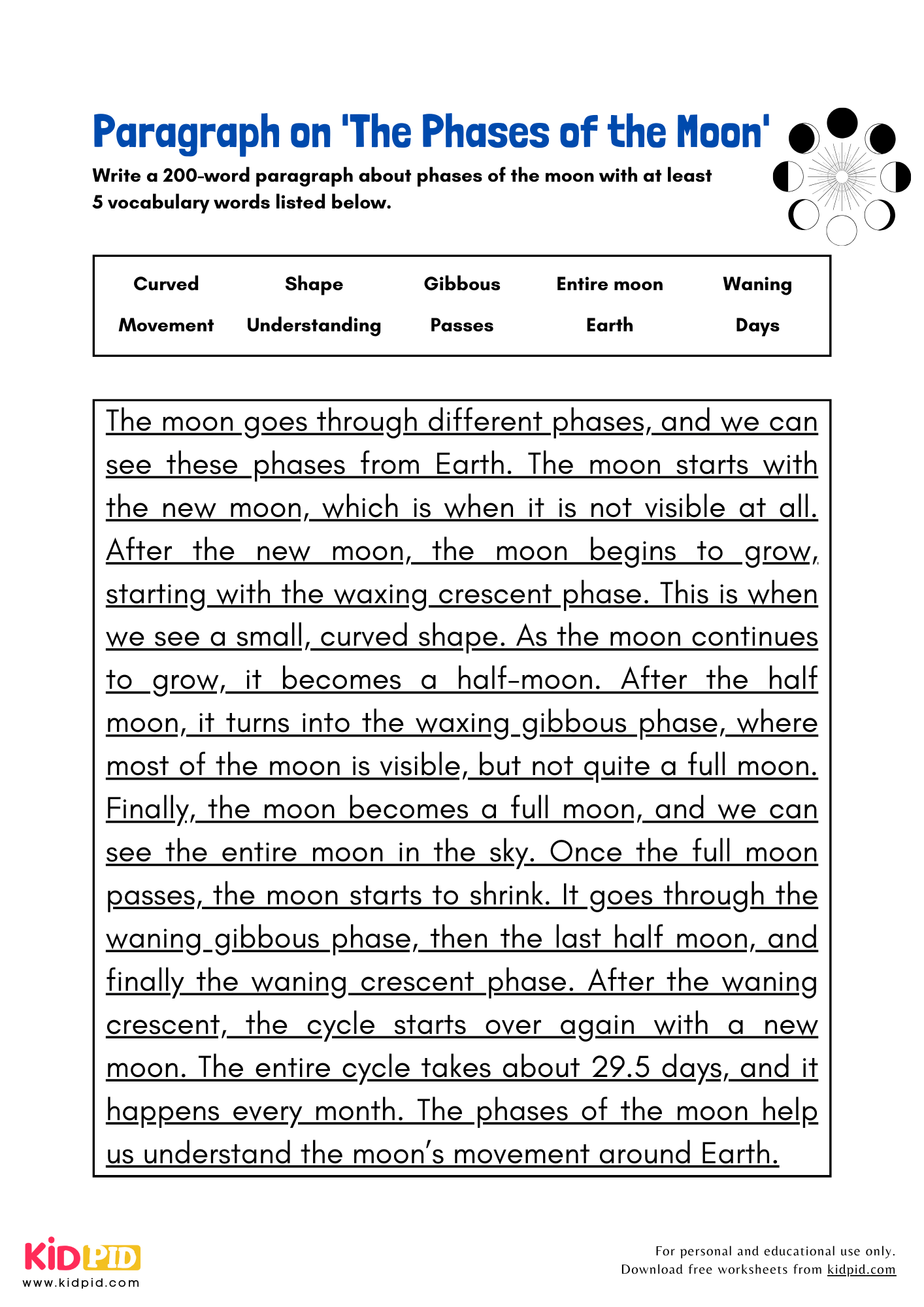

The Moon goes through eight phases, changing its shape due to its position relative to the Sun and Earth. These include new moon, crescent, and full moon.
Why can we see the Moon during the day?
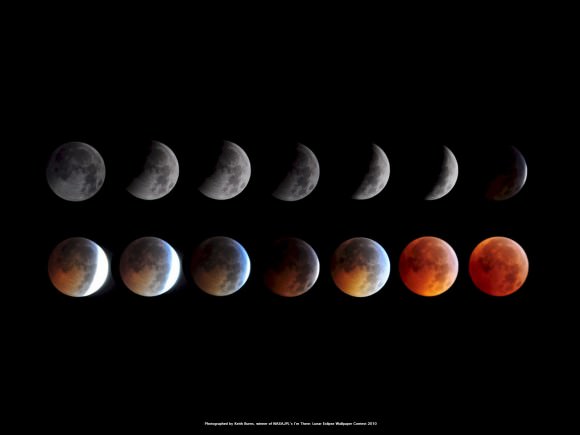

The Moon reflects sunlight and is sometimes visible during the day when it’s above the horizon and the sky is clear, appearing bright against the blue sky.
What is the Moon made of?
The Moon is made of rock and dust, primarily basalt and anorthosite. Its surface has craters, mountains, and lava plains formed by ancient volcanic activity and impacts.
Space Crafts For Kids

Space crafts for kids are fun, educational activities that explore space themes. Projects like rocket models, paper planets, and astronaut helmets inspire creativity and learning.