

“The Space Race” is a significant topic that students may be asked to write a paragraph about in school exams. In the Cold War era, the Space Race ignited fierce competition between the United States and the Soviet Union to explore space. Please check the various versions (in 100 words, 150 words, 200 words, and 300 words) provided below for the paragraph.
Contents
- Paragraph on ‘The Space Race’ in 100 Words
- Paragraph on ‘The Space Race’ in 150 Words
- Paragraph on ‘The Space Race’ in 200 Words
- Paragraph on ‘The Space Race’ in 300 Words
- MCQ’s on ‘The Space Race’
- 1. What sparked the Space Race?
- 2. Who was the first human to orbit the Earth?
- 3. What was the name of the U.S. space agency?
- 4. What major achievement did the U.S. accomplish in 1969?
- 5. Who were the first astronauts to walk on the moon?
- 6. What was Neil Armstrong’s famous quote when he stepped on the moon?
- 7. Why did the Space Race inspire many people?
- 8. What was the main goal of the Space Race?
- 9. Which event did NOT happen during the Space Race?
- 10. What was a significant outcome of the Space Race?
- You may like these:
Paragraph on ‘The Space Race’ in 100 Words


The Space Race was a big competition between the United States and the Soviet Union. It started in the late 1950s. Both countries wanted to explore space and show they were the best. In 1957, the Soviet Union launched Sputnik, the first satellite. This surprised many people. In 1961, they sent the first human, Yuri Gagarin, into space. The United States responded by sending astronauts to the moon. In 1969, Neil Armstrong became the first person to walk on the moon. The Space Race helped countries learn more about space and led to many important discoveries.
Paragraph on ‘The Space Race’ in 150 Words

The Space Race was an exciting time during the Cold War when the United States and the Soviet Union competed to explore space. It began in the late 1950s. The first major event was the launch of Sputnik by the Soviet Union in 1957. This was the first artificial satellite to orbit the Earth, and it shocked many people in America. In 1961, the Soviets sent Yuri Gagarin into space, making him the first human to orbit the planet. The United States wanted to catch up, so they worked hard on their space program. In 1969, NASA’s Apollo 11 mission landed astronauts Neil Armstrong and Buzz Aldrin on the moon. Neil Armstrong was the first person to step on the moon’s surface. The Space Race not only showed human courage and ingenuity but also led to new technologies that we still use today.
Paragraph on ‘The Space Race’ in 200 Words
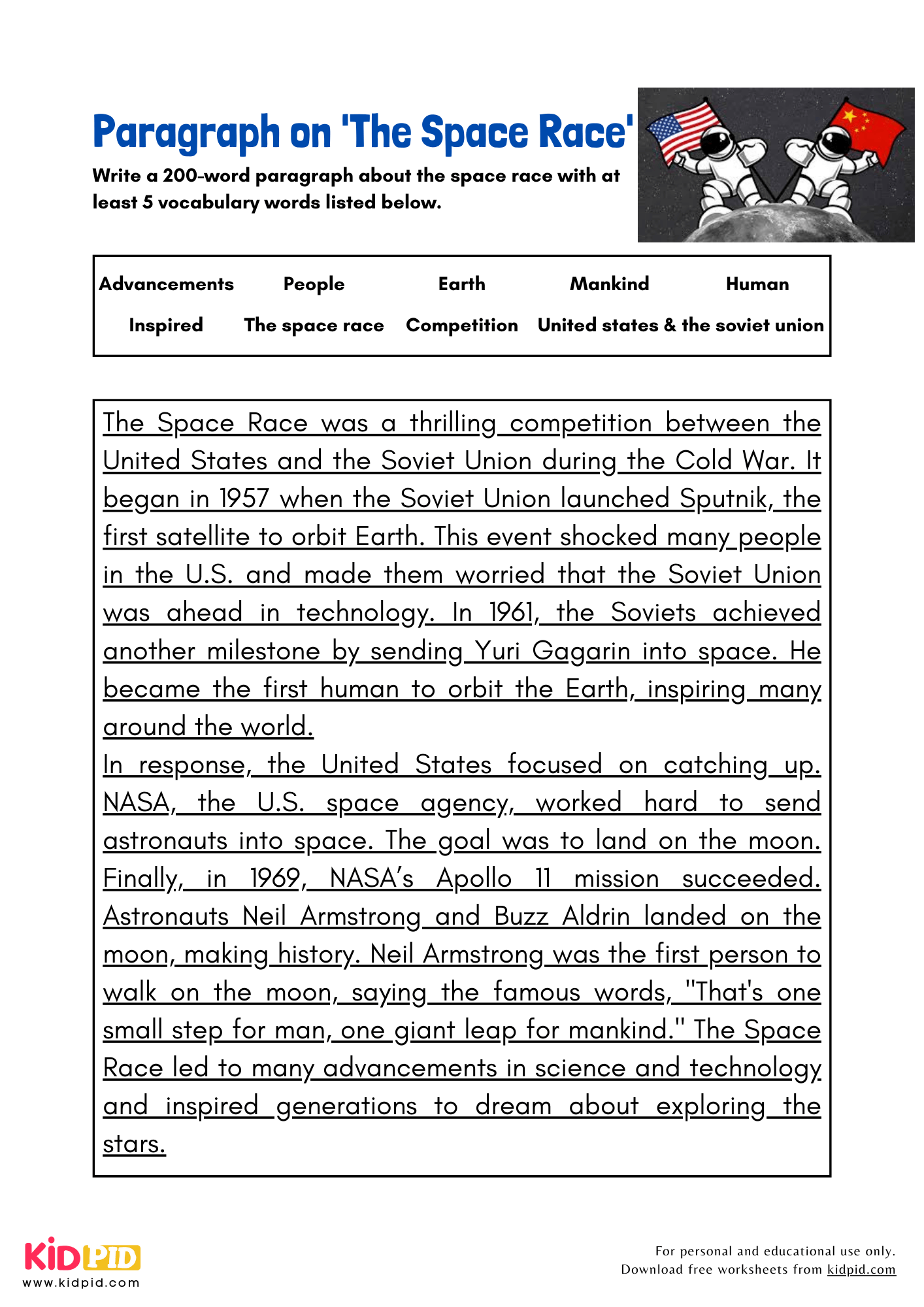
The Space Race was a thrilling competition between the United States and the Soviet Union during the Cold War. It began in 1957 when the Soviet Union launched Sputnik, the first satellite to orbit Earth. This event shocked many people in the U.S. and made them worried that the Soviet Union was ahead in technology. In 1961, the Soviets achieved another milestone by sending Yuri Gagarin into space. He became the first human to orbit the Earth, inspiring many around the world.
In response, the United States focused on catching up. NASA, the U.S. space agency, worked hard to send astronauts into space. The goal was to land on the moon. Finally, in 1969, NASA’s Apollo 11 mission succeeded. Astronauts Neil Armstrong and Buzz Aldrin landed on the moon, making history. Neil Armstrong was the first person to walk on the moon, saying the famous words, “That’s one small step for man, one giant leap for mankind.” The Space Race led to many advancements in science and technology and inspired generations to dream about exploring the stars.
Paragraph on ‘The Space Race’ in 300 Words

The Space Race was an exciting and intense competition between the United States and the Soviet Union that took place during the Cold War. It began in the late 1950s and was fueled by a desire to prove which nation had the best technology and scientific knowledge. The race officially started on October 4, 1957, when the Soviet Union launched Sputnik, the first artificial satellite, into space. This event shocked many Americans and made them realize that the U.S. needed to improve its space program.
In 1961, the Soviet Union achieved another significant milestone by sending Yuri Gagarin into space. He became the first human to orbit the Earth, which was a huge victory for the Soviets. The United States was determined to catch up, so they poured resources into their space program, NASA. They worked hard to send astronauts to the moon, and in 1969, they accomplished this amazing goal.
The Apollo 11 mission was a turning point in the Space Race. Astronauts Neil Armstrong and Buzz Aldrin landed on the moon, with Armstrong becoming the first person to step onto the lunar surface. He famously said, “That’s one small step for man, one giant leap for mankind.” The Space Race had a significant impact on science, technology, and culture. It inspired many young people to pursue careers in science and engineering.
The achievements during the Space Race led to important developments, including satellite technology, computer advancements, and a better understanding of our universe. It showed how human curiosity and determination can lead to incredible discoveries.
MCQ’s on ‘The Space Race’
1. What sparked the Space Race?
A) The invention of rockets
B) The launch of Sputnik
C) The discovery of gravity
D) The first human in space
Answer: B) The launch of Sputnik
Explanation: Sputnik, launched by the Soviet Union in 1957, was the first artificial satellite and marked the beginning of the Space Race.
2. Who was the first human to orbit the Earth?
A) Neil Armstrong
B) Buzz Aldrin
C) Yuri Gagarin
D) John Glenn
Answer: C) Yuri Gagarin
Explanation: Yuri Gagarin became the first human to orbit the Earth in 1961.
3. What was the name of the U.S. space agency?
A) NASA
B) ESA
C) JAXA
D) CNSA
Answer: A) NASA
Explanation: NASA stands for the National Aeronautics and Space Administration, the U.S. agency responsible for space exploration.
4. What major achievement did the U.S. accomplish in 1969?
A) First satellite launch
B) First human in space
C) First moon landing
D) First space station
Answer: C) First moon landing
Explanation: In 1969, the Apollo 11 mission successfully landed astronauts on the moon.
5. Who were the first astronauts to walk on the moon?
A) Yuri Gagarin and Neil Armstrong
B) Neil Armstrong and Buzz Aldrin
C) John Glenn and Buzz Aldrin
D) Neil Armstrong and Michael Collins
Answer: B) Neil Armstrong and Buzz Aldrin
Explanation: Neil Armstrong and Buzz Aldrin were the first two astronauts to walk on the moon during Apollo 11.
6. What was Neil Armstrong’s famous quote when he stepped on the moon?
A) “To infinity and beyond!”
B) “That’s one small step for man, one giant leap for mankind.”
C) “Houston, we have a problem.”
D) “The eagle has landed.”
Answer: B) “That’s one small step for man, one giant leap for mankind.”
Explanation: This quote marked Armstrong’s first step on the lunar surface.
7. Why did the Space Race inspire many people?
A) It showed that space was fun.
B) It led to more movies about space.
C) It encouraged careers in science and technology.
D) It was a competition only for scientists.
Answer: C) It encouraged careers in science and technology.
Explanation: The achievements of the Space Race motivated many young people to pursue science and engineering.
8. What was the main goal of the Space Race?
A) To find new planets
B) To prove technological superiority
C) To build space stations
D) To create space laws
Answer: B) To prove technological superiority
Explanation: The Space Race was primarily about demonstrating which country had the best technology.
9. Which event did NOT happen during the Space Race?
A) The first artificial satellite launch
B) The first human to walk on Mars
C) The first human in space
D) The first moon landing
Answer: B) The first human to walk on Mars
Explanation: No one has walked on Mars yet; this did not occur during the Space Race.
10. What was a significant outcome of the Space Race?
A) Increased global warming
B) The development of new technologies
C) More wars between countries
D) Less interest in science
Answer: B) The development of new technologies
Explanation: The Space Race led to many advancements in technology that we still use today.


We hope you enjoyed the paragraphs on the topic “The Space Race,” written by our team of experienced teachers. Keep visiting our website and explore more paragraphs, essays, worksheets, flashcards, Quizzes, and other interactive resources. Don’t forget to follow us on YouTube & Facebook.
You may like these:
Paragraph – History of Space Travel


Space travel began with the Soviet Union’s Sputnik in 1957. The U.S. landed astronauts on the Moon in 1969. Today, advanced missions explore Mars and beyond.
Paragraph About Space Exploration and Astronauts


Astronauts explore space to conduct experiments, repair satellites, and advance science. Missions, like Apollo and Artemis, expand human knowledge, preparing for future deep-space colonization.
Paragraph – International Space Station

The ISS orbits Earth, serving as a research laboratory for astronauts from multiple nations. It enables scientific breakthroughs in microgravity, technology, medicine, and space survival techniques.
Paragraph Of The Phases of the Moon
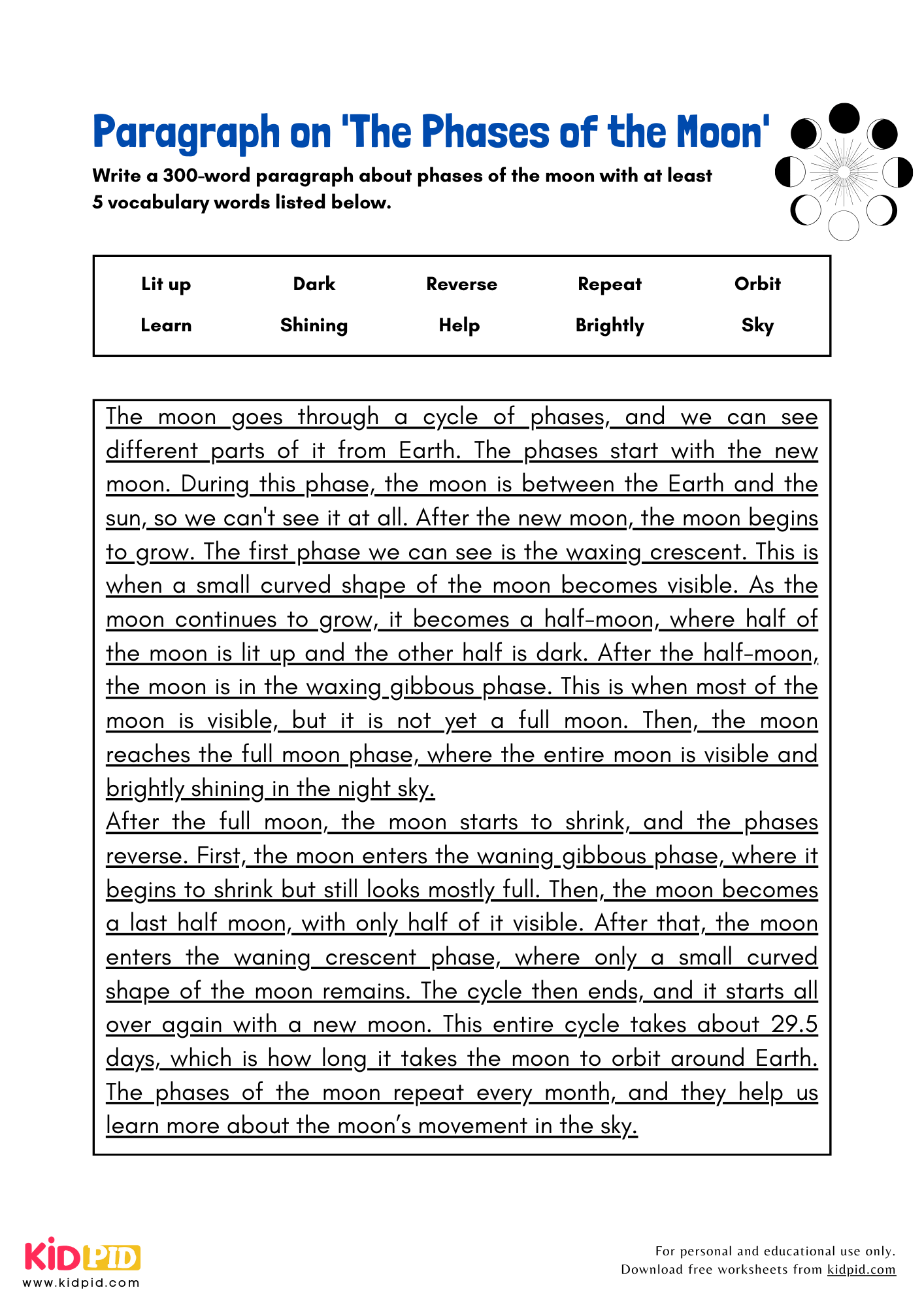
The Moon has eight phases, from the New Moon to the Full Moon and back. These phases result from the Sun’s light reflecting off the Moon’s surface.
Paragraph – Concept of Gravity in Space


Gravity in space keeps planets in orbit. Astronauts experience microgravity on spacecraft, appearing weightless, though they’re still influenced by Earth’s gravitational pull.
Explanation Of World War II
World War II (1939-1945) was a global conflict between Axis and Allied powers, involving major battles, atomic bombings, and shaping modern geopolitics through its aftermath.
About Cold War
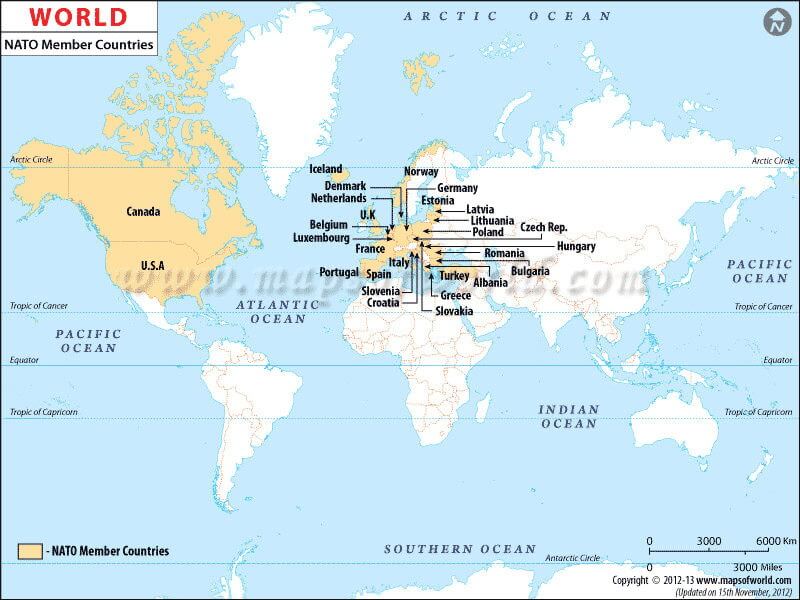

The Cold War (1947-1991) was a geopolitical tension between the U.S. and USSR, marked by nuclear threats, espionage, space race, and ideological conflicts worldwide.


