
‘What is a Chemical Reaction?’ is one of the important topics on which students can be asked to write a paragraph in exams in school. Chemical reactions occur when substances interact and transform into new substances, playing a crucial role in nature, life processes, and everyday activities. Please check the various versions (in 100 words, 150 words, 200 words, and 300 words) provided below for the paragraph.
Contents
- Paragraph on ‘What is a Chemical Reaction?’ in 100 words
- Paragraph on ‘What is a Chemical Reaction?’ in 150 words
- Paragraph on ‘What is a Chemical Reaction?’ in 200 words
- Paragraph on ‘What is a Chemical Reaction?’ in 300 words
- MCQ’s on ‘What is a Chemical Reaction?’
- 1. What happens in a chemical reaction?
- 2. What are the substances called before a chemical reaction?
- 3. What is an example of a chemical reaction?
- 4. What gas is produced when baking soda reacts with vinegar?
- 5. Which of these can happen during a chemical reaction?
- 6. Which process in plants is an example of a chemical reaction?
- 7. What do chemical reactions in our bodies help us do?
- 8. What can chemical reactions produce besides new substances?
- 9. What happens when you heat an egg?
- 10. What is the main characteristic of a chemical reaction?
- What Is a Chemical Reaction? | Easy Science Explanation for Kids
- Importance of Learning About Chemical Reactions for Students
- FAQs
- You may like these:
Paragraph on ‘What is a Chemical Reaction?’ in 100 words

A chemical reaction happens when two or more substances combine to make something new. These substances are called reactants. When they react, they form products. For example, when you mix baking soda with vinegar, they react and create bubbles. The bubbles are carbon dioxide gas, a new substance. Chemical reactions can change color, temperature, or even produce light. These changes show that the reaction is happening. Reactions are everywhere – in the air, in food, and even in our bodies!
Paragraph on ‘What is a Chemical Reaction?’ in 150 words
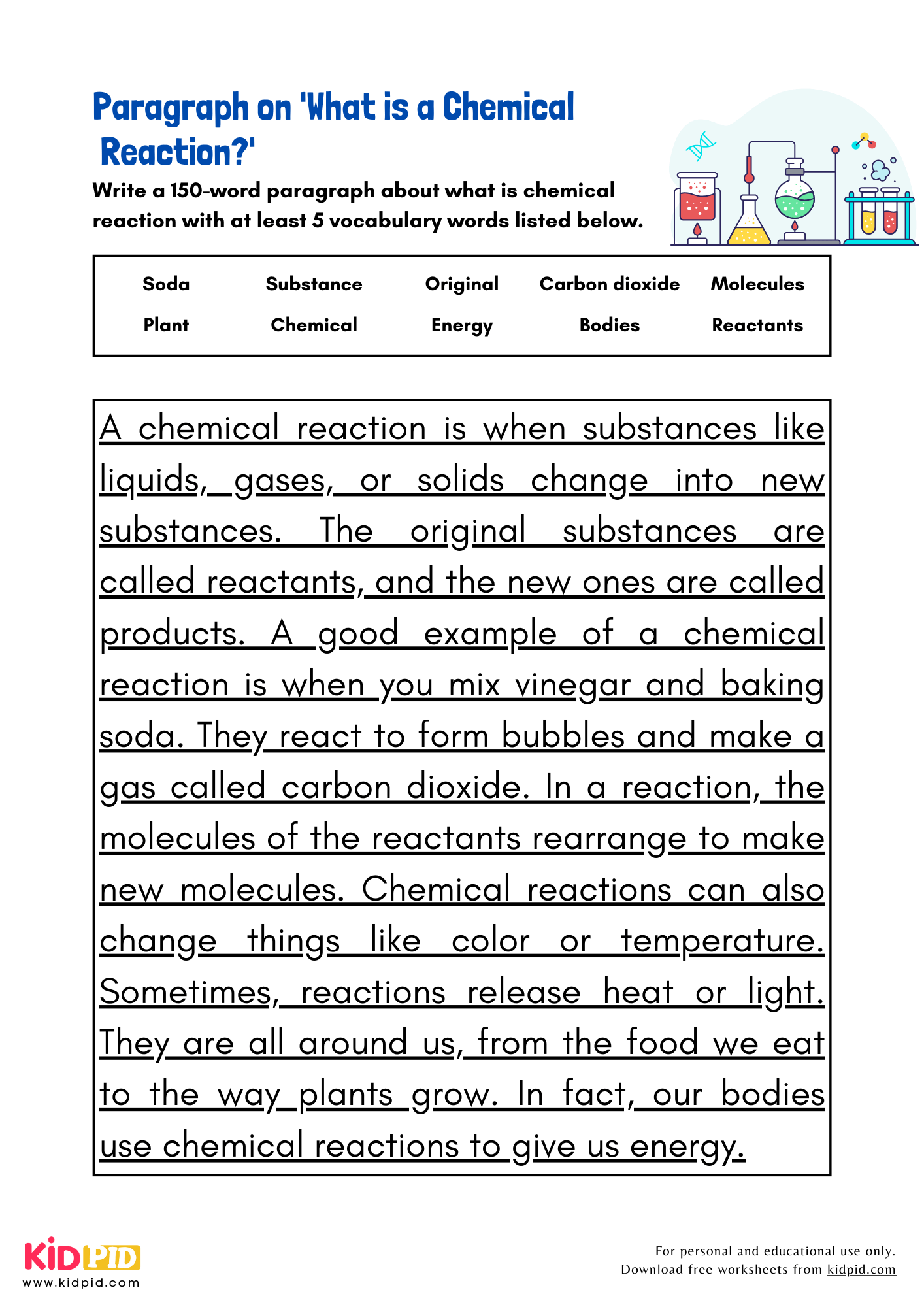
A chemical reaction is when substances like liquids, gases, or solids change into new substances. The original substances are called reactants, and the new ones are called products. A good example of a chemical reaction is when you mix vinegar and baking soda. They react to form bubbles and make a gas called carbon dioxide. In a reaction, the molecules of the reactants rearrange to make new molecules. Chemical reactions can also change things like color or temperature. Sometimes, reactions release heat or light. They are all around us, from the food we eat to the way plants grow. In fact, our bodies use chemical reactions to give us energy.
Paragraph on ‘What is a Chemical Reaction?’ in 200 words
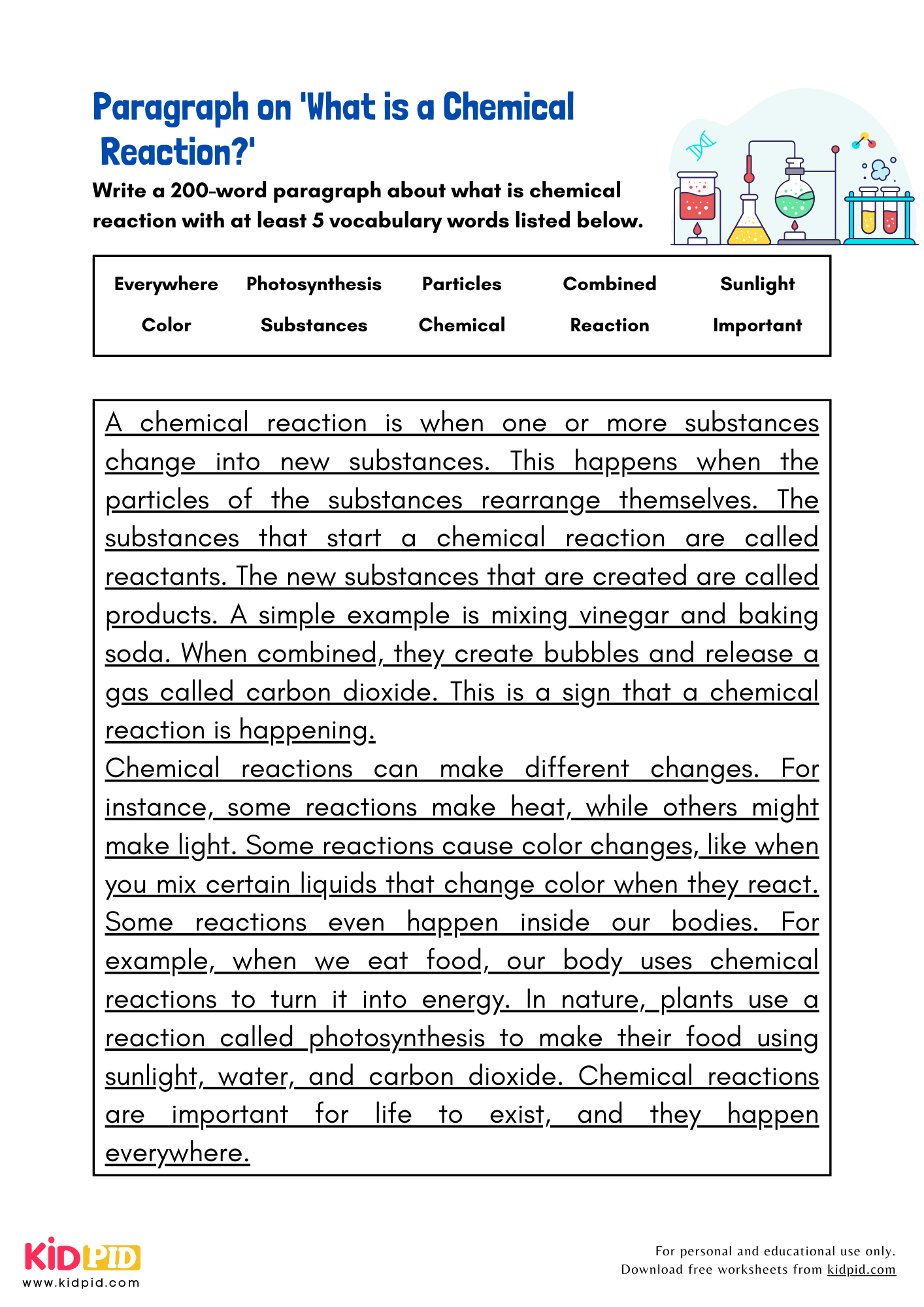
A chemical reaction is when one or more substances change into new substances. This happens when the particles of the substances rearrange themselves. The substances that start a chemical reaction are called reactants. The new substances that are created are called products. A simple example is mixing vinegar and baking soda. When combined, they create bubbles and release a gas called carbon dioxide. This is a sign that a chemical reaction is happening.
Chemical reactions can make different changes. For instance, some reactions make heat, while others might make light. Some reactions cause color changes, like when you mix certain liquids that change color when they react. Some reactions even happen inside our bodies. For example, when we eat food, our body uses chemical reactions to turn it into energy. In nature, plants use a reaction called photosynthesis to make their food using sunlight, water, and carbon dioxide. Chemical reactions are important for life to exist, and they happen everywhere.
Paragraph on ‘What is a Chemical Reaction?’ in 300 words
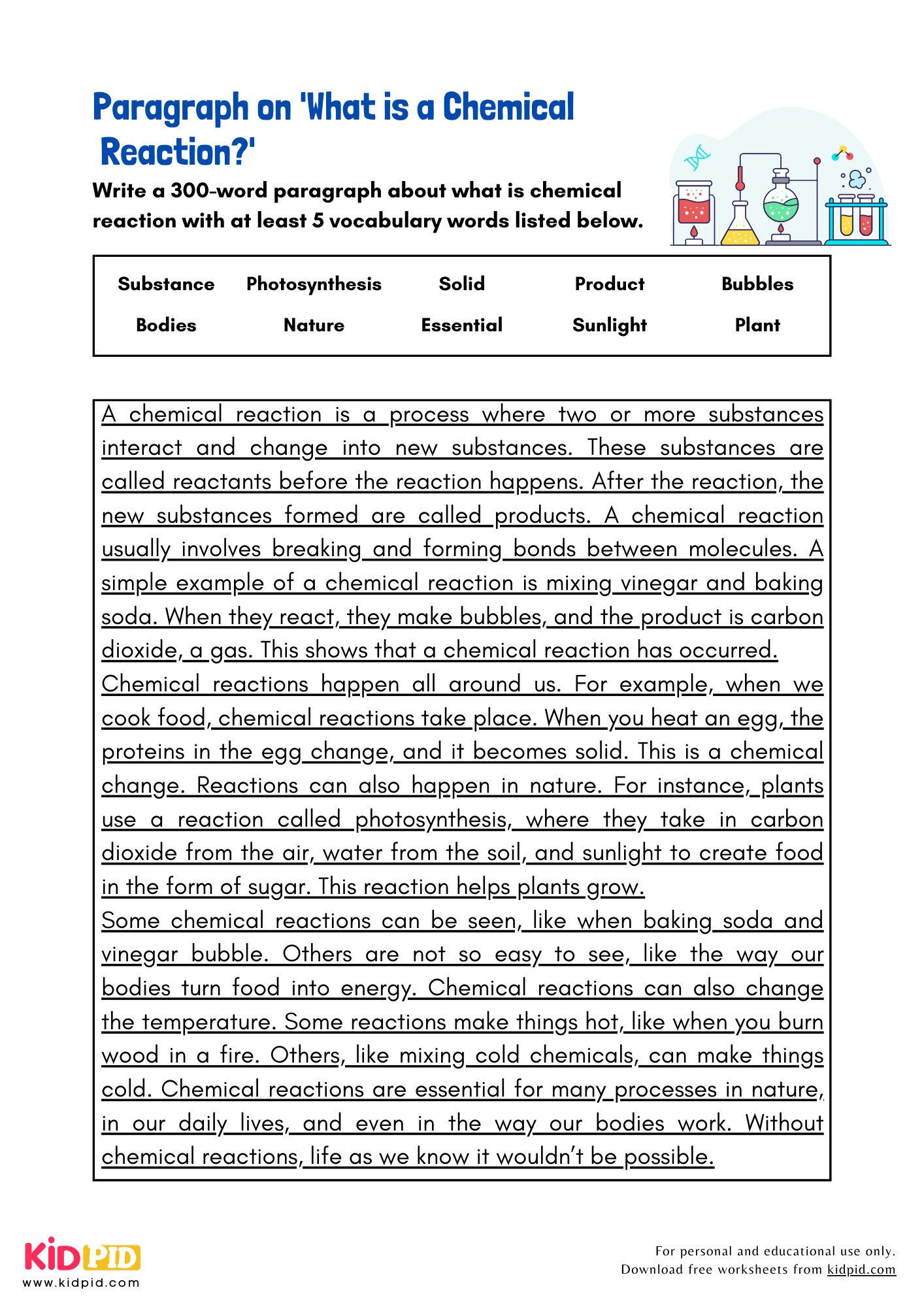
A chemical reaction is a process where two or more substances interact and change into new substances. These substances are called reactants before the reaction happens. After the reaction, the new substances formed are called products. A chemical reaction usually involves breaking and forming bonds between molecules. A simple example of a chemical reaction is mixing vinegar and baking soda. When they react, they make bubbles, and the product is carbon dioxide, a gas. This shows that a chemical reaction has occurred.
Chemical reactions happen all around us. For example, when we cook food, chemical reactions take place. When you heat an egg, the proteins in the egg change, and it becomes solid. This is a chemical change. Reactions can also happen in nature. For instance, plants use a reaction called photosynthesis, where they take in carbon dioxide from the air, water from the soil, and sunlight to create food in the form of sugar. This reaction helps plants grow.
Some chemical reactions can be seen, like when baking soda and vinegar bubble. Others are not so easy to see, like the way our bodies turn food into energy. Chemical reactions can also change the temperature. Some reactions make things hot, like when you burn wood in a fire. Others, like mixing cold chemicals, can make things cold. Chemical reactions are essential for many processes in nature, in our daily lives, and even in the way our bodies work. Without chemical reactions, life as we know it wouldn’t be possible.
MCQ’s on ‘What is a Chemical Reaction?’
1. What happens in a chemical reaction?
A) Substances disappear
B) Substances change into new substances
C) Substances remain the same
D) Substances mix but do not change
2. What are the substances called before a chemical reaction?
A) Products
B) Reactants
C) Elements
D) Molecules
3. What is an example of a chemical reaction?
A) Ice melting
B) Water boiling
C) Mixing vinegar and baking soda
D) Water evaporating
4. What gas is produced when baking soda reacts with vinegar?
A) Oxygen
B) Nitrogen
C) Carbon dioxide
D) Hydrogen
5. Which of these can happen during a chemical reaction?
A) Change in color
B) Change in shape
C) Change in state of matter
D) All of the above
6. Which process in plants is an example of a chemical reaction?
A) Respiration
B) Photosynthesis
C) Digestion
D) Evaporation
7. What do chemical reactions in our bodies help us do?
A) Grow taller
B) Breathe
C) Get energy
D) See better
8. What can chemical reactions produce besides new substances?
A) Heat
B) Light
C) Temperature changes
D) All of the above
9. What happens when you heat an egg?
A) Physical change
B) Chemical change
C) No change
D) It melts
10. What is the main characteristic of a chemical reaction?
A) It only happens in living organisms
B) It involves a rearrangement of particles
C) It causes no physical changes
D) It only happens in liquids

What Is a Chemical Reaction? | Easy Science Explanation for Kids
Learn what a chemical reaction is with this easy science explanation for kids. Discover how substances change to form new materials through exciting everyday examples and simple experiments. Perfect for students, classrooms, homeschooling, and STEM learning. This educational lesson helps children understand basic chemistry concepts in a fun way.
Importance of Learning About Chemical Reactions for Students
Chemical reactions are an important part of science because they explain how substances change and interact to form new substances. Understanding chemical reactions helps children learn about everyday processes such as cooking food, rusting iron, digestion, photosynthesis, and burning fuels. Learning about chemical reactions encourages curiosity, scientific thinking, and a better understanding of how the world works. :contentReference[oaicite:0]{index=0}
Educational Benefits of Learning Chemical Reactions
- Introduces children to basic chemistry concepts.
- Develops observation and scientific thinking skills.
- Helps students understand changes in matter.
- Encourages curiosity and experimentation.
- Improves problem-solving and analytical abilities.
- Supports STEM education and scientific learning.
- Teaches real-life applications of science.
- Enhances understanding of environmental and biological processes.
- Builds awareness of cause-and-effect relationships.
- Makes science learning engaging and meaningful.
Examples of Chemical Reactions in Everyday Life
Chemical reactions happen all around us every day. When baking soda reacts with vinegar, bubbles of carbon dioxide gas are produced. Cooking an egg, burning wood, rusting iron, digesting food, and photosynthesis in plants are all examples of chemical reactions. These reactions create new substances and often involve changes in color, temperature, light, or gas formation. :contentReference[oaicite:1]{index=1}
Signs That a Chemical Reaction Has Occurred
There are several clues that help identify a chemical reaction. These include a change in color, the release of heat or light, the formation of bubbles or gas, the creation of a new smell, or the formation of a solid called a precipitate. These signs indicate that new substances have been formed during the reaction. :contentReference[oaicite:2]{index=2}
FAQs
Q1. What is a chemical reaction?
Answer: A chemical reaction is a process in which one or more substances change into new substances with different properties. The starting substances are called reactants, and the new substances formed are called products.
Q2. What are some common examples of chemical reactions?
Answer: Examples include baking soda reacting with vinegar, burning wood, rusting iron, cooking food, digestion, and photosynthesis in plants
Q3. How can you tell a chemical reaction is happening?
Answer: Signs of a chemical reaction include color changes, temperature changes, gas formation, light production, odor changes, or the formation of a new solid substance
Q4. Why are chemical reactions important?
Answer: Chemical reactions are essential for life because they occur in digestion, respiration, photosynthesis, cooking, manufacturing, and many natural processes.
Q5. What is the difference between a chemical change and a physical change?
Answer: A chemical change creates new substances with different properties, while a physical change only changes the appearance or state of a substance without forming a new substance.
Learning about chemical reactions helps children understand how substances change and interact in everyday life. These important science concepts encourage curiosity, observation, and a deeper understanding of the world around us.
We hope you found the paragraphs on the topic ”What is a chemical reaction?” informative, written by our team of Proficient educators. Keep visiting our website and explore more paragraphs, essays, worksheets, flashcards, Quizzes, and many other interactive resources. Don’t forget to follow us on YouTube & Facebook.
You may like these:
Conducting a Simple Experiment

A simple experiment involves forming a hypothesis, gathering materials, conducting tests, observing results, and concluding. For example, mixing vinegar and baking soda produces gas.
Explain the Role of Human Activities in Global Warming

Burning fossil fuels, deforestation, and industrial emissions release greenhouse gases, trapping heat in the atmosphere. This causes rising temperatures, extreme weather, and environmental imbalances.
What is the Importance of Tree Plantation

Tree plantation enhances air quality, prevents soil erosion, supports biodiversity, and combats climate change by absorbing carbon dioxide, thus promoting a healthier and more sustainable environment.
Explain Climate Change
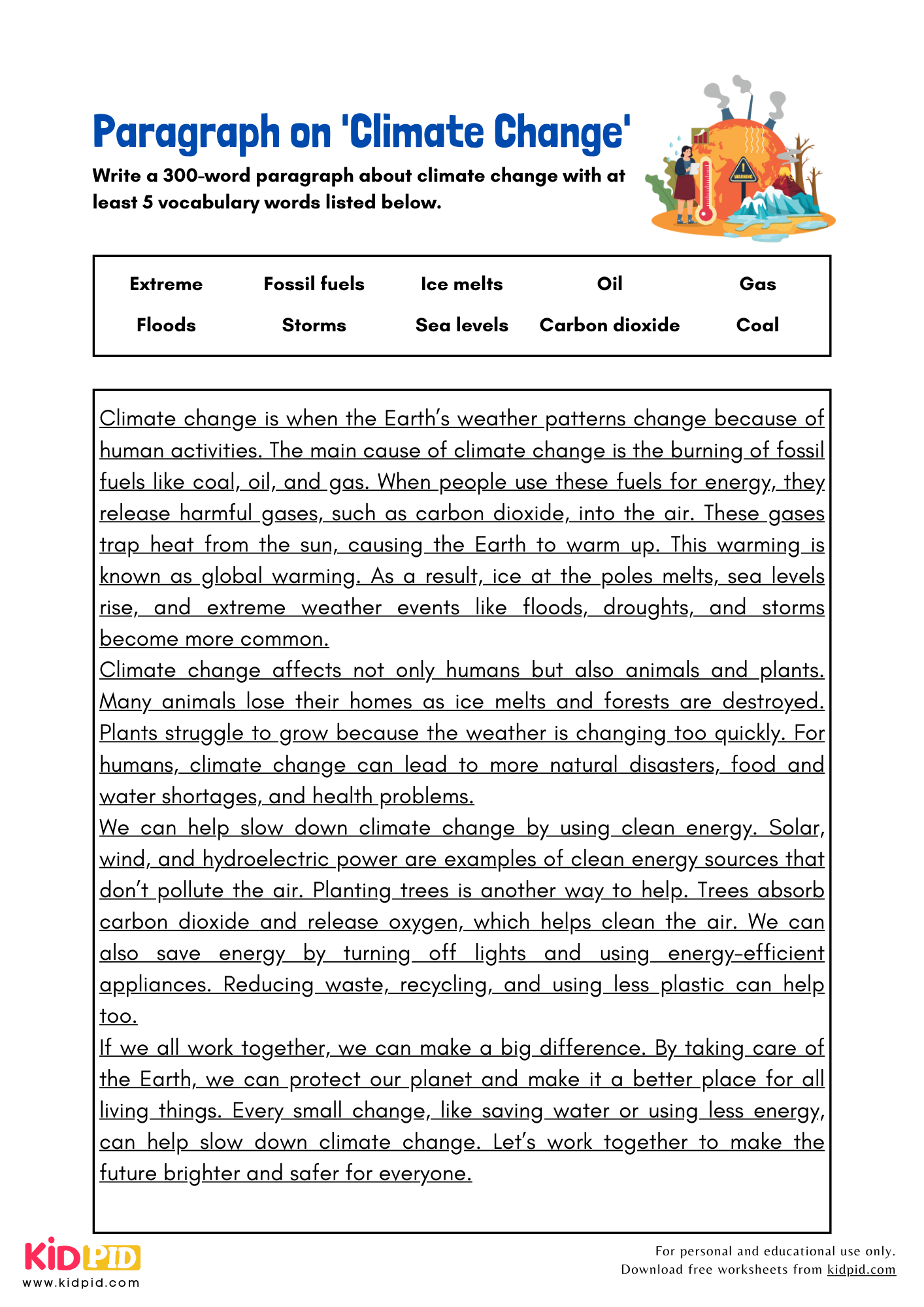
Climate change refers to long-term shifts in global temperatures and weather patterns, primarily caused by greenhouse gas emissions from human activities like burning fossil fuels.
Paragraph on ‘Action Speaks Louder Than Words’

Actions are more powerful than words because they show true intentions. People may say many things, but only genuine effort and behavior effectively prove honesty, character, and commitment.