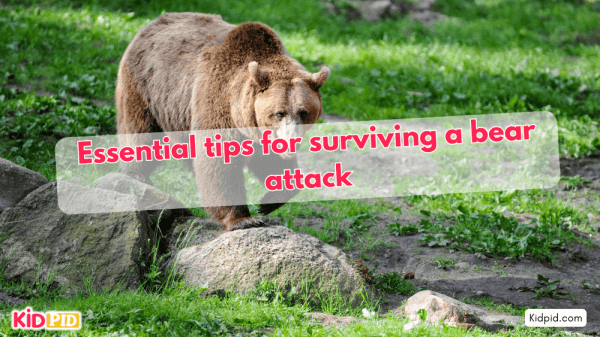
Bears are generally shy animals and don’t often attack humans. However, sometimes you might come across an angry or protective bear. Knowing what to do can help you stay safe during a bear encounter.
- Stay Calm: If you see a bear, stay calm and avoid startling it.
- Back Away Slowly: Move away without turning your back on the bear. Don’t Run: Running can make the bear chase you.
- Use Bear Spray: If the bear gets too close, use bear spray to protect yourself.
- Talk to the Bear: Speak calmly to show you’re not a threat.
- Know the Bear Type: The best way to survive depends on the type of bear.
- Black Bears: Fight back if attacked.
- Grizzly/Brown Bears: Play dead if attacked.
- Be Aware: Bears mostly attack to protect their young, so be cautious around cubs.
Contents
- Key Survival Tips For A Bear Attack: Stay Safe And Calm.
- Related MCQ’S
- 1. What should you do if you spot a bear from a distance?
- 2. What might happen if you run when a bear starts approaching?
- 3. What should you do if a bear is within range and you have bear spray?
- 4. What does a bear do when it stands on its hind legs?
- 5. What is the recommended survival strategy when confronted by a black bear?
- 6. What should you do if confronted by a grizzly or brown bear?
- 7. What is the main reason for most bear attacks on humans?
- You may like these:
Key Survival Tips For A Bear Attack: Stay Safe And Calm.

Related MCQ’S
1. What should you do if you spot a bear from a distance?
A) Run away quickly
B) Stand still and make loud noises
C) Slowly back away without turning your back
D) Approach the bear to take a closer look
Answer: C) Slowly back away without turning your back
Explanation: If you spot a bear at a distance, it’s important to stay calm and slowly back away without turning your back to avoid startling the bear.
2. What might happen if you run when a bear starts approaching?
A) The bear will stop and ignore you
B) The bear will get scared and leave
C) The bear might chase you
D) The bear will walk away calmly
Answer: C) The bear might chase you
Explanation: Running may trigger the bear’s natural hunting instinct, causing it to chase you, as bears are much faster than humans.
3. What should you do if a bear is within range and you have bear spray?
A) Stand still and wait
B) Yell loudly
C) Remove the safety tip from the bear spray and spray its face
D) Climb a tree
Answer: C) Remove the safety tip from the bear spray and spray its face
Explanation: If the bear is close enough and you have bear spray, you should remove the safety tip and spray it in the bear’s face to drive it away.
4. What does a bear do when it stands on its hind legs?
A) It is preparing to attack
B) It is trying to get a better look or smell
C) It is going to run away
D) It is trying to scare you
Answer: B) It is trying to get a better look or smell
Explanation: When a bear stands on its hind legs, it is typically just curious and trying to get a better look or smell, not necessarily threatening.
5. What is the recommended survival strategy when confronted by a black bear?
A) Play dead
B) Climb a tree
C) Fight back with any available objects
D) Run away
Answer: C) Fight back with any available objects
Explanation: Black bears are excellent climbers, and playing dead won’t help. The best way to survive a black bear attack is to fight back aggressively using objects like rocks or sticks.
6. What should you do if confronted by a grizzly or brown bear?
A) Run as fast as possible
B) Stand still and shout loudly
C) Play dead by lying down in a fetal position
D) Try to scare it with loud noises
Answer: C) Play dead by lying down in a fetal position
Explanation: Grizzly and brown bears tend to attack when they feel threatened, so playing dead can help, as they usually stop attacking when they realize you are not a threat.
7. What is the main reason for most bear attacks on humans?
A) Bears are hungry
B) Bears are protecting their territory
C) Bears are defending their young
D) Bears are chasing humans for sport
Answer: C) Bears are defending their young
Explanation: Most bear attacks occur because a mother bear is protecting her cubs from perceived danger.
You may like these:
Bear Animal Facts for Kids
Bears are large mammals with thick fur, sharp claws, and keen senses. They live in forests, mountains, and tundras, and eat a varied diet.
Do bears eat honey?
Yes, bears enjoy honey, especially from beehives. They use their powerful claws to access it, and honey provides them with a sugary energy boost.
Why is the Dead Sea dead?


The Dead Sea is hyper-saline, meaning it has extremely high salt levels. This prevents most life forms from surviving in its waters.