
Space is full of mysteries, and to explore it, we need advanced technologies and rocket science. Space engineering helps us build spacecraft, rockets, and tools to study space. Let’s dive into the exciting world of space technology!
- Space Technologies: Includes tools and systems like satellites, space telescopes, and robots to study space.
- Rocket Science: The study of how rockets work to travel into space.
- Space Engineering: Involves designing and building rockets, spacecraft, and space stations.
- Space Exploration: Space technology helps humans explore the moon, planets, and beyond.
- Importance: Space technologies help us learn more about our universe, improve life on Earth, and even explore new worlds!
Contents
- Discover Space technology, Rocket Science, and Engineering Knowledge.
- Related MCQ’s
- 1. What is Newton’s First Law of Motion?
- 2. Why do rockets need a lot of fuel?
- 3. What happens when a rocket burns fuel?
- 4. What is the International Space Station (ISS)?
- 5. What would happen if an astronaut went into space without a space suit?
- 6. How does the James Webb Telescope help us see back in time?
- 7. What is space debris?
- 8. What was the Chandrayaan 3 mission?
- You may like these:
Discover Space technology, Rocket Science, and Engineering Knowledge.
Related MCQ’s
1. What is Newton’s First Law of Motion?
a) An object will stay in motion until an external force stops it.
b) An object stays at rest or continues in uniform motion until a force acts on it.
c) An object will move faster if it’s heavier.
d) An object will stop moving without any force.
2. Why do rockets need a lot of fuel?
a) Because they are very heavy.
b) Because they have to break Earth’s gravity.
c) Because they are made of solid metal.
d) Because they are very small.
3. What happens when a rocket burns fuel?
a) It creates light.
b) It makes the rocket go down.
c) It creates thrust and moves the rocket forward.
d) It creates sound.
4. What is the International Space Station (ISS)?
a) A spaceship that travels to the moon.
b) A large spacecraft where astronauts live and work in space.
c) A place where rockets are built.
d) A satellite that orbits the Earth.
5. What would happen if an astronaut went into space without a space suit?
a) They would feel comfortable and safe.
b) They would lose oxygen and pass out quickly.
c) They would float in space without any problems.
d) They would be able to breathe in space without a suit.
6. How does the James Webb Telescope help us see back in time?
a) It looks at the stars in real-time.
b) It can capture infrared light from distant galaxies.
c) It makes stars move backwards in time.
d) It looks at objects on Earth.
7. What is space debris?
a) Objects made of stars.
b) Junk and broken pieces of satellites and rockets in space.
c) Planets floating in space.
d) Dust particles from comets.
8. What was the Chandrayaan 3 mission?
a) A mission to send humans to Mars.
b) A mission to land on the Moon’s South Pole.
c) A mission to repair the ISS.
d) A mission to study asteroids.
You may like these:
How fast do rockets go?
Rockets travel around 17,500 mph to reach Earth orbit and need about 25,000 mph to escape Earth’s gravity.
How is a Satellite Launched?
Satellites are launched atop rockets, which carry them into space. Once in orbit, the satellite is deployed to complete its intended task, like communication.
Force and Pressure
Force is a push or pull on an object, while pressure is force exerted on a surface area. Both affect motion and material behavior in physics.
Easy space crafts
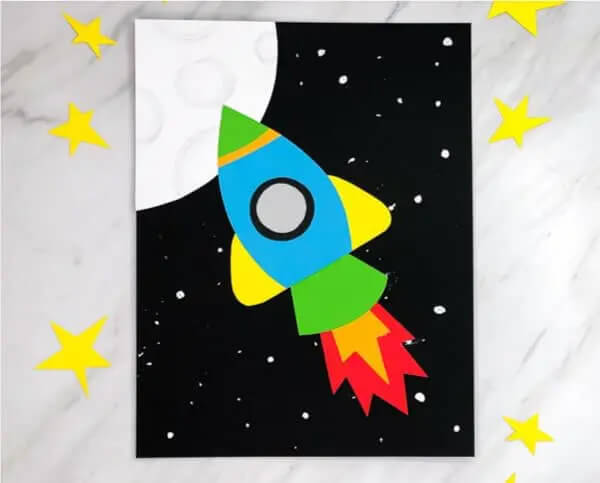
Space crafts for kids include educational models that teach about space exploration. They are often interactive, promoting learning about astronauts, planets, and space missions.
How do rockets launch into space?
Rockets launch by firing engines that produce thrust, propelling them upward. They overcome Earth’s gravity, passing through the atmosphere to reach outer space.