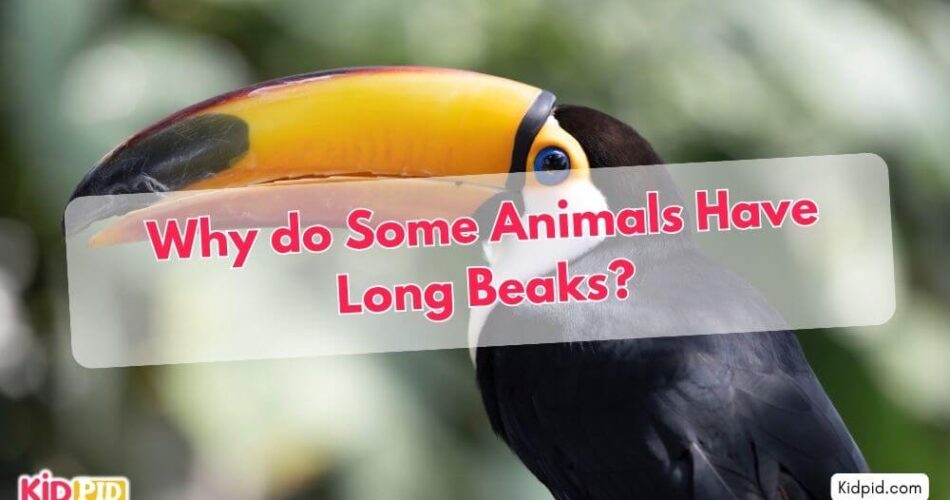
Some animals have long beaks to help them reach deep into flowers or burrows to obtain food, or to catch fast-moving prey.

Contents
- MCQs
- Fill in The Blanks
- 1. Some animals have long beaks to help them reach food that is deep inside __________.
- 2. The long beak allows animals to access nectar or __________ that other animals cannot reach.
- 3. Having a long beak is a special adaptation that helps animals survive in their __________.
- 4. Animals with long beaks are able to reach food that is __________ to other animals.
- True / False
MCQs
1. Which of the following animals is known for having a long beak?
A) Lion
B) Giraffe
C) Elephant
D) Toucan
Answer: D) Toucan
Explanation: Toucans are known for their long, colorful beaks that help them reach fruit high in the trees.
2. What is the purpose of a long beak for some animals?
A) To help them swim faster
B) To help them breathe underwater
C) To reach food sources
D) To make loud noises
Answer: C) To reach food sources
Explanation: Some animals use their long beaks to access food sources that are otherwise hard to reach.
3. How does a long beak help a bird?
A) To help them camouflage
B) To help them build nests
C) To help them fly faster
D) To reach insects deep inside tree bark
Answer: D) To reach insects deep inside tree bark
Explanation: Birds with long beaks can use them to reach insects deep inside tree bark that other birds cannot access.
4. Which of the following animals does not have a long beak?
A) Flamingo
B) Pelican
C) Penguin
D) Woodpecker
Answer: C) Penguin
Explanation: Penguins do not have long beaks as their diet mainly consists of fish and other marine animals that do not require a long beak to access.
Fill in The Blanks
Choose from These Words: Flowers or plants,Insects,Environment,Inaccessible.
1. Some animals have long beaks to help them reach food that is deep inside __________.
Answer: Flowers or plants
2. The long beak allows animals to access nectar or __________ that other animals cannot reach.
Answer: Insects
3. Having a long beak is a special adaptation that helps animals survive in their __________.
Answer: Environment
4. Animals with long beaks are able to reach food that is __________ to other animals.
Answer: Inaccessible
True / False
1. A long beak helps animals pick up smaller items like insects or seeds more easily (True / False)
True: Animals like finches and toucans use their long beaks to grab onto tiny insects or seeds with precision.
2. The shape and length of an animal’s beak has nothing to do with its diet (True / False)
False: An animal’s beak is directly related to the type of food it eats, with different shapes and lengths serving different purposes.
3. Animals with long beaks are always carnivores (True / False)
False: Animals with long beaks can be herbivores, carnivores, or omnivores, depending on their diet and feeding habits.
Read More: