


Our “Words with Different Prefixes Worksheet for Grade 3” is designed to make this learning process fun and engaging. This worksheet introduces a variety of common prefixes, such as “un-“, “re-“, and “pre-“, and provides exercises that allow students to practice identifying and using them in different contexts. By completing these activities, students will not only enhance their understanding of how prefixes work but also become more confident in their ability to decode and construct words. Let’s dive into the world of prefixes and discover how they can transform our language!
[Scroll Down for Download Link]
Contents
Prefix Word Worksheets For Grade 3
Read More: Affixes Spelling Activity Printable Worksheets
‘Dis’ – Prefix Words

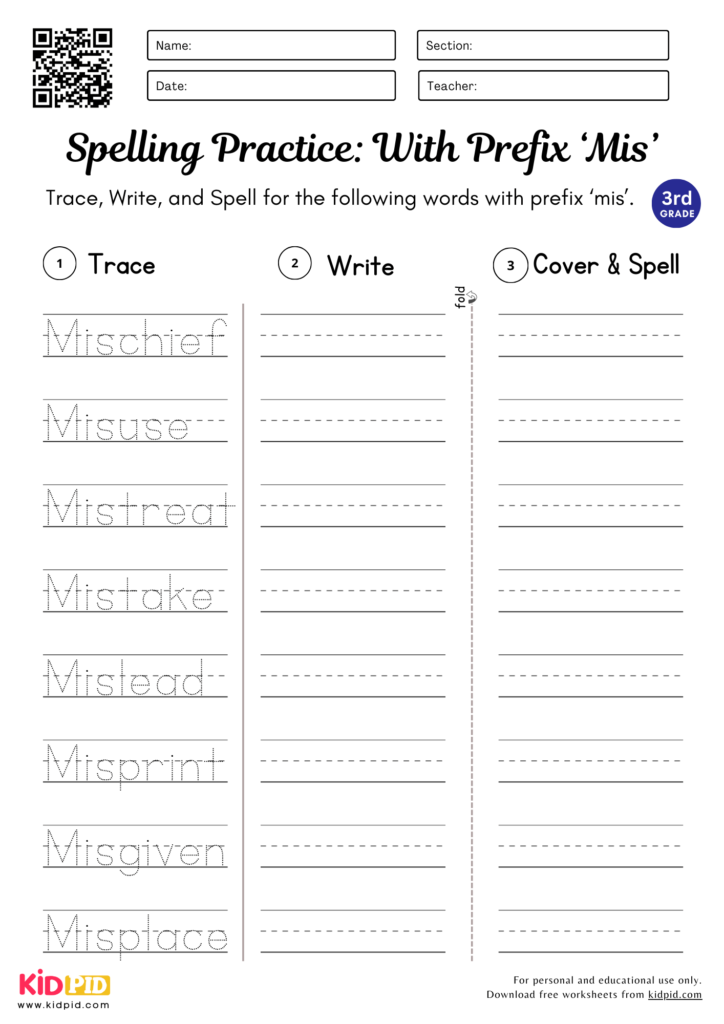
‘Mis’ – Prefix Words
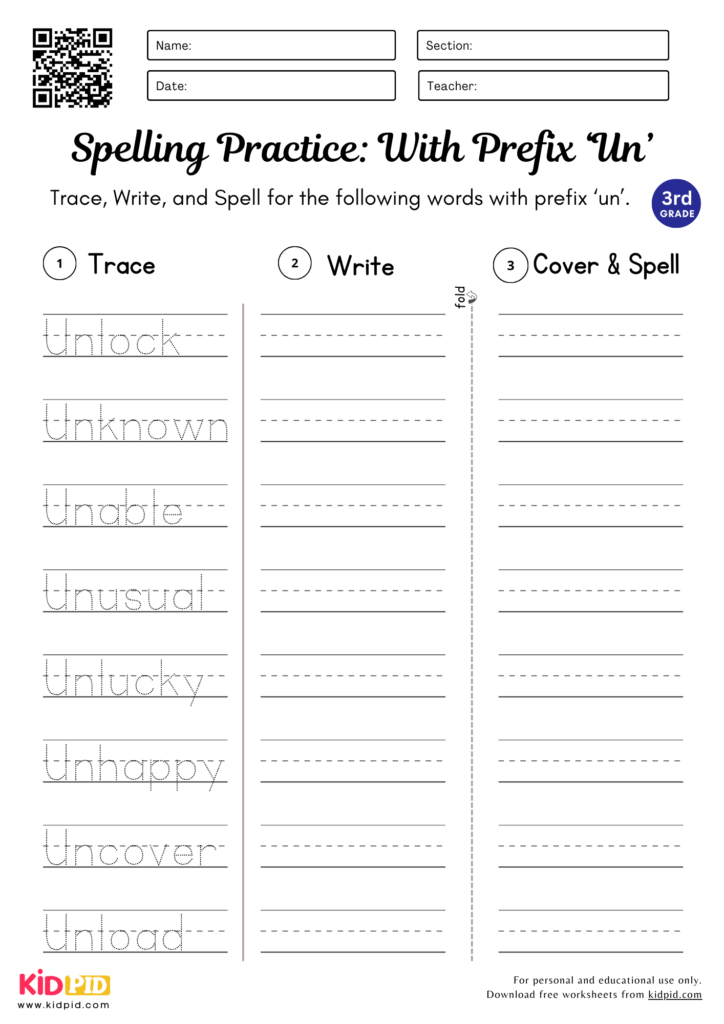
‘Un’ – Prefix Words
Key Facts About Words with Different Prefixes Worksheets
- Target Audience: Designed for 3rd-grade students (ages 8-9), aligning with primary English language arts curricula.
- Core Concept: Focuses on morphology—the study of how words are formed—by teaching students to identify and manipulate prefixes.
- Curriculum Focus: Reinforces essential prefixes such as un-, re-, pre-, dis-, and mis-.
- Skill Development: Targets vocabulary expansion, spelling accuracy, and reading comprehension through structural word analysis.
Parts, Types, and Examples of Prefixes
To master this, students learn that a prefix is a letter or group of letters added to the beginning of a base word to create a new meaning.
- The “Un-” Prefix (Negation/Reversal): Changes a word to its opposite. Example: Happy → Unhappy | Lock → Unlock
- The “Re-” Prefix (Repetition): Indicates doing something again. Example: Play → Replay | Write → Rewrite
- The “Dis-” Prefix (Not/Opposite of): Often indicates a lack of or disagreement. Example: Agree → Disagree | Like → Dislike
- The “Mis-” Prefix (Wrong/Badly): Indicates something done incorrectly. Example: Understand → Misunderstand | Place → Misplace
How Does This Worksheet Work?
- Identification: Isolate the prefix from the base word to see how meaning is built.
- Application: Attach prefixes to root words to form new, contextually correct terms.
- Contextual Practice: Tracing, writing, and sentence-completion tasks help move from rote memorization to active usage.
Benefits of Learning About Prefixes
- Decoding Mastery: Break down complex, multi-syllabic words into manageable parts to improve reading fluency.
- Vocabulary Growth: Learning one prefix (e.g., re-) unlocks the meaning of dozens of associated words.
- Spelling Confidence: Recognizing patterns in word structures reduces guesswork.
Learning Objectives
By the end of this, students will be able to:
- Identify prefixes in common 3rd-grade vocabulary.
- Define the function of un-, re-, dis-, and mis-.
- Construct new words by correctly applying a prefix to a base word.
- Use prefixed words correctly within a sentence.
Worksheet Instructions
- Read: Carefully read the instructions for each section.
- Analyze: Break down the target word into its base word and prefix.
- Practice: Use the provided tracing lines to practice spelling.
- Complete: Fill in the blanks or match the words as instructed.
- Review: Read sentences aloud to ensure the words fit logically.
Interesting Facts
- Prefixes are “Language LEGOs”: Like building blocks, you can take a root word and add different prefixes to change its identity.
- Ancient Origins: Many common prefixes come from Latin and Greek, acting as a “hidden code” for the English language.
FAQs
Q1. At what age should a child start learning prefixes?
Answer: While introduction begins in 1st and 2nd grade, 3rd grade is the critical window for mastering these in complex sentences.
Q2. Can these worksheets be used for remote learning?
- Answer: Yes. These are designed for both classroom and homeschooling environments.
-
Q3. How do I help my child if they struggle?
- Answer: Focus on the base word first. Define the base word, then explain how the prefix changes that specific definition.

Exploring words with different prefixes helps Grade 3 students understand how prefixes change word meanings. These engaging worksheets strengthen vocabulary, spelling, reading comprehension, word analysis, and language confidence through meaningful practice. Access fun worksheets, essays, paragraphs, flashcards, quizzes, and interactive resources on our website. Stay connected through YouTube & Facebook.
This educational worksheet is prepared by the Content Team to improve learning structure.
Reviewed By Drashti
Read More:



